
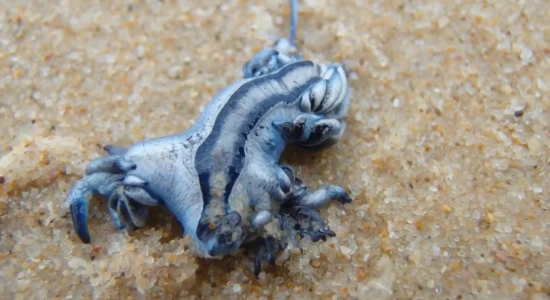
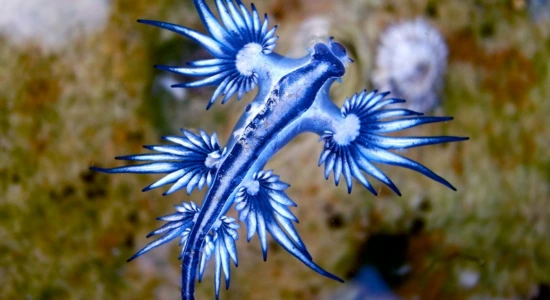
Picture this. You’re walking barefoot on some stunning Australian beach, minding your own business, when you spot this… thing. It’s washed up on the wet sand, looking exactly like a tiny, intricate piece of alien jewelry or maybe a glitchy Pokémon. Barely an inch long. Stunning electric blue and silver, with these weird little finger-like wings spreading out.
Naturally, your monkey brain kicks in. You want to pick it up. Poke it. See what it feels like.
Don’t do it. Seriously, touching it is a massive, ER-visit-level mistake. Because what you’re staring at isn’t just some harmless, pretty sea slug—it’s an absolute freak of nature. This tiny little guy actively hunts down one of the most venomous drifters in the entire ocean, eats it alive, and then literally steals its venom to use as its own personal loaded gun. Yeah. Nature is wild.
How the Blue Dragon Breaks All the Ocean’s Rules
Science nerds call it Glaucus atlanticus. But honestly? That sounds way too boring for a creature that spends its whole life floating upside down on the surface of the sea. It just swallows a bubble of air to stay afloat. Then it lets the wind and currents drag it wherever it wants to go, drifting alongside other surface-dwelling creatures in what scientists call the neuston, the community of organisms that live right at the ocean’s surface film.
Its crazy paint job? Total camouflage. But like, next-level camo called countershading. The electric blue belly faces the sky so hungry seabirds just see ocean water, while the silver-grey back faces down to reflect sunlight—meaning predatory fish looking up are totally blinded. It’s a two-sided disguise built for an animal with genuinely nowhere to hide, floating in the open water with predators potentially coming from above and below at the same time.
But don’t get it twisted. It’s not just lazily drifting around like a pool float. The Blue Dragon is a highly specialized hunter, and its absolute favorite meal is the Portuguese man o’ war. You know, that massive, floating nightmare-balloon with tentacles that can stretch dozens of feet and ruin your life with a single sting. Blue dragons also snack on other blue-tinted surface drifters like blue button jellies and by-the-wind sailors, but the man o’ war is the main event.
The Ultimate Biological Heist
So, how does a one-inch slug eat a highly venomous monster thousands of times its own size without dying instantly? The secret is basically a bulletproof gut.
When this little guy bites into those toxic man o’ war tentacles using its jagged, serrated teeth, its digestive system is completely immune to the stinging cells, called nematocysts, that would otherwise kill almost anything else that touched them. Scientists still aren’t entirely sure how the slug pulls this off, but its gut lining appears specially adapted to handle the venom without triggering the stingers to fire.
But here’s where it gets absolutely unhinged. It doesn’t just digest the venom. It steals it. Scientists have a name for this trick: kleptocnidy, literally “stealing stinging cells.” If you thought stealing venom was the ultimate biological cheat code, the ocean is hiding an even crazier glitch. What if instead of fighting for survival, a creature just… refused to die? Scientists have discovered that when things get too dangerous or they simply get too old, one tiny marine animal can hit a biological “reset button” and age backward. It turns out, the immortal jellyfish holds the secret to escaping death—and human researchers are desperately trying to crack its code.
Weaponizing the Stolen Goods
The slug meticulously sorts through its lunch, picking out only the most potent, fully-loaded stinging cells while trashing the rest. It moves those tiny venom bombs along specialized ciliated tracts in its gut and pushes them out into the tips of its cerata, the weird, finger-like appendages that also double as its gills. A single blue dragon can have as many as 84 of these cerata, each one tipped with a tiny storage pouch called a cnidosac, packed full of stolen, still-loaded stingers ready to fire.
By hoarding and concentrating all the worst, most toxic cells into such a small space, it builds its own custom biological arsenal. Because it packs so many stolen stingers into such a tight area, the blue dragon sea slug venom actually packs a much harder, more agonizing punch per square inch than the giant siphonophore it just snacked on.
If you’re dumb enough to touch those pretty blue wings, all that concentrated blue dragon sea slug venom fires at once. The payoff? Searing pain, welts, violent vomiting, and allergic reactions that can send a grown adult straight to the hospital. And here’s the part most people don’t realize: that venom stays fully active even after the slug has died and dried out on the sand, so a washed-up blue dragon is just as dangerous to touch as a living one.
Fun Fact
The blue dragon isn’t just a specialist hunter of the man o’ war. Recent research using its front cerata like tiny hands has shown it will also attack and eat fish that drift too close, making it a far more opportunistic predator than scientists once assumed.
The Prettiest Death Trap
This weird little slug is all the proof you need that the ocean is basically a beautiful, terrifying trap. It literally survives by hijacking the weapons of giants and turning their own biology against them.
So, the next time you see something ridiculously bright and pretty washed up on the sand—keep your hands in your pockets. Because sometimes the ocean’s prettiest jewelry is actually a loaded weapon.
Live Science — Blue Dragon: The Deadly Sea Slug That Steals Venom From Its Prey
Wikipedia — Glaucus atlanticus
PBS Nature — Featured Creature: Blue Dragon
BBC Science Focus — This Bizarre Underwater ‘Blue Dragon’ Fights With Stolen Jellyfish Venom
Is the blue dragon sea slug more dangerous than a Portuguese man o’ war
Its sting can actually hurt worse in a single touch, because the slug concentrates the most potent stinging cells from many man o’ war tentacles into its own small cerata, packing more toxin per square inch than the source creature it fed on.
Can a dead blue dragon still sting you
Yes. The stolen stinging cells remain active even after the slug has died and dried out on the sand, so a washed-up blue dragon poses the same risk as a live one and should never be picked up.
Why doesn’t the blue dragon get hurt by the venom it eats
Its digestive system appears to be specially adapted to handle the man o’ war’s stinging cells without triggering them, allowing the slug to swallow intact, unfired nematocysts and later move them into storage sacs at the tips of its cerata.
What should you do if you get stung by a blue dragon
Seek medical attention if the pain is severe or you notice signs of an allergic reaction, since stings have been known to cause intense pain, vomiting, and welts. According to NOAA, the venom is rarely deadly to humans but is still considered excruciatingly painful.