
Lose a blanket at home and you check behind the couch. Lose one in orbit and, apparently, people spend years arguing that it came from another star system.
The famous Black Knight Satellite photo is real. The ancient alien spacecraft it supposedly shows is not supported by the evidence. NASA’s archive identifies the object as space debris, and astronaut Jerry Ross’s account points to a thermal cover that floated away during a spacewalk on the December 1998 shuttle mission STS-88. The stranger question is how a missing piece of insulation ended up with a 13,000-year backstory.
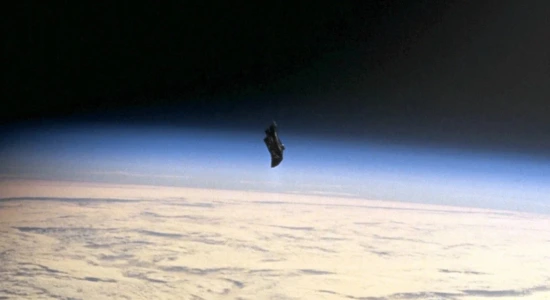
Table of Contents
What Did NASA Photograph in 1998?
In December 1998, Space Shuttle Endeavour flew the first shuttle mission to the International Space Station. The crew joined the U.S.-built Unity module to the Russian Zarya module, and astronauts Jerry Ross and James Newman carried out three spacewalks to connect equipment and prepare the station for future assembly.
Not everything stayed where it was supposed to. NASA’s mission summary lists several items that floated away, including a trunnion pin cover, a piece of insulation fitted over a metal attachment point. According to Ross’s account, a thermal cover came loose during the spacewalk. Commander Robert Cabana noticed it getting away. To the crew, it was a lost piece of hardware, not an unidentified visitor.
The much-shared frame is STS088-724-66, taken on December 11, 1998. NASA’s photo record labels it “space debris.” The archive tells you what category the object belongs to; the mission record and the astronaut’s account explain why a lost thermal cover is the best-supported identification.
What Do Tesla and Radio Echoes Have to Do With It?
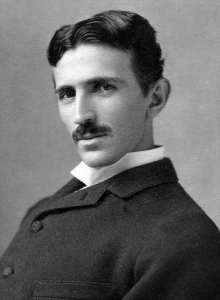
Nothing in the shuttle record connects the cover to Nikola Tesla. That part of the story starts in 1899, when Tesla picked up unusual electrical signals during experiments in Colorado Springs. He later entertained the idea that the signals could be evidence of communication from another world. That speculation is not an observation of a satellite, and there is no evidence he was listening to the object in the 1998 photo.
In the late 1920s, Norwegian radio experimenter Jørgen Hals reported a different phenomenon: radio signals that returned several seconds after transmission. These became known as long-delayed echoes. An echo is a copy of a signal coming back, not automatically a reply from whoever—or whatever—you imagine is listening. Tesla’s signals and Hals’s echoes were separate observations. The legend treats them as chapters in the same story without showing that they had the same source.
Was a Mystery Satellite Detected in 1960?
In 1960, TIME reported that the U.S. Navy had detected a dark object in orbit that might be a Soviet spy satellite. Follow-up reporting linked it to debris from the American Discoverer program. What started as an unidentified object in a news report did not stay unidentified forever.
That episode gave later retellings an appealing phrase: a dark satellite. It did not give them a continuous record of an object in orbit. A report about Discoverer debris in 1960 cannot establish that the object photographed by Endeavour in 1998 was already up there.
Where Did the 13,000-Year Claim Come From?
The number did not come from a NASA photograph, a sample of alien hardware, or a measurement of anyone’s orbit. In 1973, Scottish writer Duncan Lunan tried plotting the timing of long-delayed radio echoes. He thought one pattern resembled a star map and proposed that the echoes might have come from a hypothetical probe associated with the star Epsilon Boötis. He suggested that such a probe might have reached Earth’s vicinity about 13,000 years ago.
Lunan later withdrew his original interpretation. The number stuck anyway, and later versions attached it to the dark object in the shuttle photo. Put the dates side by side and the problem jumps out: the age claim was proposed 25 years before the photo was taken. It was never a measurement of the thing in the picture.
Is the Black Knight Satellite Real?
There was a real object in the 1998 photographs. There is no credible evidence that it was an ancient alien satellite, or that the earlier radio reports and Cold War sighting tracked the same object. For the famous photo, a thermal cover lost during STS-88 fits the records far better than a spacecraft that somehow went unverified for millennia.
The fun part is that the photo doesn’t need to be fake for the story around it to be wrong. A real photograph, an old radio puzzle, and a speculative star map can all exist without explaining one another. The shuttle crew lost a cover. The legend gave it a passport and a 13,000-year head start.
- NASA: Astronaut Photo STS088-724-66 — original frame, date, and space-debris classification.
- NASA: STS-88 mission overview — station assembly, spacewalks, and the trunnion pin cover listed among the items that floated away.
- Space.com: The “Black Knight” satellite conspiracy theory — Jerry Ross’s account of the lost cover and the history behind the legend.
- Space.com: How the Black Knight conspiracy theory survived — the 1960 report, Duncan Lunan’s proposal, and how unrelated events became part of the same story.
What was the Black Knight Satellite in NASA’s photo?
NASA classified the object as space debris. The best-supported explanation is that it was a thermal cover that drifted away during a spacewalk on the STS-88 mission in December 1998.
Is the original Black Knight Satellite photo real?
Yes. NASA’s astronaut photography archive contains the original frame, STS088-724-66, dated December 11, 1998. The archive identifies space debris, not an alien spacecraft.
Where did the claim that it was 13,000 years old come from?
It came from Duncan Lunan’s 1973 speculation about long-delayed radio echoes and a hypothetical probe. He later withdrew that interpretation. The number was never an age estimate for the object in NASA’s photo.
Did Nikola Tesla discover the Black Knight Satellite?
No. Tesla reported unusual signals during his Colorado Springs experiments, but there is no evidence that they came from an orbiting probe or had anything to do with the debris photographed in 1998.