
Back in the summer of 2011, a Swedish treasure-hunting crew called Ocean X was scanning the murky bottom of the Baltic Sea hoping to find historic shipwrecks. Instead of spotting the usual rotting galleons or sunken cargo, their sonar bounced back an image that looked suspiciously like the Millennium Falcon. Sitting nearly 300 feet underwater was a massive, circular object about 200 feet across. It seemed to have structural right angles, a raised dome, and even a long “skid mark” trailing behind it on the seafloor, looking exactly like a crash landing.
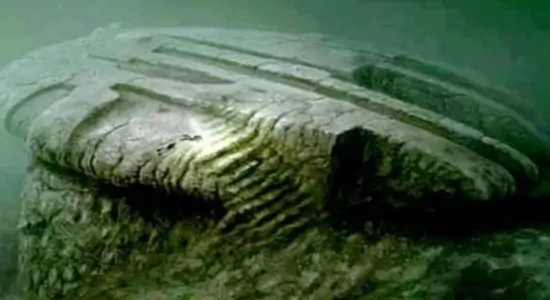
The moment that grainy sonar image hit the internet, people went wild. Headlines immediately jumped to the most extreme conclusions: it was a downed flying saucer, a top-secret Nazi anti-submarine weapon, or the sunken ruins of Atlantis. But as marine geologists and oceanographers actually started looking at the data, the true story of this bizarre underwater structure emerged. And honestly, the actual science behind it is way older—and much cooler—than a crashed spaceship.
The Anatomy of a Deep-Sea Illusion
If you want to understand how a pile of rocks ends up looking like sci-fi tech, you have to look at how we explore the ocean. The Baltic Sea is a notoriously tough place to navigate. It’s freezing, pitch black, and visibility is usually garbage. Since cameras are basically useless at that depth, explorers rely heavily on sonar, which maps the topography by bouncing sound waves off objects.
Here’s the catch. Sonar isn’t a photograph. It’s highly prone to artifacts, echoes, and low-resolution glitches. Take that grainy acoustic data and combine it with pareidolia—the psychological quirk where our brains automatically find familiar shapes in random patterns. Suddenly, a jagged rock formation starts looking exactly like a thruster engine. The Baltic Sea UFO conspiracy really took off simply because the sonar image was just ambiguous enough for the human imagination to fill in the blanks.
Crushing the Baltic Sea UFO conspiracy with Geology
Once scientists finally got their hands on physical samples pulled from the site by Ocean X divers, the extraterrestrial theories basically evaporated. The material wasn’t some unearthly titanium alloy or hyper-advanced tech. It was mostly basalt, which is a super common volcanic rock, mixed with chunks of granite and gneiss.
This brought up a different question. How exactly did heavy volcanic rock end up resting on the flat, muddy, completely non-volcanic bottom of the Baltic Sea? The answer has everything to do with the massive sheets of ice that used to cover the planet.
Glacial Erratics: The True Architects of The Baltic Sea Anomaly
During the last Ice Age, glaciers thousands of feet thick crawled across Scandinavia. Think of these advancing ice sheets as massive geological bulldozers. They picked up colossal chunks of rock, dragged them for hundreds of miles, and aggressively ground them against the bedrock. When the climate finally warmed up and the ice melted around 14,000 years ago, those glaciers just dropped their rocky cargo wherever they happened to be. That included the massive basin that eventually filled with water to become the Baltic Sea.
Geologists call these displaced boulders “glacial erratics.” As for those strange right angles and structural lines on the anomaly? Those are totally normal for basalt. When basalt cools, it naturally fractures into sharp, geometric columns. And that mysterious 1,000-foot “skid mark” trailing behind it isn’t a crash trajectory at all. It’s just a natural mound of glacial sediment. Deep ocean currents have been sweeping around that heavy rock for thousands of years, gradually dragging the sediment out into a long, straight tail.
Conclusion
Nature doesn’t really need aliens or secret government programs to build weird, awe-inspiring structures. The Baltic Sea anomaly is just a 14,000-year-old footprint from the Ice Age—a massive geological crumb left behind by a melting glacier. It’s a great reminder that while it’s fun to look for spaceships in the static, the actual mechanics of our planet’s shifting, freezing, and grinding history are pretty mind-blowing on their own.
Did You Know? If the Baltic Sea Anomaly taught us anything, it’s that we desperately want to find aliens everywhere. But the real stories are usually way darker and much weirder.
-
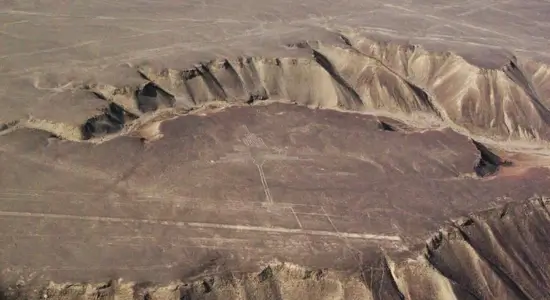
Think a sunken Ice Age rock is a wild misunderstanding? Wait until you see how massive ancient desert carvings got mistaken for intergalactic runways. Uncover the terrifying blood rituals hiding behind the Nazca Lines.
-
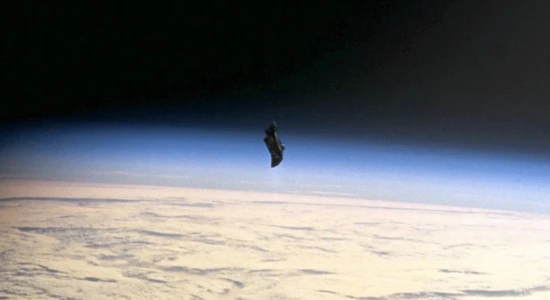
Or look up into orbit. Discover how a literal piece of dropped NASA garbage sparked a massive, 13,000-year-old space conspiracy in the bizarre truth behind the Black Knight Satellite.
References:
Live Science — “Baltic Sea Anomaly” Is Just a Glacial Deposit
Popular Mechanics — The Truth About the “UFO” at the Bottom of the Baltic Sea
National Geographic — Natural or Supernatural? The Baltic Sea Anomaly