
On July 25, 1976, NASA’s Viking 1 orbiter was cruising high above the red, dusty surface of our planetary neighbor. Its primary job was relatively mundane: snapping topographical photos of the northern Martian region known as Cydonia to scout a safe landing spot for its sister ship, Viking 2. But when one specific image—officially labeled 035A72—beamed back to the Jet Propulsion Laboratory in California, scientists found themselves staring at something that seemed completely impossible. Looking right back at them from the Martian dirt was a massive, two-mile-long human face.
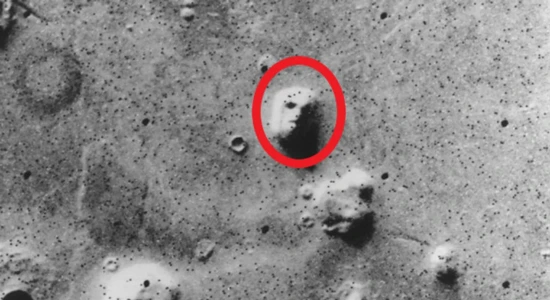
The geological formation featured deep-set eyes, a distinct nose, and a structured mouth, all perfectly proportioned and gazing stoically up into the dark void of space. NASA released the image to the public a few days later, calling it a “huge rock formation… which resembles a human head.” They thought it would just be a fun, quirky story about the tricks of light and shadow. Instead, they accidentally triggered an absolute pop-culture meltdown. For over twenty years, this single, grainy photograph fueled a massive, deeply entrenched lost Martian civilization theory that convinced millions of people we were looking at the ruins of an ancient, alien metropolis.
The Anatomy of a Planetary Illusion
To understand why a giant pile of rock ended up looking like a pharaoh’s death mask, you have to look at the technology NASA was working with in the 1970s. The cameras on the Viking 1 orbiter were absolute marvels for their time, but by today’s standards, they were incredibly primitive. The famous image had a resolution of about 43 meters per pixel. That means any physical detail smaller than half a football field was completely blurred out or rendered as a single blocky pixel.
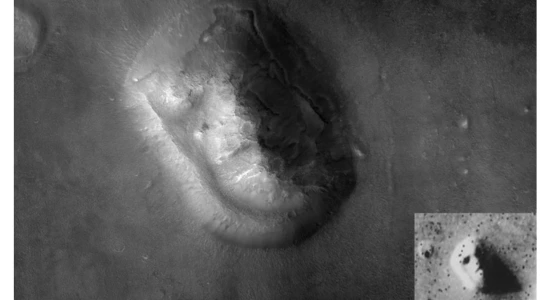
But the real culprit wasn’t just the low resolution; it was the lighting. At the exact moment Viking 1 snapped the photo, the Martian sun was hovering at a very low angle in the sky—about 20 degrees above the horizon. This severe lighting cast incredibly long, harsh shadows across the jagged surface of Cydonia. It’s exactly like holding a flashlight under your chin while telling a ghost story around a campfire. The stark, low-angle shadows completely exaggerated the dips and peaks of a perfectly normal, eroded hill (known geologically as a mesa), creating the false illusion of deep eye sockets and a prominent jawline.
Pareidolia and The Face on Mars
But why did millions of people look at a bumpy, low-resolution mesa and immediately see a human face, sparking a massive lost Martian civilization theory? The answer lies entirely inside your own skull. Humans are biologically hardwired by evolution to recognize faces. It’s a core survival mechanism. Our brains are incredibly good at finding faces in the brush to spot hidden predators, or recognizing allies in a chaotic crowd. In fact, our neurological facial-recognition software is so highly tuned that it is notoriously overactive.
This psychological phenomenon is called pareidolia. It’s the exact same mental glitch that makes you see a grinning face in the front grill of an automobile, a bunny in the clouds, or the Virgin Mary in a piece of burnt toast. When the human brain is presented with a random, ambiguous pattern of light and dark spots—like a heavily shadowed mesa on Mars—it desperately tries to make sense of the data by mapping it onto the most familiar template it knows: a face. The Face on Mars wasn’t an alien monument; it was basically the universe’s largest Rorschach test.
The 1998 Reality Check
The mystery survived completely unchecked until 1998, when NASA sent the Mars Global Surveyor (MGS) into orbit. The MGS was equipped with a camera that was exponentially more powerful than Viking’s vintage hardware, capable of capturing details down to just a few meters per pixel. When the spacecraft finally flew back over the Cydonia region on a clear, cloudless Martian day, it aimed its high-resolution lenses right at the exact coordinates of the famous face.
The resulting images were the ultimate reality check. Without the extreme, low-angle shadows and the grainy 1970s pixelation, the “face” completely vanished. It was revealed to be exactly what planetary geologists had always said it was: a heavily eroded, completely natural mesa. It had no eyes, no mouth, and no alien engineering. It was just ancient Martian dirt and rock, sculpted over billions of years by wind, frost, and time.
Conclusion
The Face on Mars stands as one of the most fascinating intersections of space exploration and human psychology. It’s a brilliant reminder of how desperately we want to find company in a seemingly empty, silent universe. We didn’t find an ancient alien monument waiting for us in the Cydonia region, but we did find a massive, planetary-scale mirror that reflected our own incredible, pattern-seeking minds right back at us.
นี่คือส่วนส่งท้าย (Outro) สำหรับนำไปวางต่อท้ายบทความ The Face on Mars ครับ ผมเขียนเชื่อมโยงเรื่อง “ภาพลวงตาจากอวกาศ” ไปสู่ปริศนาอื่นๆ ของจักรวาลและปรากฏการณ์ทางธรรมชาติในเว็บ FactFun เพื่อดึงคนให้อ่านต่อยาวๆ ครับ:
The Truth is Stranger Than Fiction…
If the Face on Mars proves anything, it’s that human psychology and space exploration make a wildly fascinating combination. But the universe is full of mysteries that aren’t just tricks of the light.
-
Think the Martian face was a crazy optical illusion? Wait until you see how a melting glacier accidentally built an underwater UFO. Unpack the real science behind the Baltic Sea Anomaly.
-
Or if you’re looking for an actual government space cover-up, dive into the desert to discover the bizarre truth behind the 1947 Roswell UFO incident.
Keep exploring the deepest corners of science and history on FactFun… because reality is always weirder than you think.
References:
NASA Science — Unmasking the Face on Mars
Space.com — The Face on Mars: Fact & Fiction
Smithsonian Magazine — How the “Face on Mars” Tricked the World