
Picture this: It’s 1940, and the British Expeditionary Force is retreating through a small village in France. A German patrol cautiously advances down the road. Suddenly, the German sergeant drops to the ground, dead, with a massive wooden arrow protruding from his chest. This isn’t a deleted scene from a medieval fantasy movie; it is a highly documented, official military kill. The man holding the bow was Lieutenant Colonel John Malcolm Thorpe Fleming Churchill, and he had just recorded the last confirmed longbow kill in modern military history.
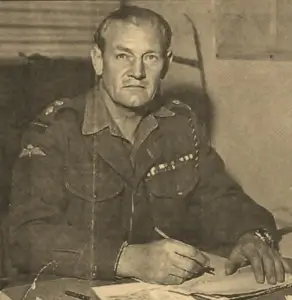
While the rest of the world was revolutionizing warfare with Panzer tanks, automatic machine guns, and aerial bombings, this eccentric British officer decided to bring medieval weaponry to a modern mechanized war. He went into combat armed with a 72-inch English longbow, a Scottish broadsword, and a set of bagpipes. But he wasn’t just a reckless lunatic trying to get himself killed for the sake of theatrics. To figure out how he actually survived and thrived on the battlefield, we have to look at the terrifying psychology and the pure physical mechanics of his ancient arsenal.
The Silent Physics of Mad Jack Churchill’s Longbow
Why use a bow and arrow in the 1940s? It seems completely insane when you are fighting an enemy equipped with rapid-fire submachine guns. But mechanically speaking, a properly crafted English longbow is essentially the ultimate stealth sniper rifle.
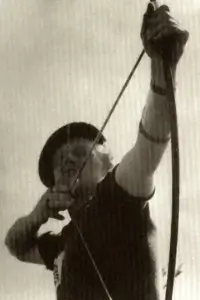
It takes massive biomechanical strength to pull back a war bow, which typically has a heavy draw weight of around 100 to 150 pounds. When that stored kinetic energy is released, the heavy wooden arrow, fitted with a razor-sharp broadhead, can silently pierce through thick winter clothing and deep tissue without creating the massive muzzle flash or the deafening, echoing crack of a standard Lee-Enfield rifle. For a stealth operative raiding enemy outposts at night, complete silence is the ultimate tactical advantage. WWII commando Mad Jack Churchill recognized that a quiet kill allowed his unit to maintain the element of surprise far longer than any firearm ever could.
The Psychological Shock of the Sword
Then there is his famous sidearm. He carried an ash-hilted Scottish broadsword into battle, famously declaring that “any officer who goes into action without his sword is improperly dressed.” But bringing three feet of sharpened steel to a modern gunfight wasn’t about hand-to-hand efficiency; it was about weaponizing human psychology.
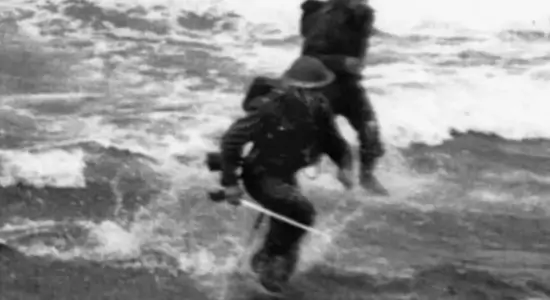
Imagine being a German sentry sitting in a pitch-black trench. You are expecting bullets and grenades. Suddenly, a screaming British soldier leaps out of the darkness, swinging a massive medieval blade. The human brain simply isn’t wired to process that kind of archaic threat in a modern context. The sheer, terrifying shock value essentially short-circuits the enemy’s reaction time. During a daring night raid in Norway, WWII commando Mad Jack Churchill actually managed to capture 42 German soldiers and a mortar crew simply by appearing out of the shadows and terrifying them into submission with his sword.
The Acoustic Warfare of the Bagpipes
To round out his bizarre loadout, Churchill carried a set of bagpipes. Historically, bagpipes were used in Highland regiments as an acoustic weapon. The sound is specifically designed to project over the deafening noise of cannon fire, boosting the morale of friendly troops while heavily intimidating the enemy.
Churchill used this exact audio strategy during amphibious assaults. When leaping from a landing craft onto enemy beaches under heavy machine-gun fire, he would stand upright and blast “The March of the Cameron Men.” From a psychological standpoint, hearing the wailing, alien drone of pipes cutting through the mechanical stutter of heavy gunfire is incredibly unnerving for defenders. It signals absolute fearlessness. Even when his entire unit was wiped out by mortar fire in Yugoslavia, the Germans found Churchill sitting in the rubble, calmly playing “Will Ye No Come Back Again” on his pipes right up until the exact moment he was captured.
Conclusion
Churchill didn’t just survive the war; he survived multiple combat deployments, escaped from two different prisoner-of-war camps, and lived a long, peaceful life until he passed away in 1996. His incredible story is more than just a funny historical footnote about a guy who liked old weapons. It proves that in the chaotic, high-stress environment of modern war, the element of total surprise is sometimes far more powerful than sheer firepower. When everyone else is relying on the advanced technology of the 20th century, the most disruptive thing you can do is hit them with the raw, visceral mechanics of the 14th century.
The Rabbit Hole Goes Deeper…
If a British officer charging into modern machine-gun fire with a broadsword and a longbow sounds like the wildest war story you’ve ever heard, the battlefields of the 1940s have plenty of other bizarre legends waiting for you.
Think Mad Jack was the only one using outdated tech to completely terrify the German army? Discover how an all-female Soviet bomber regiment used obsolete wooden crop-dusters and pitch-black skies to outsmart the Third Reich in the terrifying stealth tactics of the Night Witches.
Or maybe you prefer your unconventional WWII heroes to be a bit more… biological. Swap the medieval weapons for a 500-pound apex predator and uncover the unbelievable reason Wojtek the Bear was drafted into World War II.
References:
Imperial War Museums — The Story Of ‘Mad Jack’ Churchill
Historic UK — ‘Mad Jack’ Churchill: A Rare Breed of Warrior
National Army Museum — Fighting with a Sword in Modern Warfare