
Imagine flying over the crystal-clear, shallow turquoise waters of the Caribbean Sea, only to suddenly spot a perfectly circular, terrifyingly dark abyss staring back at you like a giant pupil. These geological anomalies look like portals to another dimension, dropping straight down into the pitch-black crust of the Earth. While they might look like the impact craters of ancient meteorites or the lairs of mythical sea monsters, the reality of how these submerged caverns formed is actually much stranger—and it involves a time when the oceans were essentially sucked dry.
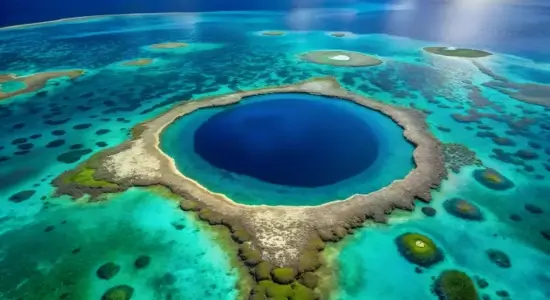
For decades, scientists have been throwing submersibles, sonar arrays, and brave divers down into these flooded chasms to figure out what survives in the dark. In 1971, legendary marine explorer Jacques Cousteau brought his research ship, the Calypso, to the Great Blue Hole off the coast of Belize to chart its depths, forever putting these submerged caves on the map. But even with modern technology, these massive underwater sinkhole formations remain one of the most dangerous and poorly understood environments on the planet, hiding toxic layers of water, perfectly preserved fossils, and bizarre bacteria that thrive without oxygen.
The Ice Age Origins of Mysterious Blue Holes
To understand how these massive vertical caves ended up in the middle of the ocean, you have to rewind the clock to the Pleistocene epoch. During the last major Ice Age, massive glaciers locked up a huge portion of the Earth’s water, causing global sea levels to drop by hundreds of feet. In places like the Bahamas and the Yucatan Peninsula, thick layers of limestone bedrock were suddenly exposed to the open air.
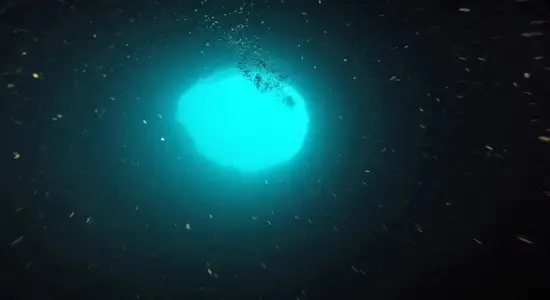
Over thousands of years, acidic rain slowly chewed through this soft rock, carving out enormous dry cave systems. When the Ice Age ended roughly 10,000 years ago, the glaciers melted, sea levels rapidly rose, and the flooded cave ceilings collapsed under the immense weight of the ocean, creating the vertical shafts we see today.
A Toxic, Oxygen-Starved Abyss
The water inside a blue hole does not circulate or mix well with the open ocean currents above it. Because of this, the deeper you go, the deadlier the environment becomes. At roughly 300 feet down in the Great Blue Hole of Belize, divers hit a hydrogen sulfide layer—a thick, opaque, and highly toxic blanket of gas suspended in the water.
Below this line, there is zero oxygen. In 2018, when businessman Richard Branson and aquanaut Fabien Cousteau took a submarine down to the very bottom, they discovered a terrifying “graveyard” of conch shells and marine life that had accidentally wandered below the toxic boundary and immediately suffocated.
Breaking Records in the Deepest Chasm
For years, marine geologists believed they had mapped the absolute limits of these sinkholes, but recent discoveries have completely shattered those assumptions. Until recently, the Dragon Hole in the South China Sea held the record for depth. However, in April 2024, researchers from the Mexican research center ECOSUR published staggering new measurements of the Taam Ja’ Blue Hole in Chetumal Bay, Mexico.
Using a specialized CTD (conductivity, temperature, and depth) profiler, they found it plunges more than 1,380 feet (420 meters) below sea level. Amazingly, their 500-meter sensor cable ran out of slack before hitting the bottom. This strongly suggests that these massive underwater sinkhole formations might not be isolated pits, but could actually be connected to a vast, undiscovered global network of subterranean ocean tunnels.
Preserving the Past in Pitch Black
Because the very bottom of a blue hole lacks oxygen, light, and scavenging bottom-feeders, it acts as a perfect biological time capsule. Anything that falls in stays completely intact. Paleontologists diving in the Bahamas’ Sawmill Sink have recovered perfectly preserved, 2,500-year-old giant tortoise shells, ancient crocodile skulls, and even the remains of early humans. Far from being just empty, dead zones, these flooded caves are giving scientists a pristine, undisturbed window into the ancient biology of our planet.
Conclusion
The ocean’s blue holes are a stunning reminder of how dynamic and extreme Earth’s geology can be. They are not simply deep pockets of water; they are flooded remnants of a frozen past and active laboratories for understanding extreme survival. As underwater drone technology improves and we drop new probes deeper into the dark, it is almost guaranteed that these vertical caves will continue to rewrite what we know about the ocean floor.
Dive Deeper into the Ocean’s Mysteries…
If the terrifying depths of a blue hole blew your mind, the ocean is full of even stranger, alien-like creatures waiting to be uncovered.
- Did you know there is a stunningly beautiful, microscopic sea slug that intentionally eats venomous jellyfish just to weaponize their toxic cells? Uncover the astonishing biology of why the tiny blue dragon hacks the ocean to steal lethal weapons.
- What if a terrifying deep-sea creature vanished from scientific records for over a century, only to suddenly reappear in the dark abyss? Explore the bizarre reality of how the faceless cusk eel was rediscovered after 144 years in deep Pacific waters.
Keep exploring the weird and wonderful archives on FactFun.co… because the ocean is Earth’s final frontier.
References:
Frontiers in Marine Science — Recent records of thermohaline profiles and water depth in the Taam Ja’ Blue Hole
National Geographic — How the Great Blue Hole in Belize formed—and why it’s so deadly Smithsonian Magazine — Inside the Deepest Blue Hole in the World