
On the morning of June 30, 1908, the sky over a remote stretch of Siberian forest literally split open. Eyewitnesses reported a massive, blindingly bright bluish-white fireball streaking across the horizon, followed instantly by an explosion so unimaginably violent that it registered on barometers all the way in England. The sheer force of the shockwave knocked people off their feet 40 miles away, shattered windows, and generated a thermal pulse that locals claimed felt like their shirts were catching fire.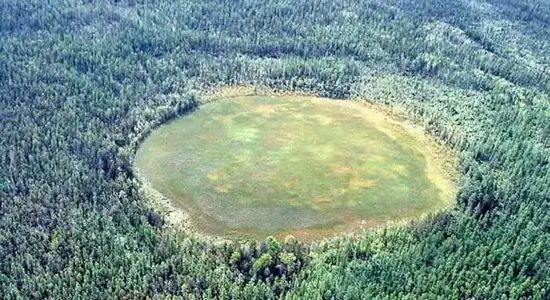
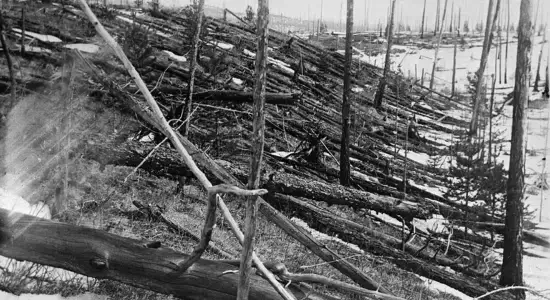
The aftermath of this blast is what really breaks the human brain. When investigators finally managed to hack their way through the unforgiving taiga to reach the Podkamennaya Tunguska River basin years later, they fully expected to find a massive, smoking crater. Instead, they found 80 million pine trees flattened outward in a perfect radial butterfly pattern stretching across 800 square miles. But right at the very center of this destruction? The trees were still standing straight up, completely stripped of their branches like dead telephone poles. And the absolute craziest part: there was no crater, and absolutely no giant space rock to be found. The object just completely vanished.
The Wild Theories Behind the Tunguska Event
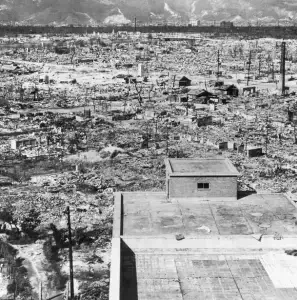
Because it took almost two decades for a proper scientific expedition to reach the site—led by Russian mineralogist Leonid Kulik in 1927—the lack of physical debris sent conspiracy theories into overdrive. People were desperate to understand how an impact roughly equal to 1,000 Hiroshima atomic bombs could leave zero evidence behind.
Without a crater, armchair theorists and pop-culture authors blamed everything under the sun. They pitched theories about rogue black holes passing through the Earth, antimatter collisions, a misfire of Nikola Tesla’s rumored death ray, and inevitably, a crashed alien spacecraft whose nuclear drive core had catastrophically failed. Because honestly, how else do you explain a devastating ground-level wipeout with no actual ground impact?
The Terrifying Physics of an Airburst
The real science behind the destruction isn’t a sci-fi movie plot; it’s a terrifying cosmic reality known as an airburst. Imagine a massive, stony asteroid or comet fragment—likely about 150 to 200 feet wide—slamming into Earth’s atmosphere at over 33,000 miles per hour. As this massive rock plows into the increasingly thick air, it creates a high-pressure shockwave in front of it.
The air compresses so violently and rapidly that it generates immense heat. The rock doesn’t even get the chance to hit the dirt. The intense atmospheric pressure literally crushes the asteroid in mid-air, causing it to pancake and violently detonate about three to six miles above the Earth’s surface. This massive 1908 Siberian meteor explosion released a downward hammer-blow of pure thermal and kinetic energy, completely vaporizing the rock into dust before it ever touched the ground.
Why the Trees Stood Up at Ground Zero
So how do you explain the creepy, branchless trees left standing perfectly upright at the very center of the blast? It all comes down to the mechanics of a downward shockwave. Directly underneath the epicenter of the 1908 Siberian meteor explosion, the concussive force was moving straight down from the sky.
The blast wave snapped the branches off the trees instantly, but the downward pressure actively pushed the thick trunks firmly into the dirt, leaving them standing up like stripped matchsticks. As that shockwave hit the ground, it violently redirected outward, knocking the rest of the 80 million surrounding trees flat on their sides. Decades later, modern scientists sampling the peat bogs at ground zero finally found the microscopic smoking gun: tiny, melted silicate and magnetite spheres. It was the vaporized dust of the asteroid, perfectly preserved in the mud.
Conclusion
The Tunguska explosion is a brilliant, terrifying reminder that we live in a cosmic shooting gallery. A space rock the size of a medium apartment building managed to flatten an area the size of a major modern city, and it didn’t even have to physically touch the Earth to do it. It proves that nature doesn’t need alien lasers or antimatter weapons to completely rewrite a landscape—just gravity, speed, and pure, raw physics.
The Rabbit Hole Goes Deeper…
If a massive, invisible space rock wiping out an entire Siberian forest blew your mind, just wait. Sometimes the most terrifying and bizarre events in history don’t fall from the sky—they are entirely human-made.
-
Think a government cover-up about aliens is bad? Uncover the absolute darkest chapter of World War II and the horrifying reason the architects of Unit 731 escaped justice.
-
Or maybe you want to see what happens when the human brain completely short-circuits. Step back into the Middle Ages to discover the fatal footwork: why doctors prescribed ‘more dancing’ to cure the 1518 plague.
Keep digging through our Weird History archives… because humanity is infinitely stranger and scarier than anything from outer space.
References:
NASA Science — The Tunguska Impact: 100 Years Later
Smithsonian Magazine — The Tunguska Mystery, 100 Years Later
Scientific American — The Tunguska Event: What Really Happened in 1908?