
A mysterious visitor streaked through our Solar System in late 2025, travelling at a blinding speed of over 60 kilometers per second. It’s the third interstellar object ever detected, and its arrival split the scientific community and the internet into two camps: is it a relic of a distant star system, or is it an alien probe sent by a civilization from the Milky Way’s dark fringes?
This is the story of 3I/ATLAS, a celestial body that is scientifically priceless, naturally bizarre, and the latest focus of the eternal debate about life beyond Earth.
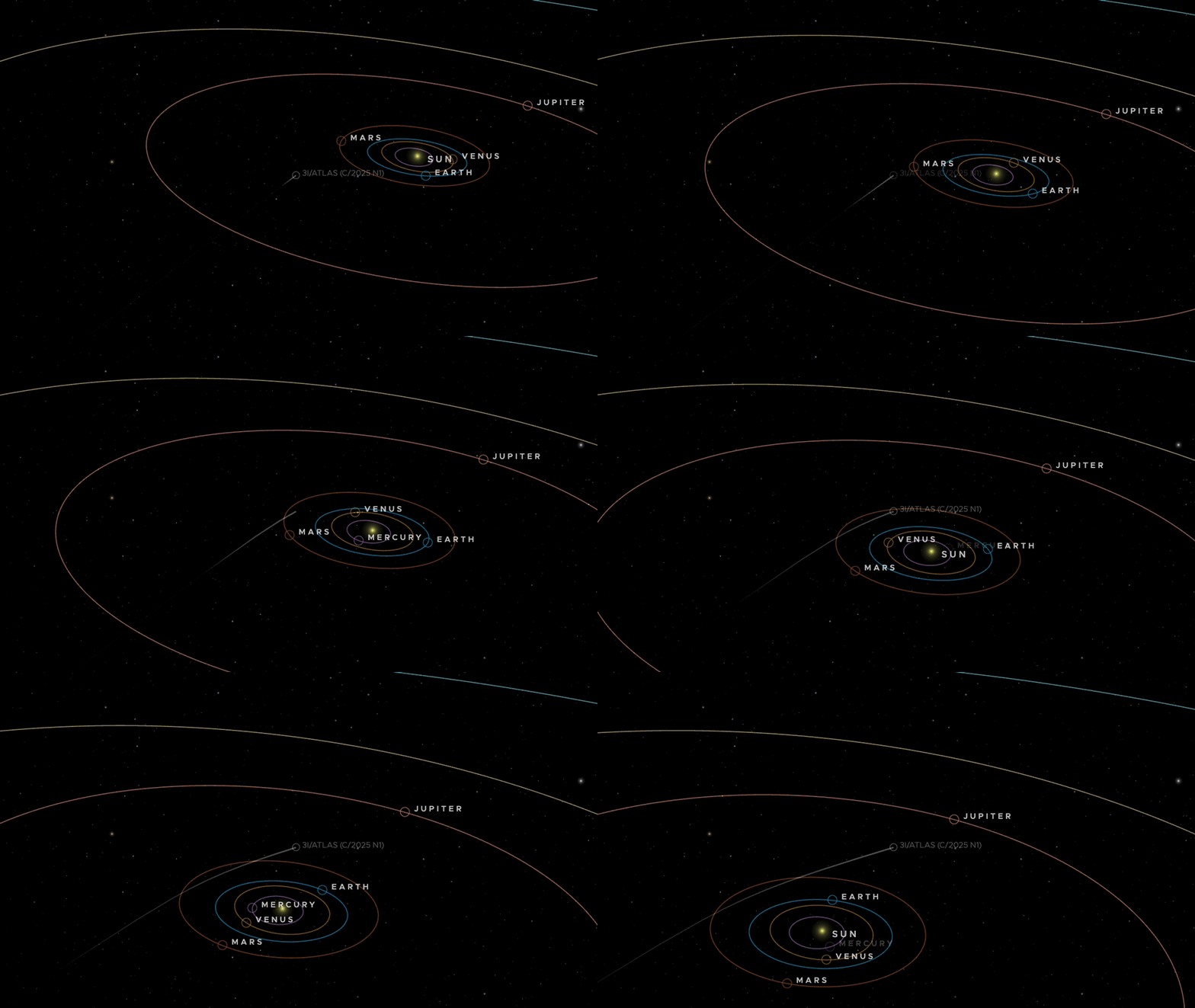 cr: science.nasa.gov
The Facts: What We Know About This Interstellar Wanderer
3I/ATLAS was first spotted on July 1, 2025, by the Asteroid Terrestrial-impact Last Alert System (ATLAS) survey station in Río Hurtado, Chile. The “3I” in its name means it is the Third Interstellar object (following ‘Oumuamua and 2I/Borisov) confirmed to have originated from beyond our Solar System.
The Scientific Verdict: A Comet, But Not a Normal One
Astronomers have overwhelmingly classified 3I/ATLAS as a comet. The evidence is clear:
- Hyperbolic trajectory: Its orbit is not a closed loop around the Sun, unlike Earth or native comets. Its extreme speed and path confirm it is simply passing through our neighbourhood before exiting permanently back into interstellar space.
- Coma and tail: Observations from powerful telescopes like Gemini South and the Hubble Space Telescope revealed a clear coma (a gaseous envelope) and a tail of gas and dust—the unmistakable hallmarks of a comet being warmed by the Sun.
- Confirmed outgassing of water: NASA’s Swift Observatory caught the first hint of water activity through a faint ultraviolet glow of hydroxyl gas, with the comet blasting out water at a rate of roughly 40 kilograms per second, far earlier and farther from the Sun than most comets typically “switch on.”
However, 3I/ATLAS is far from ordinary. It is breaking the rules of Solar System comets:
The bizarre composition: Spectroscopic studies from JWST found that 3I/ATLAS has an extremely high carbon dioxide to water ice ratio, among the highest ever recorded. In mid-2026, JWST also detected methane on the comet, the first direct methane detection ever made on an interstellar visitor, likely trapped beneath the surface since its formation and only released once solar heating reached deeper icy layers.
The origin: Analysis of its trajectory suggests it likely hails from the Milky Way’s Thick Disk, a region populated by ancient stars. Some scientists suggest it could be older than the Solar System itself, potentially by billions of years.
The Speculation: Is It a Probe in Disguise?
Every time an unusual interstellar object visits, speculation about alien technology, or technosignatures, inevitably arises. For 3I/ATLAS, much of this debate has been driven by Harvard astrophysicist Avi Loeb, a well-known proponent of the search for extraterrestrial technology and head of Harvard’s Galileo Project.
Loeb has compiled a running list of what he calls anomalies, several of which held up under scrutiny while others were explained away by mainstream astronomers:
- Non-gravitational acceleration: Around its October 30, 2025 perihelion, precision tracking data showed 3I/ATLAS accelerating in ways that outpaced standard outgassing models, with a radial component of roughly 135 km/day² and a transverse component of about 60 km/day². Most astronomers attribute this to unusually vigorous jets of carbon monoxide and other gases rather than any artificial thrust, but the magnitude did genuinely surprise some researchers studying its physics.
- The anti-tail: Early observations showed a plume of material seemingly pointing sunward rather than away from it, the typical direction for a comet tail. Loeb speculated this could hint at controlled behavior. Other scientists clarified this is a rare but natural optical effect caused by Earth’s viewing angle relative to the comet’s orbital plane and dust trail geometry.
- Unusual chemistry: Telescopes detected pure nickel vapor in the coma without the expected accompanying iron, an unusual pairing possibly explained by the breakdown of nickel carbonyl compounds at relatively low temperatures. It’s a chemical curiosity, but not something that requires an artificial explanation.
Despite the intriguing nature of these claims, the overwhelming scientific consensus is clear: 3I/ATLAS is a natural comet.
Fact Check: According to Tom Statler, NASA’s small-bodies lead scientist, “It looks like a comet. It does comet things. It very, very strongly resembles, in just about every way, the comets that we know.” There is no direct, verifiable evidence—such as radio signals or observed manoeuvres—that suggests it is an alien craft.
Fun Fact
3I/ATLAS passed within about 270 million kilometers of Earth at its closest approach in December 2025—still nearly twice the distance between the Sun and Mars—meaning there was never any realistic chance of impact. NASA, ESA, and observatories worldwide coordinated observations of the flyby anyway, since a natural visitor from another star system this close only comes along once in a great while.
The Final Window: An Opportunity for Science
The debate between natural comet and alien probe is part of what makes 3I/ATLAS so fascinating. Regardless of its origin, this object provided an invaluable “cosmic messenger.” Because it formed in another star system, its chemistry—including that unusual carbon dioxide ratio and the surprise methane detection—allows astronomers to peek directly into the chemical conditions of other planetary nurseries across the galaxy. It’s a rare, fleeting chance to compare the building blocks of planets beyond our own Solar System without having to send a costly probe. If distant, otherworldly mysteries fascinate you, you might also enjoy exploring this look at the Hubble tension and the possible spin of the cosmos, another puzzle currently reshaping how astronomers understand the universe.
3I/ATLAS has already passed its closest approach to the Sun and Earth and is now heading back out toward the outer Solar System, having passed roughly 6.7 times the Earth-Sun distance by early 2026 on its way back into interstellar space. It reminds us that whether visitors are natural or artificial, the universe always has something new to teach us.
Wikipedia — 3I/ATLAS
Science Daily — Interstellar Comet 3I/ATLAS Is Spraying Water Across the Solar System
Science Daily — NASA’s Webb Detects Methane and Strange Chemistry on 3I/ATLAS
Avi Loeb, Medium — Where Is 3I/ATLAS Now?
Is 3I/ATLAS actually an alien spacecraft
The overwhelming scientific consensus, including NASA’s own small-bodies team, is that it is a natural comet. It shows a coma, a gas and dust tail, and chemistry consistent with comets, and no verified evidence such as radio signals or deliberate manoeuvres has ever been detected.
Why do some scientists think 3I/ATLAS is unusual
It has an exceptionally high carbon dioxide to water ice ratio, detectable methane trapped beneath its surface, and stronger than expected non-gravitational acceleration near perihelion, all of which suggest it formed in a chemically different environment than our own Solar System, possibly billions of years ago.
How close did 3I/ATLAS get to Earth
Its closest approach in December 2025 was about 270 million kilometers away, nearly twice the distance between the Sun and Mars, meaning it never posed any risk of impact.
Where is 3I/ATLAS now
Having already passed perihelion and its closest approach to Earth, 3I/ATLAS is heading back out of the Solar System toward interstellar space, moving beyond Jupiter’s orbit and continuing to fade from view as it departs permanently.