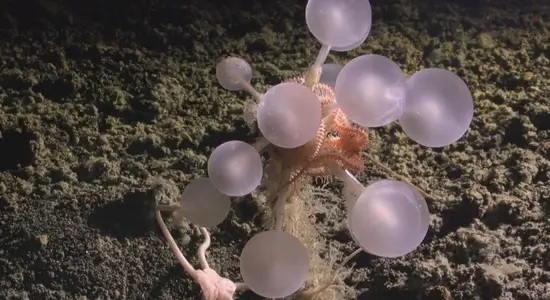

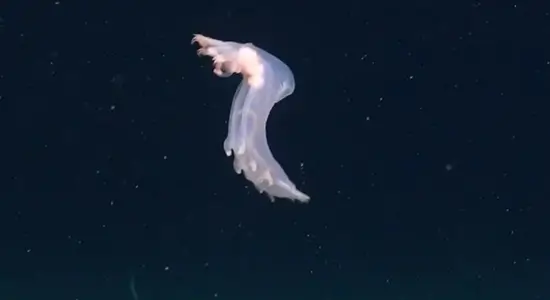
At Fact Fun, we love when science uncovers moments that seem almost too whimsical to be real. Recently, a sea pig — a bizarre deep-sea relative of the sea cucumber — was caught on camera “dancing” over 2,300 meters (7,677 feet) beneath the ocean’s surface, swaying its pink, translucent body in rhythm with the currents.
Captured Off the Coast of Uruguay
The footage was recorded by researchers aboard the Schmidt Ocean Institute’s ROV SuBastian, operating from the research vessel Falkor (too), during the Uruguay SUB200 expedition. The sea pig was spotted at a depth of 2,340 meters in the lower section of the José Ignacio submarine canyon, off the coast of Uruguay in the South Atlantic. The SUB200 program is a multi-year effort to map and explore the deep waters within Uruguay’s exclusive economic zone, much of which had never been surveyed before.
At such crushing depths, sunlight never reaches, temperatures hover just above freezing, and pressures can exceed 230 times the force of Earth’s surface. Yet, this gentle “dancer” thrives there.
What Exactly Is a Sea Pig?
The sea pig belongs to the genus Scotoplanes, most likely Scotoplanes globosa, a type of sea cucumber that lives on the ocean floor, feeding on tiny organic particles known as “marine snow” that drift down from the surface. Sea pigs are picky eaters, too, preferring only fresh sediment that fell within roughly the last 100 days, rather than older organic matter that has already lost most of its nutrients. Its plump, gelatinous body and tube-like legs help it glide gracefully over sediment — and, in this case, perform what looked like a deep-sea ballet.
The reason sea pigs appear to “dance” is their unique way of walking. Their legs, technically called tube feet, inflate and deflate using a water vascular system, filling and emptying with fluid as the animal moves, creating the illusion of rhythm. Combined with their rosy, translucent bodies, it’s no wonder this creature has become a viral sensation among deep-sea enthusiasts.
Why Scientists Care
Beyond its charm, the sea pig’s movement helps researchers understand how deep-sea invertebrates adapt to extreme pressure and low oxygen. Its skin acts as both armor and breathing surface, and its tube feet serve as locomotion and sensory tools. Sea pigs are also known to gather in herds of anywhere from 10 to over 600 individuals, all facing into the current, using their dorsal papillae almost like a sense of smell to detect fresh food drifting down from far above, such as the rich remains of a whale fall.
Did You Know
Sea pigs are found across nearly every ocean basin on Earth, typically at depths between 1,200 and 5,000 meters, though some have been recorded far deeper, including specimens found at nearly 10,000 meters in the Philippine Trench. In certain abyssal plains, they can make up over 95% of all the animal biomass on the seafloor, showing just how completely life can dominate a place with near-total darkness and crushing pressure.
If strange ocean dwellers fascinate you, explore how faceless cusk eels were rediscovered after 144 years or read how ancient “hell ants” once ruled Cretaceous forests — both proof that nature’s strangest forms often hide in plain sight. And if you ever stumble upon something wonderfully weird, just remember: the world still has plenty of secrets left for us to discover here at Fact Fun.
Schmidt Ocean Institute — Uruguay SUB200 Expedition
Monterey Bay Aquarium Research Institute (MBARI) — Sea Pig
Museums Victoria Collections — Scotoplanes globosa
Where exactly was the dancing sea pig filmed
It was recorded at a depth of 2,340 meters in the José Ignacio submarine canyon off the coast of Uruguay, as part of the Schmidt Ocean Institute’s Uruguay SUB200 expedition, not near Hawaii as sometimes reported.
Why does the sea pig look like it’s dancing
Its tube feet inflate and deflate using a water vascular system as it walks, creating a rhythmic, bouncing motion. Paired with its translucent pink body, the movement looks remarkably like dancing on camera.
How deep do sea pigs actually live
Most sea pigs live between 1,200 and 5,000 meters deep on the abyssal plain, though some species have been recorded as deep as nearly 10,000 meters in ocean trenches, making them one of the most widely distributed animals on the planet.
What do sea pigs eat
They are deposit feeders that consume marine snow, tiny bits of organic material that sink from the ocean surface. Sea pigs specifically prefer fresh sediment less than about 100 days old and will gather in large herds around nutrient-rich sites like whale falls.