
We’ve all studied the history books, and you might think the Black Death or World War I was the absolute worst time to be a human being. But historians have a dark little secret: they often whisper about the 17th Century as the single most miserable period in recorded history. If you were born between 1600 and 1700, you didn’t just have a bad time—you were living through a collective, global nightmare defined by war, plague, and freezing temperatures. Historians gave this wretched era a fitting nickname: The General Crisis.
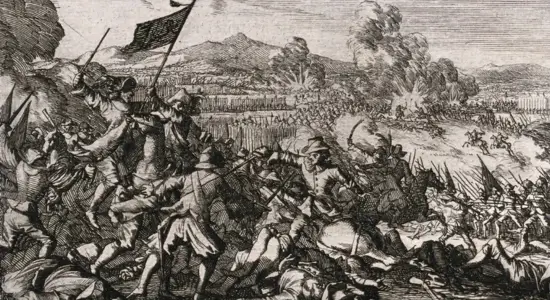 An etching created by Caspar Luyken depicting the Battle of Wittstock,
which took place on 4 October 1636 near the town of Wittstock in northern Germany during the Thirty Years’ War.
Image credit: Wellcome Collection (Public Domain)
So, why was the 1600s so uniquely dreadful? It was a disastrous cocktail of man-made and natural catastrophes happening all at once. If the wars didn’t get you, the weather would. And if the weather failed, the plague was right behind.
The Century of Endless War
The sheer scale of conflict in the 17th Century is almost unimaginable. Europe was a smoking battlefield, and the main act of terror was the Thirty Years’ War (which, ironically, lasted 30 years, from 1618 to 1648). This continent-wide nightmare dragged in nearly every major European power and was one of the deadliest conflicts ever. The result? Up to 8 million people were killed, leaving vast swathes of Central Europe devastated and depopulated.
But the bloodshed didn’t stop there. Across the English Channel, the English Civil War was tearing Britain apart. In France, the Fronde civil wars raged. Meanwhile, in Asia, one of the greatest empires in history—the Ming Dynasty—was collapsing in a heap of peasant revolts and foreign invasion. There was simply no corner of the Earth safe from the chaos of human conflict.
The Sky Fought Back
Just when you thought it couldn’t get worse, the climate decided to join the fight. The 17th Century fell right in the middle of what is known as the “Little Ice Age,” a period of global cooling that reached its peak between roughly 1560 and 1660. This wasn’t just a few cold winters; this was widespread climatic disaster. Volcanic activity is believed to have played a major role in plunging the world into a perpetual chill.
The freezing weather utterly ruined agricultural production. In turn, crop failures led to mass famine and skyrocketing grain prices, turning hungry, impoverished populations across Europe and Asia against their rulers. A historian writing in 1641 about China reportedly noted that “among all the strange occurrences of disaster and rebellion, there had never been anything worse than this.” The cold literally fueled the wars.
The Last Stand of the Plague
If you managed to survive the bullets and the frostbite, the deadly pathogens were waiting. The 17th Century saw some of the final, devastating outbreaks of the Bubonic Plague, proving that the great medieval terror was far from over.
The worst example was the Great Plague of London in 1665–1666. In just 18 months, this single outbreak claimed over 100,000 people, wiping out almost a quarter of London’s population. Cities like Naples and Seville also lost roughly half their inhabitants in mid-century outbreaks.
Conclusion: A Perfect Storm of Misery
The 17th Century was, quite simply, a perfect storm. It was a time when the man-made horrors of the Thirty Years’ War and the collapse of great empires merged seamlessly with the natural horrors of the Little Ice Age and deadly pandemics. For the poor soul alive in the 1600s, there was no respite—just perpetual misery, earning it the dark but accurate title of the most dreadful time to be alive.
Did You Know?
While the world was busy fighting and freezing, the air in the 17th Century was often filled with the terrible smell of sickness and war. But did you know that ancient Greeks and Romans intentionally made their magnificent statues smell beautiful? Discover the strange truth behind the scented statues of antiquity, how they used exotic oils and perfumes, and why they cared so much about making stone smell good.
And before the great wars of the 1600s could even begin, the world had already faced mass annihilation from a terrifying force. It turns out the worst year in human history wasn’t in the 17th Century at all, but a thousand years earlier! Discover why historians agree that the year 536 AD was the most miserable and deadly year ever, thanks to a mysterious cloud of ash and a deadly plague.
ref : iflscience , historyhit