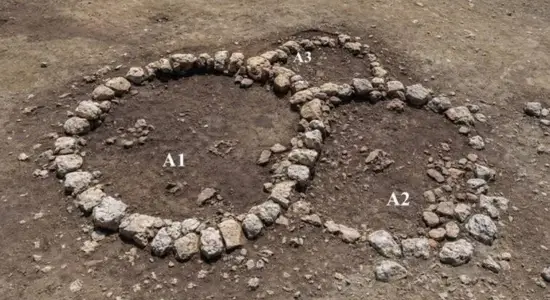

It is a discovery that pushes back the timeline of human engineering by tens of thousands of years. Deep in a Middle Pleistocene sediment layer near Rome, Italy, archaeologists unearthed a cache of tools that, according to traditional textbooks, simply shouldn’t exist there.
Among nearly a hundred bone tools recovered from the site, one stood out immediately. It was sleek, deliberately shaped, and clearly sophisticated. It wasn’t made of stone, and it wasn’t even made from the massive elephant bones scattered all around it. It was carved from the bone of a wild cattle-like animal, and it was designed to do one very specific job: soften leather.
For decades, science believed that crafting this kind of specialized, multi-stage bone tool was a distinctly “modern” skill, one that didn’t become common until roughly 300,000 years ago and was long associated with more recent Homo sapiens and late Neanderthal groups. But this artifact, found at the Castel di Guido site, has been dated to roughly 400,000 years old, pushing that timeline back by around 100,000 years. Its existence suggests that long before modern humans dominated the landscape, an earlier hominin population was already mastering a level of tool engineering nobody expected from them.
The “Swiss Army Knife” of the Pleistocene
The standout artifact is what archaeologists call a lissoir: a smooth, elongated implement used to work and soften animal hides. To the untrained eye, it looks like an unremarkable fossil fragment. To an expert, it’s a masterpiece of planning.
Its makers didn’t simply smash a bone and grab a sharp shard. They used a technique called percussion flaking, the same core method typically reserved for knapping flint or obsidian, and applied it to bone instead. They understood that bone had its own grain, density, and elasticity, entirely different from stone, and shaped this particular piece with a final polished, rounded tip built specifically for smoothing leather rather than cutting or scraping it. That kind of multi-stage, purpose-built design was thought to be unique to far more recent toolmaking traditions. Finding it at Castel di Guido is a bit like finding a genuinely modern engineering concept show up hundreds of thousands of years earlier than anyone expected.
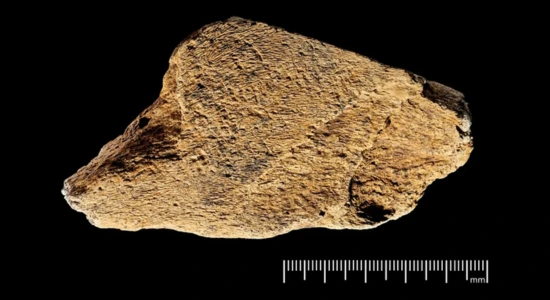 Bone fragments from Castel di Guido, including tools shaped through deliberate flaking and polishing. Image credit: NHM Photo Unit
Harvesting the Titans
The site itself tells an even bigger story, because the vast majority of the raw material at Castel di Guido came from something far larger than cattle: the straight-tusked elephant (Palaeoloxodon antiquus), a species that makes modern African elephants look modest by comparison.
Standing over 4 meters (roughly 13 feet) at the shoulder and weighing up to 13 tons, these were among the largest land mammals ever hunted or scavenged by early hominins in Europe. Researchers identified 98 verified elephant bone tools at the site, the largest collection of flaked bone tools ever attributed to a pre-modern hominin population anywhere in the world. The toolmakers, most likely early Neanderthals or possibly Homo heidelbergensis, didn’t just hunt or scavenge these animals for meat. They treated the carcasses as walking hardware stores. A single elephant limb bone offered a massive surface area of dense material that could be worked almost like wood, yet held an edge far better than most people would expect.
Fun Fact
Lissoirs like the one found at Castel di Guido didn’t become a common part of the human toolkit again until roughly 300,000 years later, in the Upper Paleolithic Aurignacian culture, where over a hundred similar smoothing tools have been found at sites across southwest France. The Castel di Guido piece predates all of them by a massive margin.
Why Bone Sometimes Beats Stone
Why go through the trouble of carving bone when rocks were everywhere? Because for certain tasks, stone simply fails.
Stone is brittle. Use a flint edge to scrape or work a hide vigorously enough, and it can snap or chip unpredictably. Fresh bone, by contrast, has genuine tensile strength. It can flex slightly under pressure without breaking, which makes it far better suited to repetitive, heavy-duty tasks like softening thick animal hide. The hominins at Castel di Guido appear to have understood this difference and exploited it deliberately, selecting bone specifically for jobs where stone’s brittleness would have been a liability. This wasn’t a fallback born of desperation; it looks like a considered material choice, made by people paying close attention to how different materials behaved under stress.
Conclusion: Genius Older Than We Assumed
The discovery at Castel di Guido forces a bit of humility. We tend to think of sophisticated, multi-stage tool design as something that arrived only with Homo sapiens. But roughly 400,000 years ago, long before anatomically modern humans existed, an earlier hominin population was already solving genuinely complex material engineering problems. They looked at the carcass of a fallen giant and a discarded piece of cattle bone and saw the raw ingredients for specialized technology most researchers assumed hadn’t been invented yet. The Stone Age was never only about stone. It was always, at its core, about the minds doing the shaping.
IFLScience — This 480,000-Year-Old Elephant Bone Tool Is the Oldest Ever Found Outside Africa
Sci-News — 400,000-Year-Old Elephant Bone Tools Unearthed in Italy
Ancient Origins — Archaic Hominin Made Elephant Bone Tools 400,000 Years Ago
How old are the Castel di Guido bone tools
The site has been dated using argon-argon (⁴⁰Ar/³⁹Ar) methods to approximately 400,000 years old, placing it firmly in the Middle Pleistocene, well before the emergence of modern Homo sapiens.
Was the famous lissoir tool made from elephant bone
No. While the site contains 98 verified tools made from elephant bone, the single most significant artifact, the polished lissoir used for softening leather, was actually carved from the bone of a wild cattle-like animal, not an elephant.
Who made the tools found at Castel di Guido
Researchers believe early Neanderthals were the most likely toolmakers, though some experts have also proposed Homo heidelbergensis, an earlier hominin species. The exact identity remains debated, since both species were present in Europe during this general timeframe.
Why is this discovery considered so significant
Lissoirs of this design weren’t thought to become common until about 300,000 years later, during the Upper Paleolithic. Finding one at Castel di Guido pushes back the known origin of this specific, multi-stage bone-tool technology by roughly 100,000 years.