
Imagine trekking through the Atlantic Forest of Southeastern Brazil, searching for rare wildlife. You might expect to find a jaguar or a brightly colored macaw, but the creature currently blowing the minds of biologists is smaller than a pencil tip: a newly discovered pumpkin toadlet from the Brachycephalus genus.
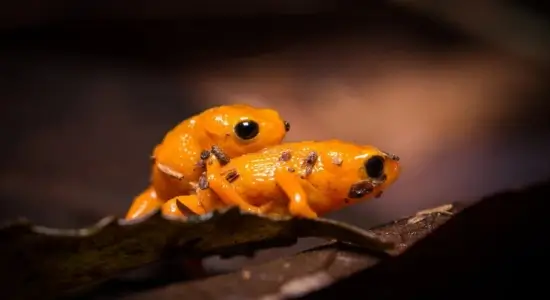
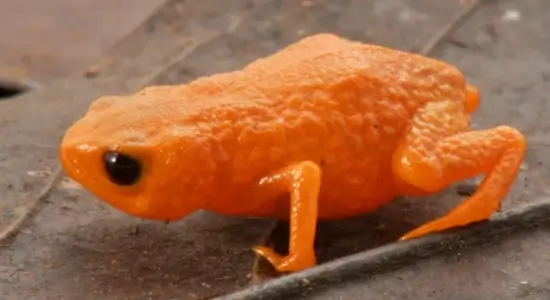 These frogs reach only about 11 to 14 millimeters in length. Image credit: Luiz Fernando Ribeiro (CC-BY 4.0)
This tiny amphibian is a masterclass in contradiction. It’s incredibly small, yet ridiculously bright. It’s venomous, yet clumsy in the air. And when researchers shine a UV light on several of its close relatives, this adorable-looking creature family reveals a bizarre, glowing secret hidden beneath its skin.
A Tiny Terror in the Leaf Litter
Described in December 2025 in the journal PLOS ONE, the newest member of the pumpkin toadlet family is called Brachycephalus lulai, named in honor of Brazilian President Luiz Inácio Lula da Silva. It was discovered in the cloud forests of the Serra do Quiriri mountain range in Santa Catarina, southern Brazil, and its discovery brought the total number of recognized species in the genus to 43, 35 of which have been described since the year 2000 alone.
These frogs are measured in millimeters, with adult males of B. lulai reaching only 8.9 to 11.3 mm and females slightly larger at 11.7 to 13.4 mm, making them among the smallest four-legged animals, or tetrapods, on the entire planet. They live exclusively in the leaf litter of the mountain rainforest floor, an environment where standing out with a bright, glowing orange body is usually a terrible survival strategy.
Small, Toxic, and Impossible to Miss
Standing out, however, is the whole point. This vivid coloration is a form of advertised danger known as aposematism. Many pumpkin toadlet species carry potent neurotoxins in their skin and internal organs, some of which are chemically related to the deadly tetrodotoxin found in Japanese pufferfish, or fugu. These little frogs are essentially walking hazard signs, warning predators that trying to eat them will not end well.
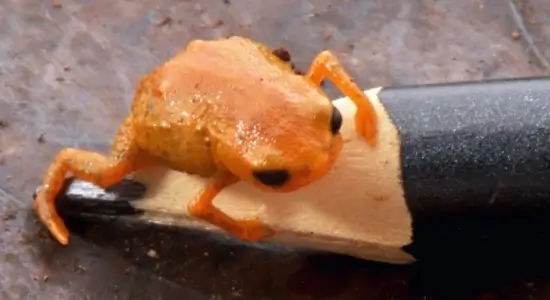 Their toes are incredibly tiny. Image credit: Luiz Fernando Ribeiro (CC-BY 4.0)
The Clumsy, Silent Communication
As if being tiny and toxic wasn’t unusual enough, several species across the pumpkin toadlet genus have physical quirks that defy logic. First, some species genuinely cannot hear their own mating calls. Researchers studying close relatives like Brachycephalus ephippium and B. pitanga found these frogs have underdeveloped inner ears, meaning they can’t perceive the high-frequency range of their own advertisement calls. Instead of relying purely on sound, they appear to communicate visually, by waving their arms, gaping their mouths, and inflating their vocal sacs where potential mates or rivals can see it.
Second, for a frog, several species in this genus are surprisingly bad at jumping. Researchers observing related toadlets found that while the animals can leap off the ground, their short, squat, heavily armored bodies seem to lose stability mid-air, sending them into chaotic, uncontrolled tumbles before landing awkwardly on their backs or bellies. If you enjoy stories about tiny creatures with extraordinary or unexpected survival tricks, you’ll probably also love learning about how tardigrades can survive being boiled, frozen, dried out for decades, and even launched into the vacuum of space.
Fun Fact
Pumpkin toadlets have essentially been racing each other for the title of world’s smallest four-limbed animal. Brachycephalus pulex, the current record holder discovered in Brazil’s Atlantic Forest, measures just 6.45 mm in its smallest recorded males, only half a millimeter smaller than its close cousin Brachycephalus dacnis, described in 2024.
The Bone-Deep Secret: Fluorescence
One of the most mind-bending features in this genus was first documented in 2019 and confirmed in several species since: bones that glow. Under normal daylight, many pumpkin toadlets simply look bright orange. But under ultraviolet (UV) light, species including Brachycephalus ephippium, B. pitanga, and the fluorescent species B. rotenbergae, described in 2021, reveal a hidden network of fluorescent bone plates that glow an eerie blue-green right beneath their thin, translucent skin.
Scientists still aren’t entirely sure why this fluorescence evolved. Leading hypotheses suggest it could help toadlets recognize each other in the dim rainforest undergrowth, or serve as an additional visual warning sign to predators layered on top of their already bright orange coloring, but researchers openly admit more study is needed to confirm its exact biological role. In a genus full of secrets, some of these tiny, toxic frogs carry their most striking mystery literally under their skin.
Bornschein, M.R. et al. (2025) — A New Species of Brachycephalus from Serra do Quiriri, Southern Brazil. PLOS ONE
Phys.org — A New Species of Tiny Orange Frog Discovered in Brazil’s Cloud Forests
Smithsonian Magazine — Biologists Discover New Species of Glowing Pumpkin Toadlet
What is the newest pumpkin toadlet species called
It’s called Brachycephalus lulai, described in December 2025 and named after Brazilian President Luiz Inácio Lula da Silva. It was discovered in the cloud forests of the Serra do Quiriri mountain range in Santa Catarina, southern Brazil.
Are all pumpkin toadlets poisonous
Many species in the Brachycephalus genus carry potent skin and organ toxins, some chemically related to tetrodotoxin found in pufferfish, which serve as a defense against predators alongside their bright warning coloration.
Why do some pumpkin toadlets have glowing bones
Researchers first documented fluorescent bone plates in this genus in 2019, visible under UV light in species like B. ephippium and B. rotenbergae. Scientists suspect it may aid communication or serve as an added predator warning, but the exact purpose remains unconfirmed.
What is the smallest pumpkin toadlet ever found
Brachycephalus pulex currently holds the record as the smallest known four-limbed vertebrate on Earth, with some adult males measuring just 6.45 millimeters, narrowly beating the closely related Brachycephalus dacnis described in 2024.