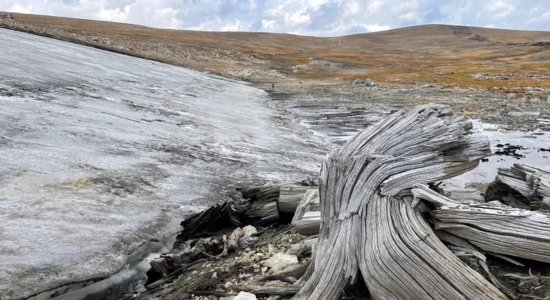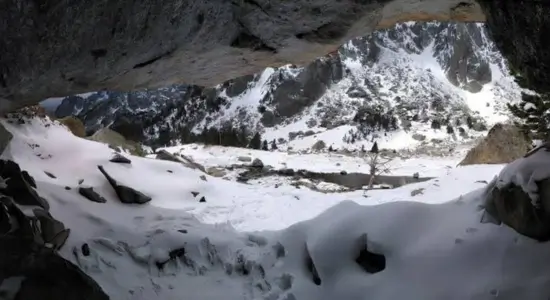

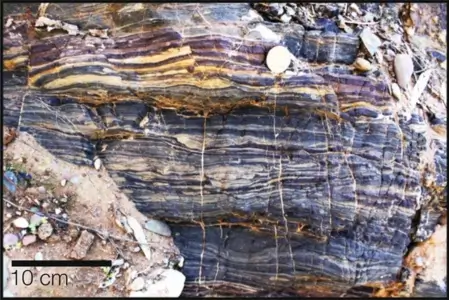
 An anomaly in the geological record: this banded iron formation, appearing over a billion years after its counterparts, serves as a frozen thermometer revealing the extreme cooling of ancient oceans. Image courtesy of Ross Mitchell
Some ocean water on Earth once got down to -15°C and stayed completely liquid. That’s not a typo, and it isn’t happening today. Geologists have just calculated it as the coldest ocean temperature ever recorded in the planet’s 4.5-billion-year history, hidden inside rock layers laid down roughly 700 million years ago during an era known as Snowball Earth.
The finding, published in Nature Communications by a team including Professor Ross Mitchell of the Chinese Academy of Sciences, solves a puzzle that’s been sitting in plain sight in the rock record for years: strange iron deposits that shouldn’t have existed a billion years after their only known predecessors.
A Chemical Signature From an Impossible Ocean
The clue came from banded iron formations, layered rock deposits that only form in water almost completely devoid of dissolved oxygen. Most of Earth’s banded iron formations date from before about 1.8 billion years ago, prior to the Great Oxygenation Event that filled the atmosphere and oceans with oxygen from photosynthesizing algae. So when geologists find banded iron dated to roughly 700 million years ago, it stands out as geologically strange, evidence of oxygen-starved water that shouldn’t have existed by then at all.
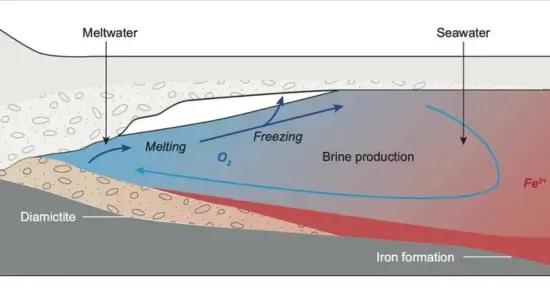 As surface ice forms, it expels salt into the depths. This frozen barrier blocks oxygen exchange, triggering iron to precipitate within the oxygen-starved, hypersaline waters below. Image courtesy of Ross Mitchell
Snowball Earth explains the timing. When ice sheets locked much of the ocean’s surface away from the atmosphere, oxygen mixing between air and sea stopped almost entirely in the water trapped beneath. That oxygen-poor environment let iron precipitate out of solution again, briefly reviving a process that hadn’t happened at scale in over a billion years. What Mitchell’s team found, though, went further than confirming that mechanism. Iron isotope ratios in these deposits carried a signature that didn’t match anything expected from low oxygen alone.
Why the Water Never Froze at -15°C
The breakthrough came from an idea raised by Professor Paul Hoffman of Harvard University, one of the scientists who originally proposed Snowball Earth decades ago. Hoffman suggested the unusual iron isotope ratios might reflect temperature fractionation, a process where unusually cold conditions cause certain isotopes to get incorporated into mineral deposits more than others. Mitchell’s team tested the idea and found it fit, but only under one condition: the water had to be sitting at roughly -15°C.
Normal seawater freezes at about -2°C, so -15°C liquid water sounds physically impossible at first. The explanation is salt. Extremely salty brine can stay liquid far below freezing, and the researchers calculated that the water responsible for these deposits was likely more than four times saltier than today’s oceans. As sea ice formed at the surface, it would have pushed dissolved salt down into the water below, concentrating it into hypersaline pockets, exactly the kind of process seen today in cold, salty brine channels beneath Antarctic sea ice, just far more extreme.
Fun Fact
This measurement now holds the record for the coldest ocean temperature ever documented in Earth’s geological history, roughly 22°F colder than the coldest ocean water found anywhere on the planet today.
How Long the Deep Freeze Actually Lasted
The specific glaciation behind these deposits is called the Sturtian, the longer and more severe of the two major Snowball Earth episodes that occurred during the Cryogenian Period. Geological evidence puts the Sturtian glaciation at roughly 717 to 660 million years ago, meaning it lasted around 57 million years, nearly as long as the entire Cenozoic Era that followed the extinction of the dinosaurs. A second, shorter freeze called the Marinoan followed later, from about 650 to 635 million years ago.
The prevailing explanation for why the Sturtian dragged on so long centers on the breakup of the supercontinent Rodinia. As Rodinia rifted apart, exposed volcanic rock weathered rapidly, pulling large amounts of carbon dioxide out of the atmosphere and locking it into sediment. With less CO2 trapping heat, global temperatures fell, ice spread toward the equator, and once ice cover crossed a critical threshold, the reflective white surface bounced away enough sunlight to keep the cooling going on its own, a feedback loop known as the ice-albedo effect.
Not every geologist agrees the planet froze completely edge to edge. Mitchell himself, once a proponent of a fully frozen “hard snowball,” now leans toward the idea that the ice may have been patchier, a “soft snowball” with occasional pockets of open water at the tropics or elsewhere depending on how the planet’s axis was tilted at the time. Either scenario is consistent with the new temperature data, so this study doesn’t settle that debate, but it does hand researchers a sharper tool for testing both ideas against the rock record going forward.
IFLScience — 700 Million Years Ago, Our Planet’s Coldest Ocean Temperatures Arrived During a Mysterious Era
National Geographic — Scientists Record Coldest Ocean Temperature Ever in Earth’s History
Hoffman, P.F. et al. (2017) — Snowball Earth Climate Dynamics and Cryogenian Geology-Geobiology. Science Advances
What was the coldest ocean temperature ever recorded on Earth
Geologists calculated a temperature of approximately -15°C in salty ocean brine trapped beneath ice during the Sturtian Snowball Earth glaciation roughly 700 million years ago, the coldest liquid ocean temperature documented in Earth’s geological history.
How could seawater stay liquid at -15 degrees Celsius
Extremely high salinity lowers water’s freezing point dramatically. Researchers calculated the brine responsible for these deposits was more than four times saltier than modern seawater, concentrated as surface ice formed and pushed dissolved salt into the water below.
How long did the Snowball Earth deep freeze last
The Sturtian glaciation, the longer of two major Snowball Earth episodes, lasted approximately 57 million years, from roughly 717 to 660 million years ago. A shorter second glaciation, the Marinoan, followed roughly 15 million years later.
What caused Snowball Earth to happen
The breakup of the supercontinent Rodinia exposed large amounts of volcanic rock to weathering, a process that pulls carbon dioxide out of the atmosphere. Falling CO2 levels cooled the planet, and once ice spread far enough, its reflective surface triggered a runaway cooling feedback loop.