
In January 2026, the World Health Organization (WHO) confirmed that the United Kingdom had once again lost its “measles-free” status, following a surge of nearly 3,000 laboratory-confirmed cases across England and Wales in 2024. It was a sobering echo of a warning the country had already received once before: the UK previously earned measles-free status in 2016-2017, lost it in 2018-2019, clawed it back between 2021 and 2023, and has now lost it for a second time. Each cycle carries the same signal — human ingenuity built an “invisible shield” of herd immunity, and that shield is now showing repeated cracks.
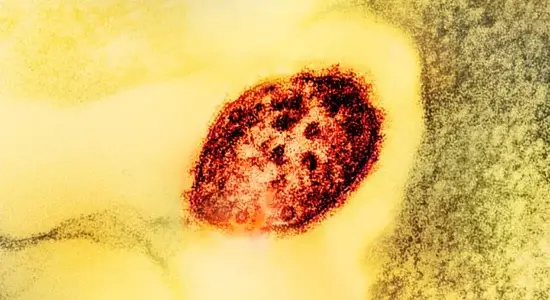 In 2024, the UK reported nearly 3,000 laboratory-confirmed cases of measles. Image credit: NIAID via Wikimedia Commons (CC BY 2.0)
But biology is a patient predator. It doesn’t need an army to invade; it only needs a crack in the armor.
The UK isn’t alone this time either. Alongside Britain, the WHO also stripped elimination status from Spain, Austria, Armenia, Azerbaijan, and Uzbekistan in early 2026, citing a broader resurgence of the disease across Europe and Central Asia. This wasn’t just a bureaucratic setback; it was a stunning biological reversal. As we watch one of the world’s most advanced healthcare systems slide backward for a second time, a chilling question emerges: if the UK can fall twice, is the United States — and the rest of the developed world — already standing on the precipice of the same collapse?
The Mathematics of “Elimination”: Why 94% Is a Failing Grade
To understand this defeat, we must demystify the word “elimination.” In epidemiology, elimination does not mean the virus is extinct — that’s “eradication.” It means that for 12 consecutive months, there has been no continuous local transmission. If a case appears, it’s an “import” that should hit a wall of vaccinated people and fizzle out.
The wall is now crumbling because of a brutal mathematical reality known as R₀ (basic reproduction number).
Measles is one of the most infectious agents known to science. While a person with influenza might infect 1 to 2 others, a single person with measles can infect anywhere from 12 to 18 people in a fully susceptible population, with published estimates ranging as high as R₀ = 17. To stop this wildfire, the math is unforgiving: most epidemiologists put the herd immunity threshold at roughly 95% vaccination coverage, though some models place the minimum closer to 93%, depending on how immunity is distributed across age groups. When national coverage dips into the low 90s, the virus doesn’t just knock at the door; it kicks it down. As the WHO itself has noted, even “extremely high” national vaccination averages aren’t enough if coverage isn’t consistent in every community and every family, for every child.
The Paradox of Success: When Safety Becomes a Threat
The most counter-intuitive reason for the UK’s repeated failures is, ironically, the vaccine’s previous success. This is known as the “prevention paradox.”
In the 1950s, parents lived in genuine terror of measles — not just the rash, but the high fevers, permanent blindness, and subacute sclerosing panencephalitis, a rare but fatal brain-swelling complication that can appear years after infection. Because the vaccine worked so effectively for decades, those horrors faded from collective memory. The perceived risk of the disease plummeted, while the perceived risk of the vaccine, fueled by a now-retracted and thoroughly debunked 1998 study linking the MMR vaccine to autism, grew disproportionately. In the UK, this complacency, combined with genuine vaccine fatigue and pockets of hesitancy, created clusters of unvaccinated individuals that act as dry tinder for a viral spark.
Fun Fact
Measles doesn’t just make you sick once — it can leave you more vulnerable to everything else you’ve already survived. A landmark study published in Science in 2019 found that measles infection can wipe out between 20% and 70% of a person’s existing antibody repertoire, a phenomenon researchers call “immune amnesia.” Essentially, catching measles can partially reset your immune system’s memory of past infections, leaving you newly vulnerable to diseases your body had already learned to fight off.
Comparative Analysis: Measles vs. Other Modern Viral Threats
To put the danger in perspective, it helps to compare measles to other widely known viral threats. Unlike COVID-19, which spreads primarily through respiratory droplets and had an estimated R₀ in the range of 2 to 4 for early variants, measles is truly airborne and remarkably hardy. The measles virus can remain suspended and infectious in the air of a room for up to two hours after an infected person has left, which is part of why it spreads so much faster than most other vaccine-preventable diseases.
| Disease | Approximate R₀ | Herd immunity threshold needed |
|---|---|---|
| Measles | 12–18 | ~93–95% |
| Seasonal influenza | 1–2 | ~40–60% |
| COVID-19 (early strains) | 2–4 | ~50–75% |
Is the United States the Next Domino?
The UK’s repeated losses are a warning the US should be listening to closely. The United States declared measles eliminated in 2000, and the armor is now showing similar stress fractures. In recent years, the US has recorded its highest case counts in decades, driven by the same dynamic seen in the UK: travel-related imports finding pockets of low vaccination and igniting sustained local outbreaks. The Centers for Disease Control and Prevention (CDC) has repeatedly warned that elimination status is not a permanent trophy — it is a status that must be actively defended every single year. If under-vaccinated communities in the US continue to grow, the country risks following the UK’s path into renewed endemic transmission. If public health mysteries and biological quirks fascinate you, you might also want to explore the bizarre true story of the 1518 dancing plague, a reminder that population-level health crises have taken strange forms throughout history.
Conclusion: The Math Doesn’t Care About Politics
The UK’s second loss of measles-free status in under a decade is a stark reminder that biological victories are never permanent. Viruses do not respect borders, they do not care about a nation’s GDP, and they are immune to rhetoric. They care only about mathematics. As long as vaccination coverage remains below that critical threshold in even a fraction of communities, the ghost of this ancient, preventable disease will continue to resurface in the modern world.
BBC News — UK Loses Measles Elimination Status (January 2026)
The Guardian — UK Loses WHO Status as Measles-Free After Rise in Deaths and Fall in Jab Uptake
CDC — Measles History: From the Pre-Vaccine Era to Elimination
Science — Measles Immune Amnesia (Mina et al., 2019)
How many times has the UK lost its measles-free status
Twice. The UK first lost the status in 2018-2019 after achieving it in 2016-2017, regained it between 2021 and 2023, and lost it again in January 2026 following a surge of nearly 3,000 cases in England and Wales during 2024.
What vaccination rate is needed to stop measles from spreading
Most epidemiologists cite a threshold of roughly 93 to 95 percent population immunity, since measles has an unusually high basic reproduction number of 12 to 18. Coverage must be consistently high across every community, not just as a national average.
What is measles immune amnesia
It’s a phenomenon where measles infection destroys a portion of the antibodies your immune system has built up against other diseases, potentially wiping out 20 to 70 percent of prior immune memory, leaving survivors more vulnerable to illnesses they had previously fought off.
Could the United States lose its measles elimination status too
It’s a real concern among public health officials. The US has seen its highest measles case counts in decades in recent years, driven by the same pattern seen in the UK: imported cases spreading within under-vaccinated communities, which the CDC warns could eventually trigger a loss of elimination status if left unaddressed.