
The Man Who Became a Cave: The Fate of the Altamura Neanderthal
Picture walking across a limestone plateau in southern Italy sometime during the last Ice Age. The ground gives way without warning. You slide down a vertical shaft, ten meters deep, then keep falling through a narrow tunnel stretching another 60 meters into the dark. When you finally stop, broken and alone, there’s no light, no way to climb back up, and no one who knows where you are.
That’s the scenario researchers believe played out for a Neanderthal man whose remains sat undisturbed in Italy’s Lamalunga cave system for somewhere between 128,000 and 187,000 years, until a group of cave explorers stumbled onto him in 1993.
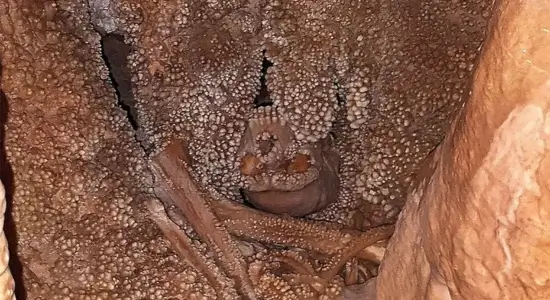 The ‘popcorn’ texture is the most straightforward aspect to explain. Image credit: Riga et al, PLOS ONE 2020 (CC BY 4.0)
An Accidental Discovery in the Dark
On October 3, 1993, speleologists mapping the unexplored Lamalunga karst system near the city of Altamura in Puglia found something their flashlights weren’t prepared for: a human skull, inverted and hollow-eyed, staring out from a wall of mineral deposits at the end of the tunnel. What they’d found wasn’t a body lying on a cave floor. It was a skeleton fused directly into the rock itself.
Over tens of thousands of years, water rich in dissolved calcite had dripped continuously over the remains, slowly building up layers of calcium carbonate on every exposed surface. The result is a texture cave scientists call “cave popcorn,” small, knobby mineral nodules that coat the entire skeleton and make it look less like a fossil and more like something the cave itself grew.
A Body Too Fragile to Move
For over two decades after the discovery, researchers couldn’t safely extract the remains at all. Any attempt to chip the skeleton free from its calcite shell risked destroying it completely, so scientists were limited to studying the body through on-site observation and photographs, without ever touching it directly.
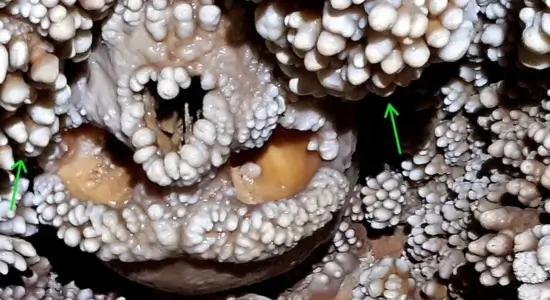 The popcorn-like morphology is the simplest feature to interpret. Image credit: Riga et al, PLOS ONE 2020 (CC BY 4.0)
That changed in 2015, when a research team finally managed to extract a small fragment of the man’s right shoulder blade. Uranium-thorium dating of the surrounding calcite placed his death between roughly 130,000 and 172,000 years ago, and genetic and morphological analysis confirmed he wasn’t a modern human, as some had speculated, but a Neanderthal. The sample also turned out to hold the oldest Neanderthal DNA ever recovered up to that point, a discovery published in the Journal of Human Evolution.
Why the “Ugly” Crust Was the Whole Point
Archaeologists generally prefer clean bone, since mineral crusts usually complicate analysis rather than help it. The Altamura skeleton flips that assumption. The same calcite buildup that makes the fossil look almost monstrous also sealed it off from oxygen and bacteria for well over 100,000 years, preserving genetic material that would have degraded completely in an open-air burial. Most Neanderthal remains from this period exist only as scattered fragments, a jaw here, a few finger bones there. Because this man fell into an isolated pocket of the cave and was never dragged off by scavengers, his skeleton remains essentially complete and still articulated, an extraordinarily rare condition for a fossil this old.
Fun Fact
A 2020 study examining the man’s teeth found that he’d lost one molar just a few weeks before he died, based on how the surrounding teeth had already started shifting to fill the gap. Whatever his final weeks looked like, they weren’t easy even before the fall that killed him.
The specimen’s exceptional preservation has kept producing new science well beyond the initial DNA breakthrough. Researchers studying his remarkably intact nasal cavity in recent years expected to confirm a long-standing theory that Neanderthals had special internal nose structures for surviving cold climates. Instead, they found his nasal cavity closely resembles that of modern humans, effectively ruling out that specific adaptation as a defining Neanderthal trait and showing that Neanderthal cold tolerance worked through a different mechanism than scientists had assumed.
Altamura Man vs. Ötzi the Iceman
The two most famous “accidental mummies” in European archaeology were preserved by almost opposite processes. Ötzi, discovered frozen in the Alps, was preserved through cold: his soft tissue survived well enough that scientists could examine his tattoos, stomach contents, and even his last meal. The Altamura man was preserved through mineralization instead, essentially becoming a stone mummy where the rock itself holds the record of his body, but with none of the soft tissue Ötzi offered.
Riga, A. et al. (2020) — PLOS ONE, Dental Wear Analysis of the Altamura Neanderthal
IFLScience — Neanderthal “Altamura Man” Suffered an Unfortunate Death and Became Embedded in a Cave Wall
Phys.org — Altamura Man Yields Oldest Neanderthal DNA Sample
How old is the Altamura Man fossil
Uranium-thorium dating of calcite surrounding the skeleton places his death between roughly 128,000 and 187,000 years ago, with the most precise estimate ranging from 130,100 to 172,000 years, making him one of the oldest Neanderthal specimens ever directly dated.
Why is the Altamura skeleton covered in rock-like nodules
The nodules, known as cave popcorn, formed as mineral-rich water dripped over the remains for tens of thousands of years, depositing layer after layer of calcium carbonate. The crust encased the entire skeleton and is what makes it appear fused into the cave wall.
How did scientists confirm the Altamura Man was a Neanderthal
In 2015, researchers extracted a small fragment of the fossil’s shoulder blade, allowing genetic and morphological analysis that confirmed Neanderthal identity. The sample also yielded the oldest Neanderthal DNA recovered at the time.
Has the entire skeleton been removed from the cave
No. Because disturbing the calcite-encased remains risks irreparable damage, only a small bone fragment has ever been extracted. The rest of the skeleton remains in place inside the Lamalunga cave system, studied primarily through on-site observation and imaging.