
It’s the spring of 1944, and the Battle of Monte Cassino is raging in Italy. It stands out as one of the bloodiest, most exhausting conflicts of World War II. Artillery shells are screaming overhead, and exhausted soldiers are desperately hauling 100-pound crates of ammunition up a jagged, unforgiving mountainside. Amidst the chaos and deafening noise of the Polish II Corps, a massive figure suddenly stands up on its hind legs, calmly picks up a heavy crate of live artillery shells, and casually walks it over to the frontline guns. It wasn’t some experimental supersoldier or a secret military robot. It was a 500-pound Syrian brown bear.
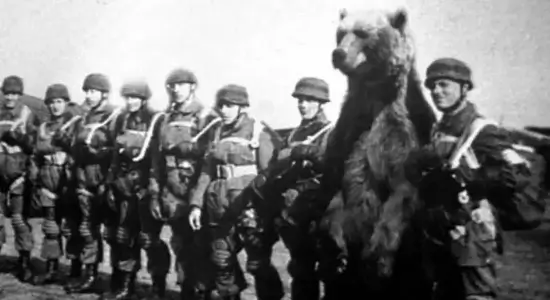
While this sounds like a ridiculous cartoon pitch, it is a highly documented historical fact. Wojtek (pronounced VOY-tek) wasn’t just a mascot or a regiment pet. He was an officially enlisted combat soldier, complete with a rank, a serial number, and a standard-issue military paybook. But how exactly does a massive apex predator end up fighting fascists in Europe? The answer comes down to a group of desperate refugees, incredibly strict British military regulations, and the fascinating biology of bear socialization.
From Orphaned Cub to Artillery Trainee
To figure out how this happened, you have to look at animal psychology. In 1942, a group of Polish soldiers who had just been evacuated from Soviet labor camps were traveling through the mountains of Iran. Along the way, they bought a severely malnourished, orphaned bear cub from a local boy. Because they raised him from infancy, Wojtek completely bypassed normal wild bear development. Instead, he experienced a biological phenomenon known as imprinting.
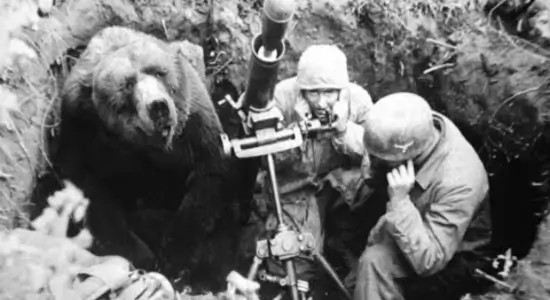
Bears are highly intelligent and social creatures. Because Wojtek grew up surrounded by human men in a military camp, his brain essentially wired itself to believe he was just another one of the guys. He learned to salute when officers walked by, loved to wrestle with his fellow soldiers, and famously developed a taste for drinking beer and eating cigarettes. He became the ultimate morale booster for the unit, but his role as a Polish army bear in WWII was about to get a lot more official.
Bypassing British Bureaucracy with Wojtek the Bear
By 1944, the Polish II Corps was assigned to sail from Egypt to Italy to fight alongside the British Eighth Army. But they immediately hit a massive bureaucratic brick wall. The British transport ships had incredibly strict regulations: absolutely no pets or mascot animals were allowed on military vessels. If Wojtek stayed behind, he would likely die, since he had absolutely no idea how to survive in the wild.
To get their massive best friend across the Mediterranean, the Polish troops used a brilliantly hilarious legal loophole. If pets weren’t allowed on board, they simply wouldn’t bring a pet. Instead, the regiment formally drafted him into the military. They submitted the official paperwork, and the bear was given the rank of Private in the 22nd Artillery Supply Company. Because he was now a legitimate soldier with a serial number and a paybook, the British commanders had no choice but to let him walk right onto the ship.
The Biomechanics of a 500-Pound Ammo Carrier
Wojtek’s real test came at the Battle of Monte Cassino. The terrain was brutal—steep, rocky, and completely impossible for supply trucks to navigate. Human soldiers were exhausting themselves trying to manually carry heavy artillery shells up the mountain under heavy fire. Wojtek watched his friends struggling, casually walked over to a supply truck, stood up on his hind legs, and held out his front paws.
A Syrian brown bear naturally possesses immense upper body strength and a low center of gravity. This makes carrying heavy, awkward loads relatively easy for them, even when walking on two legs. Wojtek easily grabbed 100-pound boxes packed with live artillery shells—boxes that normally required two grown men to lift—and carried them directly to the active gun emplacements. He did this for days under deafening mortar fire without dropping a single explosive, essentially functioning as a biological forklift. His efficiency was so legendary that the 22nd Company officially changed its emblem to a bear carrying a massive artillery shell.
Conclusion
After the war finally ended, Wojtek’s unit was demobilized in Scotland. Since he couldn’t return to the wild, he was given a permanent home at the Edinburgh Zoo. For years, his old army buddies would visit him. Some of them would even jump the fence into his enclosure to wrestle with him, much to the absolute horror of the zookeepers. Wojtek’s legacy as a Polish army bear in WWII is more than just a funny historical footnote. It’s an amazing look at animal cognition and a great reminder that even in the middle of humanity’s most destructive conflict, a displaced group of soldiers and an orphaned bear managed to find a weird, beautiful family in each other.
The Rabbit Hole Goes Deeper…
If a 500-pound bear carrying live artillery shells sounds like the weirdest military history fact you’ve ever heard, the battlefield has plenty of other absurd stories waiting for you.
Think Wojtek was the only time animals got involved in a major military operation? Check out what happens when the animals are actually the enemy in The bizarre reason the military lost the Great Emu War.
Or, if you want another unbelievable WWII story, discover how the Allies used Hollywood special effects and inflatable rubber tanks to completely fool the Nazis in how a bunch of artists built the Ghost Army to prank the Third Reich.
Keep exploring the Weird History archives on FactFun… because truth is always stranger than fiction, especially during wartime.
References:
TIME Magazine — The Bear Who Became a World War II Hero
BBC News — The Bear Who Fought in WWII
National Geographic — Wojtek the Bear: The Unlikely Hero of Monte Cassino