
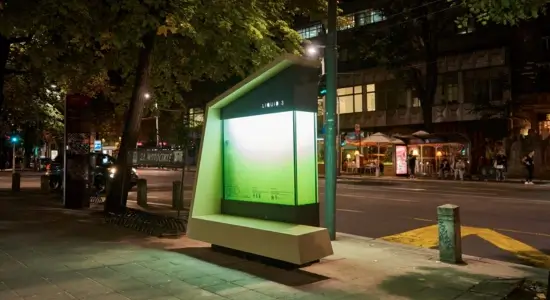
If you take a walk down the concrete sidewalks of Belgrade, Serbia, you might stumble upon something that looks like it was ripped straight off a sci-fi movie set. Wedged between bus stops and gray buildings are massive, glowing green tanks filled with a bubbling, neon-colored sludge. At first glance, it looks like a hazardous waste container or a weird modern art installation. But this glowing green box is actually a highly efficient, living machine fighting one of humanity’s quietest killers: severe urban air pollution.

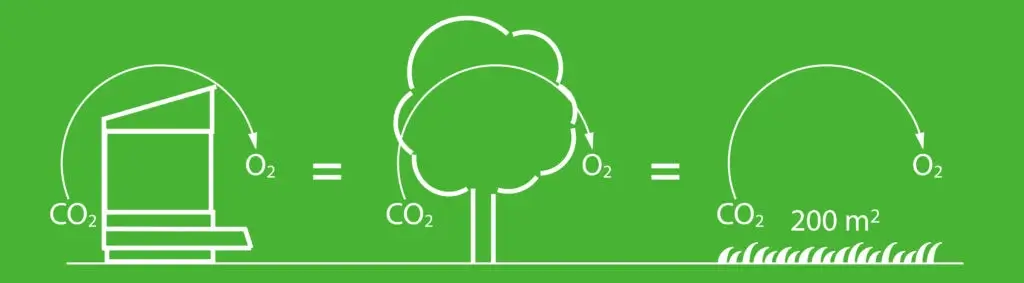
These bizarre structures are officially called LIQUID3 photobioreactors, though locals have simply dubbed them “liquid trees.” While they might lack the romantic, leafy charm of a towering oak, these tanks pack a massive biological punch. A single unit holds about 600 liters of water and microalgae, pulling the exact same amount of carbon dioxide out of the air as two 10-year-old trees or a 200-square-meter lawn. They are rapidly becoming the ultimate hack for cities that are literally choking on exhaust fumes.
The Biological Engine Inside Liquid Trees
To figure out how a box of green soup can outperform a forest canopy, you have to look at the biology of microalgae. These single-celled organisms are the original terraformers of our planet. When a traditional tree grows, it has to spend a massive amount of its gathered energy building structural support—wood, bark, deep root systems, and complex branches. Microalgae, on the other hand, do not care about building a trunk. They dedicate 100 percent of their energy to eating carbon dioxide, performing photosynthesis, and multiplying.
Because they are suspended in water, the algae have constant, uniform access to light and nutrients. As city smog is pumped into the tank, the algae eagerly devour the carbon and pump out pure oxygen. This hyper-efficient biological design is exactly why urban algae air purifiers are capable of doing heavy environmental lifting in a fraction of the space. It is essentially photosynthesis running on high-speed internet.
Surviving the Concrete Jungle
You might be asking the obvious question: why go through the trouble of building a cybernetic tank when you could just plant a normal seed? The problem boils down to urban geometry and extreme pollution. In densely packed cities, there simply isn’t enough exposed dirt to plant a meaningful number of saplings. Even if you rip up the sidewalk, a tree’s roots will eventually destroy underground water pipes, fiber optic cables, and foundation walls.
Beyond the lack of space, trees are actually highly sensitive. If you plant a young oak next to a heavily trafficked intersection, the intense concentration of exhaust fumes, heavy metals, and particulate matter will often poison and kill it before it reaches maturity. Microalgae are entirely different. They actually thrive in heavily polluted environments. The thicker the carbon dioxide, the faster these urban algae air purifiers eat, multiply, and spit out fresh oxygen.
Maintaining a Living Cyber-Plant
The design of these bioreactors is surprisingly self-sustaining. The top of the tank is fitted with a solar panel, which powers a small internal pump. This pump constantly draws in polluted city air and bubbles it through the green water, ensuring the algae get a steady diet of toxic smog.
Of course, because the algae are constantly eating and dividing, the tank eventually gets too crowded. About once a month, city maintenance workers simply drain out a large portion of the biological sludge, replace it with fresh water and essential minerals, and let the cycle continue. That harvested green sludge doesn’t go to waste, either. It is incredibly rich in nutrients and gets repurposed as a premium, organic fertilizer for the city’s regular parks and gardens.
Conclusion
The scientists who developed these bioreactors are quick to point out that their invention is not an excuse to chop down natural forests. A glass box of algae will never provide shade, host a bird’s nest, or replace the psychological benefits of walking through a real park. However, for the hyper-dense, heavily polluted corners of our modern world where a real tree would simply die, liquid trees offer a brilliant biological band-aid. They prove that sometimes, the best way to clean up the future is to rely on one of the oldest, slimiest organisms on Earth.
The Rabbit Hole Goes Deeper…
If you think that is the wildest leap in modern medicine, the world of bioengineering has plenty of other sci-fi realities happening right now.
What if the ultimate cure for a deadly, antibiotic-resistant superbug is actually a capsule filled with another human being’s waste? Uncover the stomach-churning but miraculous reality behind the life-saving fecal microbiota transplant.
Did you know doctors can now safely extract swallowed batteries from a patient’s stomach using a tiny, magnetic device made from dried pig intestine? Discover the brilliant mechanics behind the swallowable origami robot surgeon.
Why wait on a massive global list for a donor match when doctors could eventually just print a brand new heart? Explore the astonishing science behind 3D bioprinting human organs on demand.
References:
World Economic Forum — These ‘liquid trees’ are cleaning the air in Serbia
Euronews — Scientists in Serbia have created a ‘liquid tree’ to clean the air
Smithsonian Magazine — Can ‘Liquid Trees’ Improve City Air Quality?