
When you picture a robot, your brain automatically jumps to metallic joints, whirring gears, silicon chips, and heavy battery packs. Now, throw all of that out the window. What if a robot didn’t look like a shiny mechanical rover, but instead looked like a tiny, fleshy blob of biological tissue that can swim, push payloads, and heal its own wounds? It sounds like a premise ripped straight from a bizarre sci-fi thriller, but it emerged from active laboratories starting in 2020.
In January 2020, a team of biologists and computer scientists from Tufts University, the University of Vermont, and Harvard’s Wyss Institute for Biologically Inspired Engineering completely blurred the line between organism and machine. By scraping skin and heart stem cells from embryos of the African clawed frog, Xenopus laevis, they built something entirely new. It is not a traditional robot, nor is it a naturally occurring species. It is a programmable, biological machine designed with the help of artificial intelligence, named a Xenobot after the frog species that donated its cells.
Designing Xenobots Inside a Supercomputer
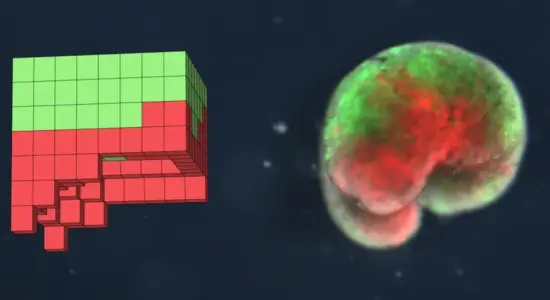
Before the scientists even picked up a petri dish, computer scientist Josh Bongard’s team at the University of Vermont used an evolutionary algorithm running on a supercomputer to test thousands of random body designs for these new biological machines. The AI simulated how different configurations of skin and heart cells would behave in a watery environment. The basic building blocks were simple: skin cells act as a rigid structural frame, while heart muscle cells, which naturally expand and contract on their own, act as microscopic motors.
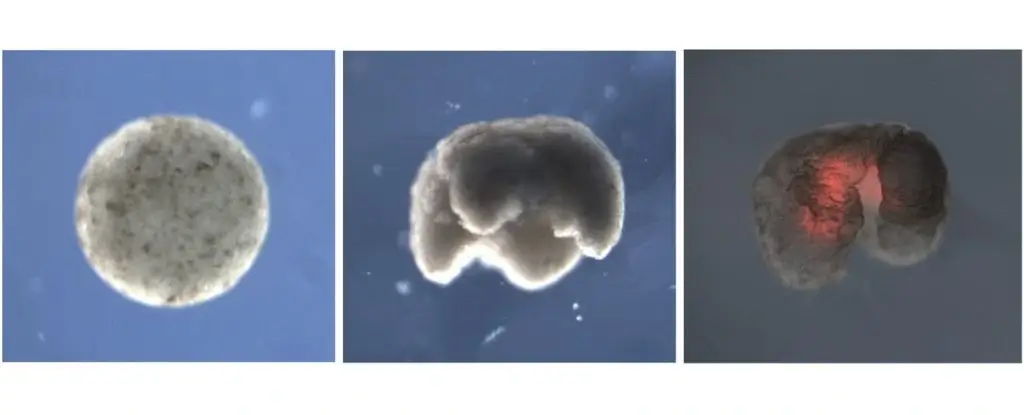
The computer mercilessly tested these 3D designs, keeping the ones that successfully moved forward and discarding the failures. Eventually, it produced a final blueprint suited for movement and payload-carrying. Only then did the human biologists, led by Tufts developmental biologist Michael Levin and researcher Douglas Blackiston, take over. Using microscopic forceps and a tiny cauterizing electrode, they carefully sculpted actual frog stem cells to match the AI’s design, successfully creating the first generation of living robots made from frog cells.
The Mechanical Biology of Swimming Blobs
Unlike a remote-controlled drone, these biological machines do not need an external power source, a motherboard, or a control chip. They run entirely on the natural energy stored within the embryonic cells themselves. This biological fuel supply is enough to keep them alive and active for about one to two weeks in a simple dish of water, without any additional food.
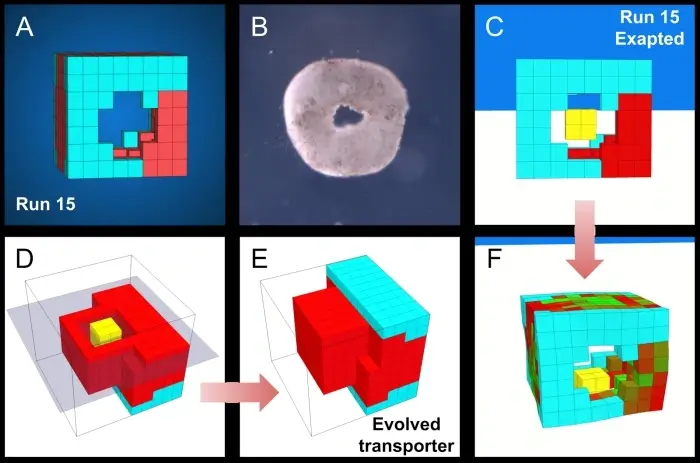
Because their “engines” are made of pulsating heart muscle tissue, they naturally beat and contract on their own. By shaping the blob in highly specific ways, the scientists channeled those otherwise random contractions into coordinated, forward movement. They can swim in circles, push microscopic objects like drug payloads into designated piles, and even move in loose, coordinated groups alongside other Xenobots. The scientists essentially harnessed the raw mechanical power of biology to perform physical tasks at a microscopic scale.
A Machine That Fixes Itself
Perhaps the most striking advantage of these living robots is their sheer resilience. If you crack a mechanical drone, it stays broken until a human manually replaces the hardware. Biology, by contrast, has spent billions of years perfecting the art of survival and cellular repair.
When researchers sliced one of these tiny biological machines almost entirely in half to see what would happen, the blob didn’t die or permanently break down. Instead, the surrounding cells immediately began pulling themselves back together, closing the wound and returning to their normal swimming routine shortly afterward. It’s a level of self-repair no household robot vacuum could ever manage after being hit with a hammer.
Fun Fact
In 2021, the same research team discovered something even stranger: Xenobots can reproduce. Using a form of movement scientists call kinematic self-replication, Xenobots swim through their dish, gather loose stem cells into piles using their curved, Pac-Man-like shape, and mold those piles into brand-new “baby” Xenobots that grow up to look and move just like the originals. It’s a form of reproduction never before observed in any plant or animal at the level of whole cells or organisms, and it typically takes about five days under ideal conditions for a new copy to fully form.
Conclusion
Right now, most Xenobots are less than a millimeter wide and relatively simple in their functions. But the implications for the future are genuinely striking. Researchers have floated the idea of deploying custom-built biological machines into the ocean to hunt down and break apart microplastics, or introducing them into human arteries to safely scrape away dangerous plaque and deliver targeted cancer drugs directly to a tumor. Once their mission is complete, they simply degrade back into harmless, inert cellular material, leaving no lasting pollution behind. They force a rethink of the boundary between biology and technology, suggesting that living tissue itself might become one of engineering’s most versatile raw materials.
Tufts Now — Living Machines Are Created in the Lab
NPR — Living Robots Made in a Lab Have Found a New Way to Self-Replicate
Kriegman, S. et al. (2021) — Kinematic Self-Replication in Reconfigurable Organisms, Proceedings of the National Academy of Sciences
CNN — Scientists Have Built the World’s First Living, Self-Healing Robots
Are Xenobots actually alive
The cells themselves are living frog cells, so in that sense yes, but Xenobots are not a naturally occurring species and don’t reproduce, grow, or evolve the way typical organisms do. Researchers describe them as an entirely new class of artifact: a living, programmable organism rather than a traditional animal or robot.
How long do Xenobots survive
They typically survive for about one to two weeks in a simple water-based environment, running entirely on the energy already stored in their embryonic cells, without needing any external food source or power supply.
Can Xenobots actually reproduce
Yes, in a very unusual way. In 2021, researchers discovered Xenobots can gather loose stem cells and mold them into new Xenobots through a process called kinematic self-replication, a form of reproduction never previously observed in any whole organism.
What are Xenobots actually being developed for
Proposed future applications include cleaning microplastics from oceans, delivering drugs to targeted locations inside the human body, scraping plaque out of arteries, and other precision medical or environmental tasks, since they can be programmed to degrade harmlessly once their job is finished.