
Imagine sinking 4,000 meters into the pitch-black abyss of the Pacific Ocean. The water pressure here is strong enough to crush a car into a cube, and the temperature hovers just above freezing. For decades, biologists exploring this midnight zone faced a massive problem: without sunlight or familiar landmarks, everything on a camera monitor looks exactly the same size. A giant, meter-long sea cucumber and a tiny, thumb-sized sea slug appear identical on a flat screen. To solve this optical illusion, marine biologists started equipping their deep-diving Remotely Operated Vehicles (ROVs) with high-powered parallel lasers. It sounds like a setup for a sci-fi action movie, but these deep-sea lasers are actually precision scientific rulers that have totally changed how we document the unknown.
The grueling work of piloting these robots through the dark has been perfectly described by researchers as “interesting, challenging, and all-involving.” In a sweeping biological survey of the Clarion-Clipperton Zone—a massive abyssal plain stretching between Hawaii and Mexico—scientists from the Natural History Museum in London used this exact technology to pull off a biological miracle. By casting bright laser grids across the muddy seafloor, they successfully executed a massive deep sea expedition discovering new species, formally documenting 31 completely unknown alien-like creatures. It is a stunning victory for taxonomy that forces us to look at the bottom of the ocean not as a barren wasteland, but as a thriving, fragile ecosystem.
Why an Ocean Expedition That Used Lasers Changes Everything
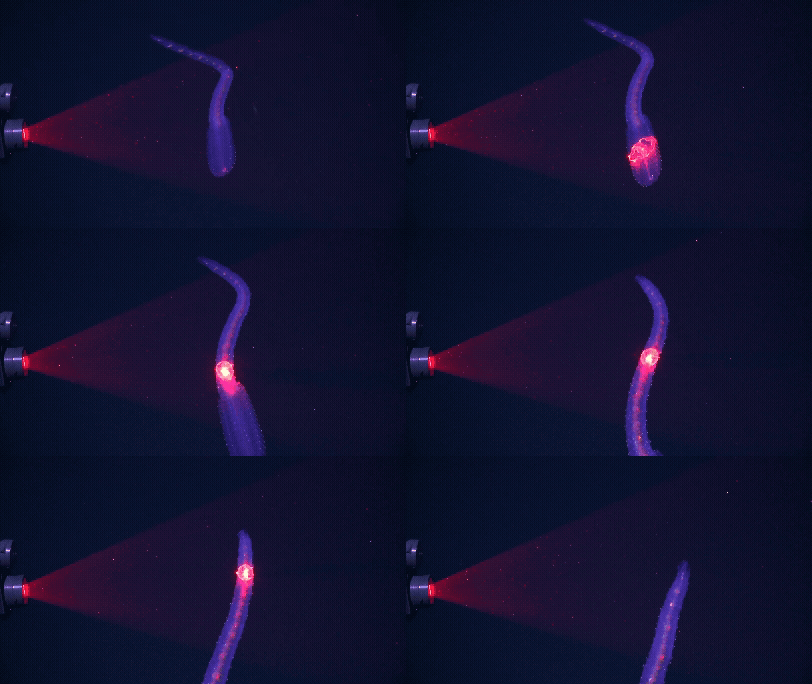
To understand why this method works so well, you have to look at the mechanics of underwater exploration. When an ROV films the deep ocean, the darkness absorbs standard lighting, instantly destroying any sense of depth perception or scale. To fix this, engineers mounted two bright red or green lasers on the front of the submarine, perfectly calibrated to project dots exactly 10 centimeters apart directly onto the seafloor.

Whenever a strange creature crawls into the camera’s view, the pilot simply aims the vehicle so the two laser dots shine directly next to or onto the animal. This creates an unbreakable geometric baseline. Using these lasers, biologists can accurately measure the size, width, and biological proportions of a creature without ever having to capture it or bring it to the surface. This deep sea expedition discovering new species heavily relied on this non-invasive laser-scaling to officially classify dozens of new invertebrates, saving the animals from the fatal pressure changes of being hauled up to a laboratory.
The Bizarre Reality of the 31 New Species
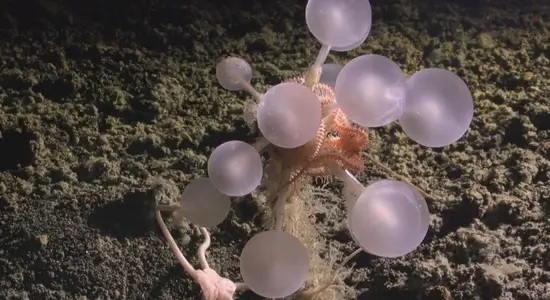
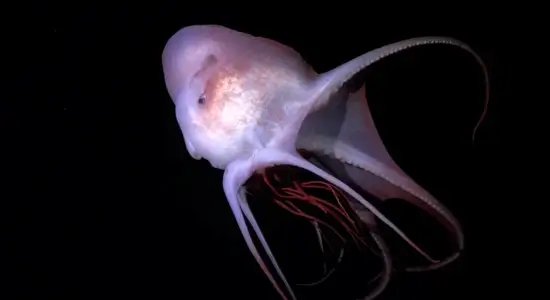
The creatures illuminated by these lasers are spectacular evolutionary oddities. Because food is incredibly scarce 4,000 meters down, the animals here have adapted to run on ultra-low energy. The research team documented a weird and wonderful menagerie of life, including ancient glass sponges that use silica to build structural skeletons, strange deep-sea starfish, and an animal affectionately known as the “gummy squirrel”—a brightly colored sea cucumber with a massive tail that it uses to slowly sail across the ocean currents.
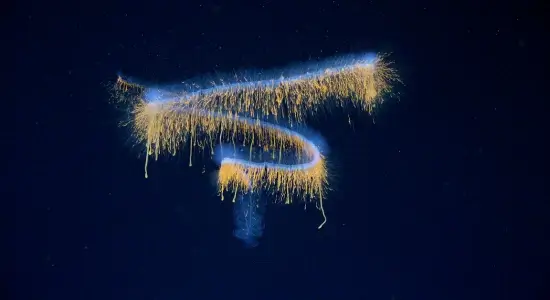
Many of these animals are deposit feeders. They spend decades slowly sifting through the soft mud to extract the microscopic rain of dead organic matter that falls from the ocean surface. In this freezing, slow-motion environment, a single sponge might live for centuries, making the ecosystem incredibly stable, but also terrifyingly vulnerable.
A Fragile Ecosystem in the Crosshairs
The scientific race to document this area isn’t just driven by pure curiosity; it is a desperate sprint against industrialization. The Clarion-Clipperton Zone is littered with polymetallic nodules, which are potato-sized rocks heavily concentrated with cobalt, nickel, and copper. These rare metals are highly sought after by mining companies to build electric car batteries and modern electronics.
If deep-sea mining machines are deployed to bulldoze the ocean floor to harvest these rocks, the resulting sediment plumes and physical destruction could instantly wipe out these ancient, slow-growing ecosystems. The discovery of these 31 new species serves as a massive biological warning flag. It provides hard, scientific proof that the abyssal plains are completely covered in unique lifeforms that exist nowhere else on the planet.
Conclusion
The reality of deep-sea exploration is that we still know more about the surface of the moon than we do about the bottom of our own oceans. By strapping lasers to robots and sending them into the abyss, marine biologists are slowly piecing together the biological puzzle of the deep. These 31 new species are a beautiful reminder that Earth’s final frontier is still full of wildly adapted, bizarre creatures that desperately need our protection before they are wiped out by the push for technological progress.
Dive Deeper into More Deep-Sea Oddities…
If discovering 31 new alien-like species in the abyss blew your mind, the ocean floor is hiding even more ridiculous creatures waiting in the dark.
- Did you know there is a strange, floating marine creature that bears an uncanny and hilarious resemblance to a farm animal’s rear end? Discover the bizarre reality behind the pigbutt worm.
- What happens when a translucent, deep-sea cucumber decides to show off some moves in the midnight zone? Find out why researchers were completely stunned to film a dancing sea pig 2,300 meters below the Pacific.
References
Natural History Museum — Deep-sea study reveals diverse new species in the Clarion-Clipperton Zone
Frontiers in Marine Science — Megafauna of the abyssal plains: laser-scaling and ROV imaging
Smithsonian Magazine — How Deep-Sea Lasers Are Illuminating the Ocean’s Darkest Corners