
Imagine the ultimate lone predator. For decades, biology textbooks have painted tigers as the quintessential introverts of the animal kingdom. Unlike lions, who rely on the chaotic, highly social structure of a pride to raise their young, a wild tiger is a solitary machine. A mother tiger defends her sprawling territory fiercely, rearing her cubs entirely alone while aggressively driving away any adult intruders. That is the ironclad rule of the jungle—until a hidden camera trap completely shattered it.
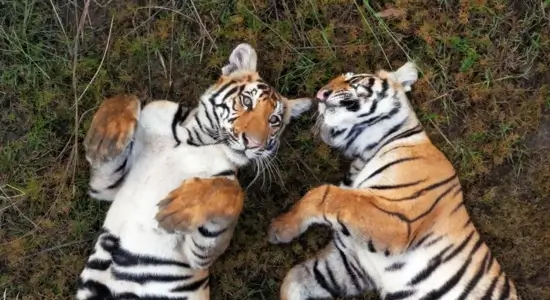
When field researchers checking remote footage deep within the tiger reserves of India spotted a completely unexpected interaction in early 2024, they were stunned. The footage revealed a mature adult tiger casually hanging out with and watching over a litter of cubs that definitively belonged to another female. This wasn’t a territorial dispute or a violent encounter; it was a peaceful, coordinated daycare session. This unprecedented discovery forces biologists to completely rethink the rigid social boundaries of the world’s largest cat, exposing a hidden layer of feline empathy that science is only just beginning to understand.
Breaking the Solitary Rule: A Tiger Caught On Film Babysitting
To understand why this is so mind-bending, you have to look at the mechanical reality of tiger survival. In places like Ranthambore National Park in Rajasthan, India, a tiger’s territory is its absolute lifeblood. Resources are incredibly scarce, and competition is lethal. Usually, if an adult tiger encounters another’s cubs, the interaction ends in tragedy, as eliminating rival genetics is a standard survival strategy for apex predators.
Yet, the camera trap data tells a completely different story, capturing this rare wild tiger alloparenting behavior in crystal-clear definition. Alloparenting—the scientific term for an animal providing care to non-descendant young—is incredibly common in highly social mammals like elephants, wolves, and meerkats. But seeing it in a strictly solitary killer is like finding a great white shark voluntarily sharing a meal. It provides hard, undeniable proof that tigers are capable of complex social networking previously thought impossible.
The Mechanics of Inclusive Fitness
So, why would a 300-pound solitary predator suddenly moonlight as a nanny? Evolutionary biologists, building on theories first proposed by scientists like W.D. Hamilton, point to a brilliant genetic strategy called “inclusive fitness” or kin selection. While tigers live alone, their territories often heavily overlap with their own blood relatives. A female’s neighboring territory might belong to her sister, her mother, or her grown daughter.
If the babysitting tiger shares a significant amount of DNA with the cubs’ mother, keeping those specific cubs alive is a massive genetic victory. By protecting her sister’s or daughter’s offspring from rival males or leopards while the mother is away hunting, the babysitter is actively ensuring her own extended family line survives. This rare wild tiger alloparenting behavior isn’t just a random act of kindness; it is a highly calculated evolutionary investment.
A Changing Perspective on Feline Intelligence
This discovery fundamentally shifts how conservationists and wildlife biologists view the spatial dynamics of big cats. It strongly suggests that solitary animals actually maintain an invisible, scent-based social network across the forest. They know exactly who their neighbors are, using familiar pheromones and vocalizations to perfectly distinguish between a dangerous, invading stranger and a trusted family member.
When a mother tiger leaves for a grueling, multi-day hunt, she leaves her cubs completely vulnerable. Having a genetically linked “aunt” nearby to keep a watchful eye could easily be the difference between life and death for the next generation, proving that family bonds matter even for the most isolated creatures on Earth.
Conclusion
The reality of a solitary predator stepping up to care for another’s young proves how brilliantly complex nature can be. Tigers are not just mindless, isolated hunting machines; they are intelligent, calculating survivors capable of deep social tolerance when it benefits their bloodline. As camera trap technology continues to improve, casting a wider, unblinking net across the world’s last remaining wild spaces, it is almost guaranteed that these magnificent cats will continue to rewrite the rules of their own biology.
References
National Geographic — The Hidden Social Lives of Solitary Big Cats
Journal of Zoology — Kin Selection and Alloparenting in Wild Felids
IFLScience — Tiger Caught On Film Babysitting Another Mother’s Cubs In The Wild For The First Time