
Picture a desolate, freezing, radiation-blasted desert. Now, rewind the clock 3.5 billion years. This same region—Mars’ 28-mile-wide Jezero Crater—was once a massive, rippling lake fed by a sprawling river delta. For decades, astrobiologists have theorized that if ancient microbial life ever existed on the Red Planet, this dried-up mudbath is exactly where their fossilized remains would be hiding. That’s precisely why NASA landed the car-sized Perseverance rover there in February 2021, tasking it with drilling into the ancient sediment to hunt for chemical ghosts.
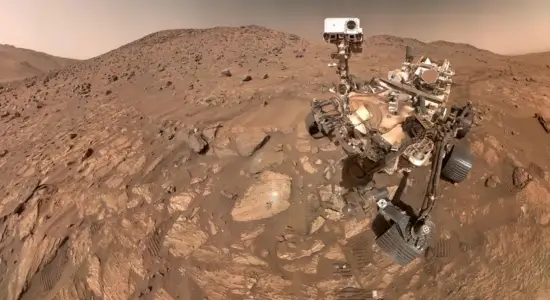
On July 21, 2024, as the rover navigated a dried river channel called Neretva Vallis, it drilled into a strange, arrowhead-shaped rock nicknamed “Cheyava Falls.” What it found inside completely electrified the scientific community. Using its onboard instruments, Perseverance registered the highest concentration of organic molecules it had ever seen. But finding carbon-based molecules doesn’t automatically mean we’ve found aliens. It’s like walking into a kitchen and finding flour, sugar, and eggs on the counter; the raw ingredients are sitting right there, but scientists still have to prove that biology actually baked the cake.
The Mechanics of Organic Detection At Mars’ Jezero Crater
To understand how a robot detects invisible chemicals millions of miles away, you have to look at Perseverance’s mechanical “eyes.” The rover is equipped with a brilliant piece of technology called SHERLOC (Scanning Habitable Environments with Raman & Luminescence for Organics & Chemicals). Mounted on the end of the rover’s robotic arm, SHERLOC uses an ultraviolet laser to map the microscopic surface of a rock.
When this UV laser hits different chemical compounds, they glow, or fluoresce, in specific colors and wavelengths. By analyzing this glow, scientists back on Earth can instantly identify the chemical makeup of the rock. When SHERLOC blasted the Cheyava Falls sample, it lit up with the unmistakable signatures of organic molecules. Organics are complex compounds built primarily from carbon, hydrogen, and oxygen. On Earth, these are the fundamental building blocks of all living things.
“Leopard Spots” and a Potential Martian Biosignature
What makes the Cheyava Falls sample so exciting isn’t just the presence of organics—it’s what those organics are physically attached to. When the rover scraped away the top layer of the rock, it revealed dozens of tiny, millimeter-sized white splotches surrounded by black rings, making the surface look like it was covered in leopard spots.
According to NASA’s Perseverance Project Scientist, Ken Farley of Caltech, these specific black rings contain iron and phosphate. On Earth, these exact types of “leopard spots” are formed when chemical reactions in the rock release iron, providing a direct energy source that microbes can feed on. Finding a highly robust organic detection on Mars physically locked inside the exact same geological structures that feed bacteria on Earth is considered a potential biosignature. It is the closest we have ever come to finding the fossilized footprint of extraterrestrial life.
Why Ingredients Don’t Always Equal Life
Despite the massive excitement, scientists are incredibly cautious. The biggest hurdle in astrobiology is that biology isn’t the only thing that can create organic molecules. Purely geological processes can play the same chemical tricks. For example, when water interacts with certain types of volcanic rock in a process called serpentinization, it can naturally produce organic compounds without a single microbe involved. Meteorites raining down from space are also known to carry heavy loads of raw carbon.
To definitively prove whether this robust organic detection on Mars is the result of ancient alien microbes or just a lifeless geological chemical reaction, we need stronger microscopes than a rover can carry. The ultimate goal is the Mars Sample Return mission, a highly ambitious, multi-agency operation designed to launch these exact rock cores back to Earth in the 2030s.
Conclusion
The discovery at Cheyava Falls is exactly what the Perseverance rover was built to do. We finally have a rock that contains the chemical ingredients of life, a potential energy source for ancient microbes, and a watery history all bundled into one sample. While we can’t definitively say we’ve found life on Mars just yet, we have successfully zeroed in on the most promising piece of real estate in the solar system. The geological breadcrumbs have been found; now we just have to bring them home to solve the mystery.
Dive Deeper into More Martian Mysteries…
If the organic discoveries inside Jezero Crater blew your mind, the Red Planet has plenty of other mind-bending secrets hiding in its rusty dust.
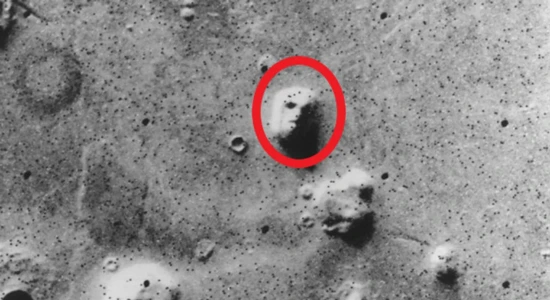
- Did you know that a massive, eerie “human countenance” photographed on the Martian surface in 1976 wasn’t an alien monument at all? Uncover the mind-boggling science behind the Face on Mars optical illusion.
- What about the time another robotic explorer stumbled upon a completely different carbon goldmine? Explore how the Curiosity rover discovered organic molecules that completely shattered previous scientific records.
References
NASA Jet Propulsion Laboratory — NASA’s Perseverance Rover Finds Possible Biosignature on Mars Smithsonian Magazine — Perseverance Rover Discovers Rock With Potential Signs of Ancient Martian Life Nature — Mars rover detects carbon signature that hints at past life source