
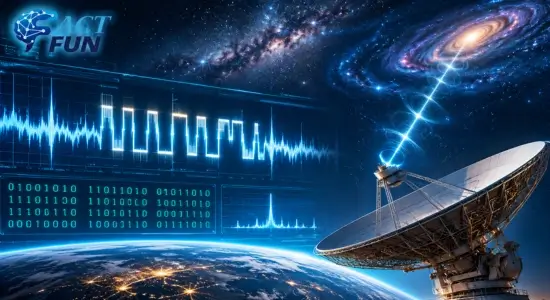
In the early hours of March 14, 2026, the control room at the Green Bank Observatory in West Virginia was dead quiet. The massive 100-meter radio telescope, a colossal dish parked right in the middle of the National Radio Quiet Zone, had been pointing toward the constellation Vela, staring straight into the dusty center of the Milky Way. Researchers working with the Breakthrough Listen initiative were hunting for fast radio bursts (FRBs)—brief, chaotic flashes of cosmic energy that usually last just a few milliseconds. Instead, they caught something that practically made them drop their coffee: a highly structured, continuous radio emission that lasted a staggering 54 minutes.
Unlike the messy, static-filled noise typically blasted out by exploding stars or feeding black holes, this signal was unnervingly clean. It pulsed in a precise, repeating three-part cycle: bright flashes, weak flashes, and absolute silence. Decades after the famous 1977 Wow! signal—a legendary 72-second spike that vanished forever—humanity has suddenly been handed a brand new cosmic mystery. The sheer length and strange rhythm of this new detection have astronomers completely baffled, and it might just force us to rewrite the textbooks on neutron stars.
The Anatomy of The 2026 “Wow!” Signal 2.0
To understand why this detection is so mind-bending, think about how radio astronomers actually tune into the universe. Imagine driving down an empty highway, slowly turning the dial on an old car radio. Almost everywhere on the dial, you just hit dead static—the cosmic equivalent of background radiation and distant supernovas. But every once in a while, you lock onto a crystal-clear station.
That is exactly what happened here. Astronomers detected this unexplained radio pattern from deep space using a combination of the Green Bank Telescope and the Murchison Widefield Array (MWA) in Western Australia. The signal is highly polarized, meaning the radio waves are all twisting in a synchronized direction as they travel through space. In astrophysics, this level of polarization usually points to the presence of an unimaginably strong magnetic field. However, the exact timing of the emission—a nearly hour-long loop of activity followed by silence—defies the known mechanics of any standard celestial object.
Pulsars, Magnetars, or Something Else?
Naturally, the usual suspect in any deep-space radio mystery is a neutron star. When massive stars die in a fiery supernova, their cores collapse into ultra-dense spheres roughly the size of a small city. These bizarre objects spin wildly, shooting intense beams of radiation out of their poles. If Earth happens to sit directly in the path of that sweeping beam, we see it as a “pulsar”—flashing exactly like a cosmic lighthouse. Throw in a magnetic field trillions of times stronger than our own, and you get a magnetar, an even rarer beast.
But there is a glaring mechanical problem with blaming a magnetar for this unexplained radio pattern from deep space. Neutron stars spin incredibly fast—sometimes hundreds of times per second. As they age, they slow down. According to the standard model of astrophysics, if a neutron star slows down too much, it crosses the “death line,” meaning it no longer has enough rotational energy to produce radio emissions. The 54-minute cycle of the 2026 signal is painfully slow. If it is a neutron star, it is operating well below the theoretical death line, meaning it shouldn’t be emitting anything at all.
The Peryton Problem: Ruling Out Earthly Interference
Whenever a signal this strangely organized hits a telescope, astronomers like Dr. Andrew Siemion at the SETI Institute have to step back and rule out basic human error. The history of radio astronomy is packed with embarrassing false alarms. The most infamous one happened at the Parkes Observatory in Australia, where scientists spent years tracking “Perytons”—weird bursts of radio waves that seemed to completely defy physics.
In 2015, they finally solved it: the signals were caused by impatient staff members popping open the facility’s microwave oven door before the timer went off. To make sure The 2026 “Wow!” Signal 2.0 wasn’t just a rogue military satellite or a microwaved burrito, the team aggressively cross-referenced the data across multiple international observatories. Because the signal shifts in exact alignment with the rotation of the Earth, its origin point is undeniably extraterrestrial, pinned down to a spot about 16,000 light-years away.
A Reality Check on Our Cosmic Solitude
While it is always fun to imagine that a highly organized radio broadcast might be a technosignature—an interstellar “hello” from an advanced alien civilization—the reality is probably a wildly exotic natural phenomenon. We might be looking at a highly magnetized white dwarf star acting in ways we never thought possible, or maybe an entirely new class of stellar object we haven’t even named yet. Either way, this discovery proves that the universe is far weirder, and far more inventive, than our current physics can fully explain.
If you are fascinated by the unknown, explore our full coverage of deep space anomalies and the search for extraterrestrial intelligence.
References:
- Nature Astronomy — Radio transients and the neutron star death line
- Scientific American — The Enduring Mystery of Fast Radio Bursts and Magnetars
- The Astrophysical Journal — Polarization and Structure in Deep Space Narrowband Emissions