
Sponges have a reputation for being the couch potatoes of the ocean: rooted in place, filtering seawater for scraps, doing absolutely nothing that could be described as threatening. Then scientists dropped a robotic submersible more than 3,600 meters into one of the most remote stretches of ocean on Earth and found a sponge that hunts.
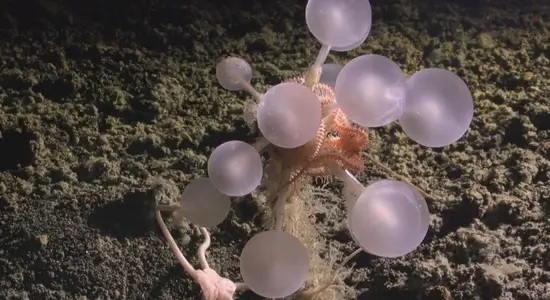 The newly confirmed carnivorous “death-ball” sponge, photographed by ROV SuBastian at 3,601 meters near Montagu Island. Credit: The Nippon Foundation-Nekton Ocean Census/Schmidt Ocean Institute
 Table of Contents
How the Death Ball Sponge Was Found
The discovery comes from the Southern Ocean, in the waters around the remote South Sandwich Islands, one of the most under-explored marine environments on the planet. In 2025, an international team from The Nippon Foundation-Nekton Ocean Census, working with the Schmidt Ocean Institute, sent the remotely operated vehicle ROV SuBastian down to the seafloor near Montagu Island as part of a broader expedition to catalogue Southern Ocean biodiversity.
Among the nearly 2,000 specimens the team collected across 14 different animal groups was a small, round, oddly geometric organism that stood out immediately: a new species of predatory sponge, provisionally classified as Chondrocladia sp. nov. Researchers nicknamed it the “death-ball” sponge, a name that turned out to be more literal than a marketing gimmick.
It’s worth noting that ROV SuBastian has a track record of finding creatures that look nothing like what they turn out to be. The same vehicle and research institute were behind the viral footage of a sea pig “dancing” 2,300 meters below the Pacific, a soft, harmless little grazer that couldn’t be further from a predator. The death-ball sponge is almost its opposite number: something that looks passive and geometric, and turns out to be quietly lethal to anything small enough to brush against it.
How a Sponge Without a Brain Catches Prey
Most sponges survive by filter-feeding, passively pulling water through their bodies and straining out microscopic food particles. It’s about as far from predatory behavior as an animal can get. The death-ball sponge throws that entire model out. Its spherical body is covered in tiny, hook-shaped structures that snag small crustaceans and other prey that brush against it, holding them in place while the sponge slowly digests them externally.
Carnivorous sponges aren’t entirely new to science, a small number of species in the genus Chondrocladia and related groups have been documented before in other deep-sea environments, but each confirmed species adds valuable detail to a still poorly understood feeding strategy. Without a nervous system, a brain, or moving parts in any conventional sense, this sponge manages to functionally hunt using nothing but passive mechanical structure, which is part of why researchers find it so interesting.
The ocean floor has a habit of naming its residents after the last thing you’d expect a predator or a mystery to look like. Case in point: the pigbutt worm, a segmented deep-sea creature identified in 2007 that was mistaken for something entirely different before scientists worked out what they were actually looking at, much like the death-ball sponge was, for a long time, mistaken for just another harmless filter feeder.
Fun Fact
The death-ball sponge wasn’t the only headline-worthy find on this expedition. The same research program also captured the first-ever confirmed video footage of a live juvenile colossal squid in its natural habitat, an animal so elusive that scientists had never filmed a living one in the wild before this project.
A Record-Breaking Expedition
The death-ball sponge was just one of 30 new species confirmed from this single expedition, verified during a Southern Ocean Species Discovery Workshop hosted by Universidad de Magallanes in Punta Arenas, Chile in August 2025. The haul also included newly identified armored scale worms, several undescribed sea stars, and crustaceans that may represent an entirely new amphipod family.
According to Dr. Michelle Taylor, Head of Science at The Nippon Foundation-Nekton Ocean Census, the team had processed under 30 percent of the samples collected by the time these 30 species were confirmed, meaning the true number of new species from this single trip is likely to climb significantly higher as analysis continues. The expedition also happened to stumble onto a rare piece of geological timing: after a 510-square-kilometer iceberg calved from the George VI Ice Shelf in January 2025, the research vessel diverted to study a patch of seafloor that had been sealed beneath roughly 150 meters of ice moments before, the first time humans had ever seen it.
Why This Discovery Matters
Confirming a species as “discovered” is only the first step. Under Ocean Census’s own classification system, a species isn’t formally “described” with a full scientific name and published classification until it clears peer review, a process that historically takes an average of 13.5 years. Ocean Census exists specifically to compress that timeline by pairing expeditions directly with rapid, expert-led verification workshops instead of letting specimens sit unprocessed in storage for over a decade, which has long been one of taxonomy’s quiet bottlenecks.
The Southern Ocean remains one of the least sampled marine regions on Earth despite its outsized role in global ocean circulation and climate regulation. Every new species confirmed here, carnivorous sponge or otherwise, adds to a genuinely thin baseline of knowledge about how life persists in some of the coldest, most pressurized, and most remote habitats the planet has to offer.
Schmidt Ocean Institute — South Sandwich Islands Expedition Reports
What is the death ball sponge and how does it hunt
The death-ball sponge is a newly confirmed carnivorous sponge species, provisionally named Chondrocladia sp. nov., found at 3,601 meters deep near Montagu Island in the Southern Ocean. Its spherical body is covered in tiny hooks that trap small crustaceans, which it then digests externally, unlike most sponges that passively filter-feed.
Are carnivorous sponges common in the ocean
No, carnivorous sponges are rare. The vast majority of sponge species filter-feed passively. Only a small number of species, mostly in the genus Chondrocladia, have been documented using predatory strategies, making each new discovery scientifically significant.
How many new species were found during this expedition
Researchers confirmed 30 new species during the Southern Ocean expedition, though the team had processed less than 30 percent of collected samples at the time, suggesting the true number will likely rise substantially as analysis continues.
What else did scientists discover on this same expedition
The same expedition captured the first-ever confirmed video footage of a live juvenile colossal squid in the wild, discovered new hydrothermal vents, and became the first team to survey a patch of seafloor exposed after a massive iceberg calved from the George VI Ice Shelf in January 2025.