
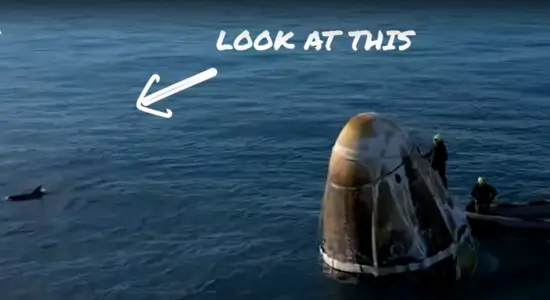
NASA astronauts Suni Williams and Butch Wilmore are safely back on Earth, but their welcome party turned out to be a bit more special than expected — a pod of dolphins showed up to greet them near their capsule.
After launching to the International Space Station (ISS) on June 5, 2024, as part of the first crewed test flight of Boeing’s Starliner spacecraft, the duo was initially set to return after just 8 to 10 days. But once Starliner reached orbit, engineers detected multiple helium leaks in its propulsion system along with the in-flight failure of 5 of its 28 reaction control thrusters. As NASA and Boeing worked to troubleshoot the problems from the ground, the astronauts’ short test flight kept getting extended, eventually stretching into a nine-month stay.
NASA ultimately decided the risk of bringing Wilmore and Williams home aboard the malfunctioning Starliner was too high. In September 2024, the spacecraft undocked and returned to Earth empty, landing safely but experiencing yet another thruster issue during its uncrewed descent to White Sands, New Mexico. Williams and Wilmore stayed behind on the ISS, folded into the Expedition 72 crew and the SpaceX Crew-9 mission, until a return seat became available.
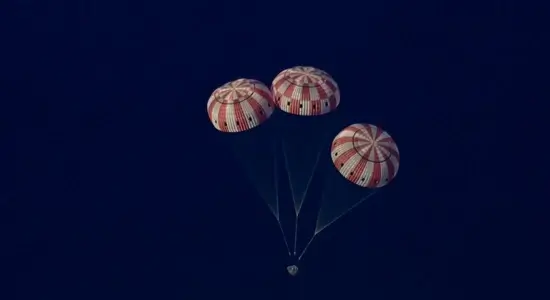
Despite the extended stay, Williams and Wilmore made the most of their time, even taking part in a spacewalk while waiting for their ride home. NASA must have breathed a sigh of relief when the astronauts finally splashed down safely aboard a SpaceX Dragon capsule off the coast of Tallahassee, Florida, in the Gulf of Mexico at 5:57 PM EDT on March 18, 2025. Joining them on the return trip were Roscosmos cosmonaut Aleksandr Gorbunov and NASA astronaut Nick Hague, both of whom had launched separately as part of Crew-9.
“We are thrilled to have Suni, Butch, Nick, and Aleksandr home after their months-long mission conducting vital science, technology demonstrations, and maintenance aboard the International Space Station,” said then-NASA Acting Administrator Janet Petro.
Once the capsule safely splashed down, a team of SpaceX recovery vessels moved in to assist. That’s when a surprise pod of dolphins decided to crash the party. The curious animals circled and surfaced near the capsule as the astronauts and cosmonaut prepared to exit their spacecraft and return to land, turning what’s normally a tightly choreographed recovery operation into a genuinely unplanned wildlife encounter caught on camera.
You can watch the moment they opened the hatch and took their first breaths of fresh air in nine months in the video below. After reaching shore, the crew was flown to NASA’s Johnson Space Center in Houston to reunite with their families.
During their time on the ISS, the crew traveled an astonishing 195,289,856 kilometers (121,347,491 miles), orbiting Earth 4,576 times. Thanks to this extended mission, Wilmore logged 464 days in space across his career, while Williams reached an impressive 608 days, making her one of the most experienced American astronauts by cumulative time in orbit. If unexpected space milestones like this fascinate you, you might also enjoy learning more about NASA’s ongoing missions and the record-setting journeys of the astronauts behind them.
Fun Fact
A NASA investigation later classified the Starliner Crew Flight Test as a Type A mishap, the agency’s most serious safety classification. The final report, released in 2026, pointed to a mix of hardware failures, testing gaps, and organizational miscommunication, and estimated Starliner likely won’t achieve full human-rating certification until 2027 at the earliest.
“This mission showcases NASA and SpaceX’s commitment to pushing the boundaries of human space exploration, from low Earth orbit to the Moon and Mars,” Petro added.
| Detail | Figure |
|---|---|
| Original planned mission length | 8–10 days |
| Actual time in space (Wilmore & Williams) | ~9 months |
| Distance traveled | 195,289,856 km (121,347,491 mi) |
| Orbits of Earth completed | 4,576 |
| Wilmore’s total career days in space | 464 days |
| Williams’ total career days in space | 608 days |
Conclusion
What began as a routine eight-day test flight turned into a nine-month space odyssey, technical drama, and ultimately a heartwarming splashdown moment nobody could have scripted. Between the record-setting time in orbit and a curious pod of dolphins showing up to welcome the crew home, the return of Crew-9 became one of the more memorable chapters in NASA’s ongoing partnership with commercial spaceflight.
NASA — Back to Earth, Forward to the Future: NASA’s SpaceX Crew-9 Returns
NASA — NASA Releases Report on Starliner Crewed Flight Test Investigation
Associated Press — NASA Astronauts Butch Wilmore and Suni Williams Return to Earth After 9 Months Stuck in Space
Why were Suni Williams and Butch Wilmore stuck in space for so long
Their Boeing Starliner spacecraft developed multiple helium leaks and lost 5 of its 28 reaction control thrusters shortly after reaching the ISS. NASA judged it too risky to bring them home on the malfunctioning capsule, so Starliner returned to Earth uncrewed while the astronauts waited for a seat on a later SpaceX mission.
How did the astronauts actually get back to Earth
They returned aboard a SpaceX Crew Dragon capsule as part of the Crew-9 mission, splashing down in the Gulf of Mexico off Tallahassee, Florida, on March 18, 2025, alongside NASA astronaut Nick Hague and Roscosmos cosmonaut Aleksandr Gorbunov.
What happened to the Boeing Starliner spacecraft
It undocked from the ISS and returned to Earth without a crew in September 2024, landing at White Sands, New Mexico, though it experienced another thruster issue during descent. A later NASA investigation classified the mission as a Type A mishap, the agency’s most serious safety rating.
How much time did Suni Williams and Butch Wilmore spend in space overall
Including this mission, Wilmore’s career total reached 464 days in space, while Williams reached 608 days, making her one of the most experienced American astronauts in terms of cumulative time spent in orbit.