
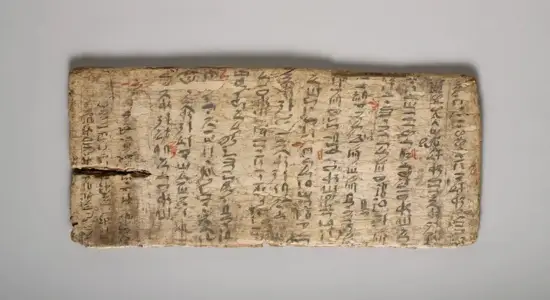
If you’ve ever felt the sting of seeing a red pen all over your homework, take comfort in the fact that students have been dealing with this for four millennia. Archaeologists have uncovered a fascinating Babylonian clay tablet dating back roughly 4,000 years that proves the relationship between a struggling student and an ancient teacher hasn’t changed much since the dawn of civilization.
This artifact, found in what was once Mesopotamia (modern-day Iraq), is a literal window into an ancient classroom. It’s a practice piece where a student was learning the complex cuneiform script. But the most human part isn’t the student’s shaky handwriting; it’s the clear, decisive marks made by the instructor to correct the mistakes.
The First “Red Pen” in History
In the Old Babylonian period (around 2000–1600 BCE), being a student was a grueling job. They attended schools known as the Edubba, or “tablet house.” To master the hundreds of characters in cuneiform, students had to press a reed stylus into wet clay over and over again.
On this particular tablet, the student was tasked with copying a legal document or a list of signs. However, the student slipped up, making several spelling and grammatical errors. The ancient teacher didn’t let it slide. Using their own stylus, the instructor pressed deeply into the clay right next to the errors, essentially marking them for correction. While it wasn’t “ink” in the modern sense, the intent was exactly the same as a 21st-century teacher circling a typo in red ink.
A Brutal Education System
While the tablet shows a teacher’s dedication to accuracy, the history of education in Mesopotamia tells us that these schools were far from relaxed. Being an ancient teacher often meant being a strict disciplinarian. Records from the time suggest that students were frequently beaten with a cane for everything from untidy handwriting to speaking without permission.
Yet, this rigorous Babylonian schooling was highly effective. It produced the world’s first professional scribes, accountants, and administrators who managed some of the greatest empires in history. The tablet serves as a reminder that the pressure to get “straight A’s” (or the ancient equivalent) has been a constant part of the human experience for centuries.
The Humanity Behind the Clay
What makes this 4,000-year-old classroom artifact so special is how relatable it is. We often think of ancient people as mysterious figures from a distant world, but this tablet shows a kid just trying to pass a test and a teacher who probably had a long day of grading. It proves that whether you’re using a digital stylus or a wooden reed, the struggle of learning—and the necessity of a good teacher—is truly timeless.
Did You Know?
The harsh life of a Babylonian student might seem distant, but history has a way of repeating its strangest habits. Did you know that the year 536 AD was considered the most miserable year to be alive, far worse than any school day? A mysterious cloud of ash plunged the world into darkness, leading to failed crops and a deadly plague that makes a strict teacher look like a dream.
And while Babylonian teachers were busy marking up clay, people in other parts of the world were focusing on a different kind of aesthetics. Discover the strange truth behind the scented statues of antiquity, where ancient Greeks and Romans used exotic oils to make their stone masterpieces smell as beautiful as they looked. It seems that even in the most rigid societies, there was always room for a little sensory luxury.