
On a hot day, you might sprint for the nearest bus shelter. A camel spider can do much the same thing, except the shelter might be your shadow. If it runs toward you and seems to follow when you move, it may be trying to stay in the shade, not trying to catch you.
That distinction is easy to miss when a fast, hairy animal with a startling set of jaws is coming straight at your boots. It also helps explain how a real desert arachnid ended up with a reputation for chasing soldiers, growing to the size of a human calf, and delivering a venomous bite. The animal is real. Those are three different claims, and they don’t hold up the same way.
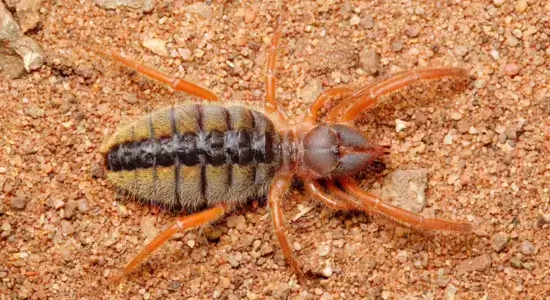
Table of Contents
Do Camel Spiders Chase You?
Camel spiders don’t hunt people. The Burke Museum’s explanation for reports of one running toward a person in bright desert sun is that the animal is seeking shade. A standing person casts a patch of it. So does a camel, and so does a tent. To the animal, the useful thing isn’t who or what made that patch. It’s that the patch is out of the sun.
Here’s why it can look like a chase: take a few steps and your shadow moves with you. If the solifuge keeps moving toward that darker patch, it can look as though it’s following you. The same movement can be real without the scary interpretation being right. And shade-seeking explains the familiar daytime reports; it doesn’t tell us what every individual animal is doing every time it runs.
How Big Is the “Giant Desert Spider” in the Iraq Photo?
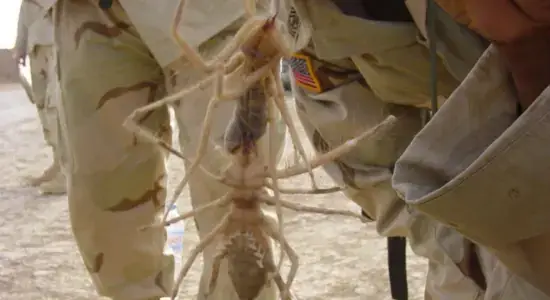
The famous photo circulated by email in 2004 and was said to come from Baghdad. It looks like one enormous desert spider dangling next to a soldier. Look again: there are two animals, and they’re much closer to the camera than the parts of the scene you’re using to judge their size. That’s forced perspective: a nearby object takes up more of the frame than an object farther away, even when it’s much smaller in real life.
The Burke Museum cites a report that the animals in the photo were roughly 4 centimeters long (about 1.6 inches). Its account puts the maximum body length of Near Eastern solifuges at around 5 centimeters (2 inches). Neither figure means every camel spider worldwide is the same size. It also matters whether a measurement includes the legs. A photo of an animal with its limbs stretched out is not a measurement of its body.
Can a Camel Spider Bite You?
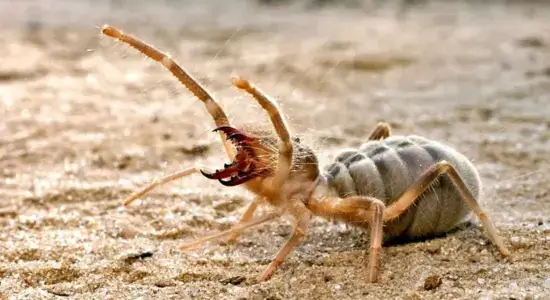
Yes. A camel spider can deliver a painful bite, and a large one can break the skin. The animals behind the Iraq stories do not inject venom: their jaws do the damage mechanically. That’s different from saying the bite can’t hurt. It’s also very different from the old story that they numb sleeping people and eat their flesh.
The jaws are called chelicerae. They’re the prominent paired structures at the front of the animal, and they’re built to grab and break up prey. Think of the difference between being pinched and being injected with something. A solifuge can do the first without doing the second.
Is a Camel Spider Really a Spider?
No. A camel spider is a solifuge, an arachnid in the order Solifugae. “Sun spider” and “wind scorpion” are other common names, but neither one tells you what group it actually belongs to. There are solifuges in the southwestern United States as well as in North Africa and the Middle East. The viral photo made one region’s animals famous; it didn’t define the whole group.
What Do Camel Spiders Actually Hunt?
Mostly smaller animals, including insects and other invertebrates. A camel spider doesn’t need a web to catch dinner. It can seize prey and use its large chelicerae to break it apart. Those jaws are genuinely impressive for an animal its size, which is a better reason to look twice than any story about it eating a camel.
So if a camel spider rushes toward your boots in full sun, remember the moving patch on the ground before you assume you’re on the menu. You might just be casting the most useful shadow around.
- Burke Museum: Too many “camel spider” tall tales — shade-seeking, the 2004 photo, body size, bite myths, and the limits of speed claims.
- American Museum of Natural History: Camel Spiders’ Fearsome Jaws — solifuge classification, chelicerae, and pedipalps.
- National Geographic: Camel Spider — behavior, prey, and the difference between a painful bite and a venomous one.
Why would a camel spider follow my shadow?
In bright sunlight, your shadow can provide a patch of cover. If you move and the animal keeps trying to stay in that shade, it can look like it’s chasing you. Humans aren’t its prey.
Are camel spiders venomous?
The camel spiders behind the Iraq War stories don’t inject venom. Their powerful jaws can still give a painful bite and may break the skin.
Was the giant camel spider photo from Iraq fake?
The apparent size is explained by forced perspective, not by a human-sized animal. The photo shows two solifuges close to the camera, where they look much bigger relative to the background.
Are camel spiders the same as sun spiders?
Yes. Camel spider, sun spider, and wind scorpion are common names for solifuges. They are arachnids, but they are neither true spiders nor scorpions.