
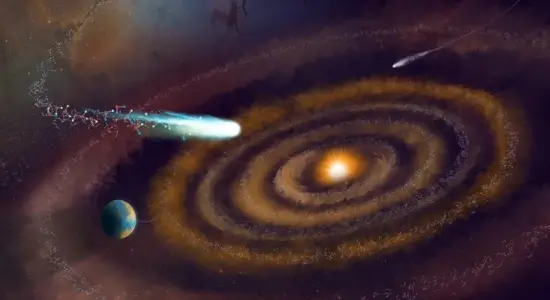
 An artistic illustration showing comets delivering both regular and heavy water to Earth. Image credit: NSF/AUI/NSF NRAO/P. Vosteen, B. Saxton
At Fact Fun, we often look back at Earth’s origins, but this time scientists looked even further — and what they found rewrites our cosmic story. According to a series of recent studies, the water flowing in our oceans might be billions of years older than the Sun itself.
A Telescope Peering Back in Time
Using the Atacama Large Millimeter/submillimeter Array (ALMA) in Chile, astronomers have spent several years studying a young star called V883 Orionis, located in the Orion constellation roughly 1,300 to 1,350 light-years from Earth. Its surrounding disk of gas and dust is where planets are actively forming — a cosmic snapshot of how our own Solar System likely looked 4.6 billion years ago.
In 2023, a team led by astronomer John Tobin of the National Radio Astronomy Observatory (NRAO) made the first direct detection of water vapor in this planet-forming disk, along with a standard form of heavy water. The ratio of heavy water to normal water closely matched what’s found in comets within our own Solar System, hinting that Earth’s oceans and space-born ice might share the same ancient origin. That research was published in the journal Nature.
Older Than Our Star
Then, in October 2025, a follow-up study pushed the story even further. A team led by astronomer M. Leemker, with Tobin now serving as a co-author, made the first-ever detection of doubly deuterated water (D₂O) — an even heavier variant of water — in that same disk around V883 Orionis. This particular molecule is considered a much stronger chemical fingerprint of truly ancient, unprocessed ice, the kind that would have existed in the cold interstellar cloud long before any star ignited.
“Until now, we weren’t sure if most of the water in comets and planets formed fresh in young disks like V883 Ori, or if it’s ‘pristine,’ originating from ancient interstellar clouds,” said John Tobin. “This finding is the first direct evidence of water’s interstellar journey from clouds to the materials that form planetary systems — unchanged and intact.”
The 2025 findings, published in the journal Nature Astronomy, suggest that much of the water present in our Solar System — including the water on Earth — likely didn’t originate here at all. Instead, it may have been inherited almost unchanged from the cold molecular cloud that eventually collapsed to form our star and planets.
Fun Fact
The disk around V883 Orionis isn’t just old — it’s enormous. Astronomers estimate it contains at least 1,200 times more water than exists in all of Earth’s oceans combined, sitting frozen and gaseous around a star that hasn’t even finished forming yet.
How Heavy Water Tells Ancient Stories
Because deuterium enrichment only builds up efficiently in extremely cold conditions, typically below about -240°C (30 Kelvin), the presence of heavy water acts almost like a chemical fossil, marking where and roughly when a batch of water molecules first formed. By tracing these ratios in V883 Orionis’s disk, astronomers can follow water’s journey from interstellar space all the way to newborn worlds, showing that many of the same molecules likely floated through space long before our Sun, or Earth, ever existed. If distant, otherworldly discoveries fascinate you, you might also enjoy exploring the mystery of the universe’s rotation and the Hubble tension or how NASA detected a 7,000-kilometer gravity anomaly over the Atlantic — two other stories that push our understanding of space even further.
ALMA Observatory — First-Ever Detection of “Heavy Water” in a Planet-Forming Disk
Leemker, M. et al. (2025) — Pristine Ices in a Planet-Forming Disk Revealed by Heavy Water, Nature Astronomy
ESO — Astronomers Find Missing Link for Water in the Solar System (2023)
Space.com — Scientists Discover Exoplanet-Forming Disk With Water Older Than the Star It Orbits
Is Earth’s water really older than the Sun
The evidence strongly suggests at least some of it is. Deuterium ratios detected in the planet-forming disk around V883 Orionis closely match those found in Solar System comets, indicating this water likely formed in the cold interstellar cloud before the Sun ignited, rather than forming fresh within our young Solar System.
What is heavy water and why does it matter here
Heavy water is water in which one or both hydrogen atoms are replaced by deuterium, a heavier isotope of hydrogen. Because deuterium only enriches efficiently in extremely cold environments, its presence acts as a chemical marker revealing where and when the water originally formed.
Who led the research on V883 Orionis
Two related studies were involved. John Tobin of the National Radio Astronomy Observatory led the 2023 Nature study that first detected water vapor in the disk, while M. Leemker led the 2025 Nature Astronomy study that made the first detection of doubly deuterated water, with Tobin as a co-author.
How far away is V883 Orionis
It sits roughly 1,300 to 1,350 light-years from Earth in the constellation Orion, making it far too distant to visit but close enough for ALMA’s radio telescopes to study its chemical composition in detail.