
If you split open a slab of ancient shale in the mountains of Europe, you might uncover something that looks like it belongs in a geometry textbook rather than a natural history museum. Pressed into the stone is a perfectly symmetrical, honeycomb-like grid of raised lines, often small enough to be covered by a single coin. When Italian geologist Giuseppe Meneghini first described these curious geometric patterns in the Apennine Mountains in 1850, scientists were utterly baffled. It didn’t look like a leaf, a bone, or a shell. It looked exactly like a miniature architectural blueprint.
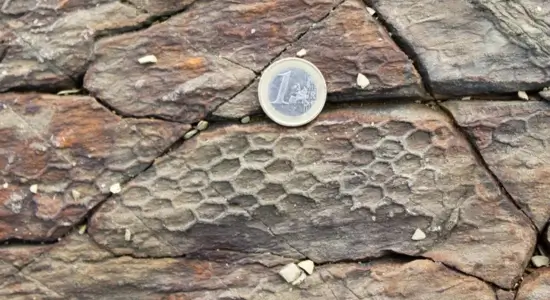
After a century of debate, paleontologists finally realized they were looking at an ichnofossil—a trace fossil left behind by an animal’s activity, rather than the physical body of the animal itself. Like a set of muddy footprints on a kitchen floor, the creature that made it was long gone. The scientific community named the structure Paleodictyon, dating its earliest designs back to the Cambrian explosion over 500 million years ago. But the real shock came decades later when deep-sea explorers realized this ancient, faceless architect hadn’t gone extinct. It is currently alive, perfectly active, and building these exact same structures right now at the bottom of the ocean.
The Deep-Sea Resurgence of Paleodictyon
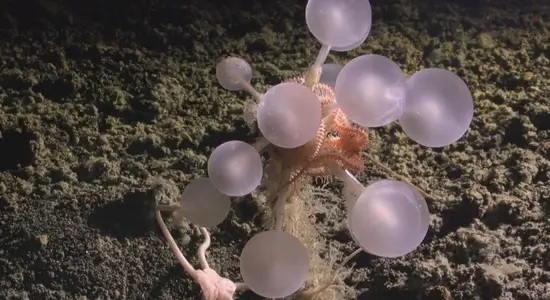
In 1976, marine geologist Peter Rona was strapped inside the deep-diving submersible Alvin, exploring the dark, crushing depths of the Mid-Atlantic Ridge. Roughly 3,500 meters (11,500 feet) below the surface, the submersible’s lights swept across the barren, muddy seafloor and illuminated something impossible. Stamped directly into the soft sediment were thousands of fresh, perfectly formed honeycomb patterns. Rona had essentially stumbled upon a massive, living city of the mysterious hexagonal trace fossil that scientists previously assumed had vanished millions of years ago.
The Biological Farming Machine
To understand why an organism would build such a precise, mathematically perfect structure, legendary German paleontologist Adolf Seilacher proposed a brilliant theory: it’s an underwater farm. Deep beneath the ocean surface where sunlight cannot penetrate, food is incredibly scarce. Seilacher theorized that the creature burrows this complex, multi-tiered honeycomb to trap floating organic debris or to cultivate specific bacteria. By pumping water through the hexagonal shafts, the organism essentially creates its own sustainable agriculture system in the abyss. This would explain why this mysterious hexagonal trace fossil has remained completely unchanged in its design for half a billion years; it is a highly successful evolutionary strategy for survival.
The Ultimate Ghost of the Abyss
The most frustrating part of this biological mystery is that, despite finding thousands of fresh, living examples on the modern seafloor, we have absolutely no idea what makes them. In 2003, Peter Rona and Adolf Seilacher teamed up for a dedicated expedition to finally catch the architect in the act. They used a remotely operated vehicle to carefully scoop up intact, fresh honeycombs from the ocean floor, seal them in containers, and bring them to the surface. When they searched through the mud under laboratory microscopes, they found absolutely nothing. No worm, no sponge, no crustacean.
Conclusion
The complete absence of a physical body has led to fascinating scientific theories. Some biologists suspect the builder might be a xenophyophore—a gigantic, fragile, single-celled amoeba that simply turns to mush and washes away the moment it is disturbed. Others think a highly mobile deep-sea worm quickly builds the structure, cultivates its bacterial food, and immediately abandons the site before scientists can scoop it up. Whatever the truth is, the creator of Paleodictyon remains one of the greatest enduring mysteries of the natural world. It is a biological ghost that has been silently stamping its perfect geometric signature across the Earth for 500 million years, daring us to find it.
Unearth More Earth Mysteries…
If the invisible architect of the deep ocean blew your mind, our planet is full of other bizarre anomalies hiding right under our noses.
- Did you know the tyrant lizard king wasn’t a rapidly expanding monster, but actually took decades to reach its massive, terrifying proportions? Discover the surprising paleontology behind T-Rex aging and growth rates.
- What happens when the ocean floor collapses into a toxic, oxygen-starved abyss that perfectly preserves ancient fossils? Plunge into the dark to find out what really lies at the bottom of the ocean’s mysterious blue holes.
Keep exploring the weird and wonderful archives on FactFun.co… because the natural world is always stranger than fiction.
References:
The New York Times — Deep in the Ocean, a Mystery in a Honeycomb
Search and Discovery — Paleodictyon: The Trace of a Mysterious Ancient Organism
Smithsonian Magazine — The 500-Million-Year-Old Mystery of Paleodictyon