
Sometimes nature throws us a curveball, and animals show up in colors we never expected. From albino anteaters to all-black penguins, genetics can shake things up in surprising ways. This time, it’s a Spix’s disc-winged bat in Belize that’s caught everyone’s attention—because it’s entirely white!
Leucism is a condition where an animal lacks pigmentation in its fur or skin, but unlike albinism, it doesn’t affect eye color. Until now, leucism had never been documented in this species—or even in the entire Thyropteridae family to which Spix’s disc-winged bats belong. These bats are usually dark brown with reddish-brown tinges on their ears and white or yellow fur on their bellies. But the individuals in this new report? Almost completely white.
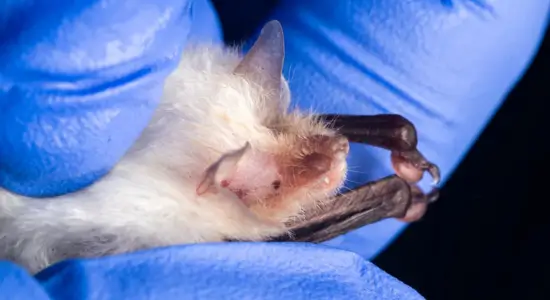 A rare all-white Spix’s disc-winged bat discovered in Belize, marking the first recorded case of leucism in this species.
“We haven’t conducted DNA analysis on this leucistic bat yet, but we hope to do so in the future,” explained Vanessa Martin, lead author of the study, in an interview with IFLScience. “Leucism is genetically induced and typically a recessive trait, meaning both parents must carry the gene for it to appear in their offspring.” The study, published in the journal Neotropical Biology and Conservation in early 2025, describes leucism as a partial or total loss of pigment in the fur, skin, or feathers—while the eyes and claws stay normally colored. That’s the key difference from albinism, where the eyes lose pigment too and often appear pink or red.
A Rare Bat With an Unusual Home
Spix’s disc-winged bats have a widespread distribution, ranging from Mexico through Central America down to Brazil. In Belize, however, they’re not particularly common and are only found in four known locations. They have a genuinely unique roosting habit: curling up inside rolled Heliconia leaves, which they can only use for about 24 hours before the leaves naturally unfurl and become unusable. The suction discs on their wrists and ankles—the “disc-winged” part of their name—let them cling to the smooth inner surface of these leaves, something almost no other bat can do. Unfortunately, commercial harvesting of Heliconia plants for the floral trade adds yet another challenge to an already tightly restricted habitat.
Three Sightings That Made History
The first sighting of an all-white Spix’s disc-winged bat happened on March 22, 2023, when researchers saw a small group of these bats tumble out of a freshly cut Heliconia leaf. Among them, at least one was leucistic. The rest quickly flew away, but this brief sighting sparked serious interest. Later that year, on December 15, researchers captured an adult leucistic male for closer study. The following April, in 2024, another male with leucism was found among a group of four bats at the same research station—the Toucan Ridge Ecology and Education Society (T.R.E.E.S.) in Belize’s Stann Creek District. Three separate sightings, spanning more than a year, all pointing to the same rare trait quietly persisting in one small, isolated bat population.
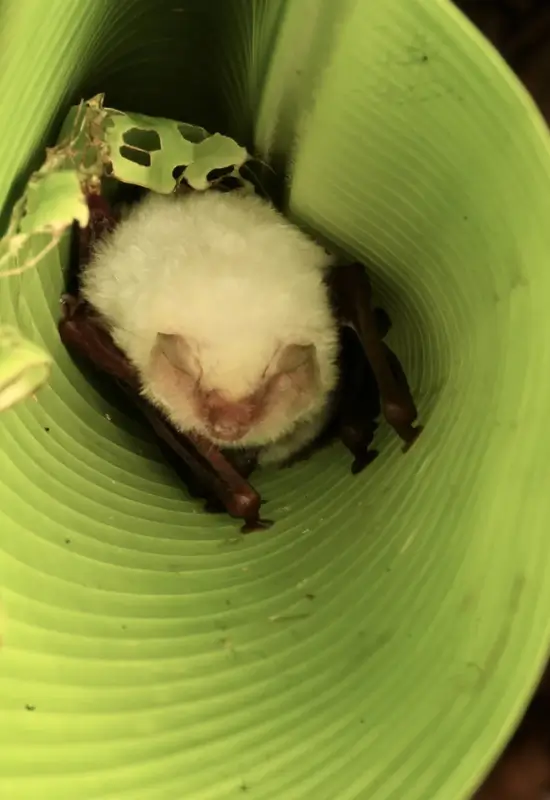 Close-up of the leucistic Spix’s disc-winged bat, showing its unique white fur while maintaining normal eye pigmentation.
Does Being White Put These Bats at Risk?
So, does standing out this much put these bats at a disadvantage? “Some researchers suggest that leucism might make bats more visible to predators or affect their social acceptance,” Martin said. “However, other studies have shown that leucistic bats can reach maturity and even reproduce, meaning it may not significantly impact survival or social integration.” Interestingly, Spix’s disc-winged bats already have naturally white bellies, which may help them blend into their pale, rolled Heliconia leaf homes. If that’s the case, being fully white might not be as costly a trait as it would be for an all-brown species trying to hide in dark foliage.
But does the unusual coloring affect their social relationships with other bats? “We didn’t observe any social interactions, so we can’t say for sure. However, the leucistic bat we found was roosting with others, suggesting it wasn’t excluded,” Martin noted. That detail matters a lot in the animal kingdom, where genetic outliers are sometimes pushed out of the group. If you enjoy stories about animals with one-of-a-kind traits reshaping what scientists thought they knew, you might also like reading about the muntjac deer that looks like something out of the movie Avatar.
Fun Fact
Leucism is genuinely rare in bats. A survey of chromatic disorders across bat populations found 609 documented cases spanning 115 species—yet only 11 of those were true leucism, compared to 152 albinism cases and 269 cases of piebaldism (partial white patches). That makes a fully leucistic bat one of the rarest color mutations you can find in the entire order Chiroptera.
A Pattern Bigger Than One White Bat
While this is the first recorded case of leucism in this species, Martin and her team have observed various color mutations in bats before. “Through mist-netting surveys, we’ve noticed many bats with chromatic disorders like piebaldism, which causes white patches on the skin or fur. These variations might be more common than we previously thought, so we encourage researchers to report their findings, even as short notes, as we did,” she said. That’s a meaningful point for citizen science and field researchers alike—rare mutations like this one often go undocumented simply because nobody writes them up.
With more eyes on the lookout, who knows what other rare color variations might be out there waiting to be discovered?
Martin, V.I., Kilburn, V.L., Charette, M., Miller, B.W. (2025) — First record of leucism in the Spix’s disc-winged bat, Thyroptera tricolor, in Belize. Neotropical Biology and Conservation 20(1)
Miami Herald — Odd-Colored Creature Seen Falling From Tree Turns Out to Be First-of-Its-Kind Find
López-Baucells et al. — Aberrant Coloration in Bats: A Review of Albinism, Leucism, and Piebaldism
What is the difference between leucism and albinism
Leucism causes partial or total loss of pigment in fur, skin, or feathers, but the eyes keep their normal color. Albinism affects melanin production throughout the entire body, including the eyes, which is why albino animals typically have pink or red eyes.
How rare is leucism in bats
Extremely rare. Out of 609 documented chromatic disorder cases across 115 bat species, only 11 were confirmed as true leucism, compared to 152 cases of albinism and 269 cases of piebaldism, which only affects patches of fur rather than the whole body.
Where was the leucistic Spix’s disc-winged bat found
The bat was documented at the Toucan Ridge Ecology and Education Society research station in the Maya Mountains of the Stann Creek District, Belize, across three separate sightings between March 2023 and April 2024.
Does leucism harm a bat’s chances of survival
Not necessarily. Researchers noted the leucistic bat was found roosting alongside others, suggesting it was not socially excluded, and past studies show leucistic bats can reach maturity and reproduce normally despite the unusual coloring.