
 Credit: WH Amazing Animals YouTube channel
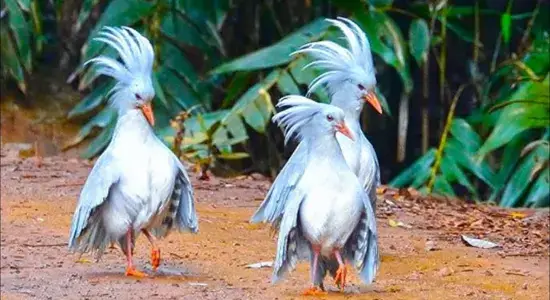
Deep in the misty mountain forests of New Caledonia, a small Pacific archipelago east of Australia, lives a ghostly grey bird that can’t fly, screams like something out of a nightmare at dawn, and breathes through a body part found on no other bird on Earth. Meet the Kagu, New Caledonia’s national bird and one of the strangest evolutionary outliers left standing.
Table of Contents
The One Feature No Other Bird Has
The Kagu’s most famous trait isn’t its slate-blue plumage or its long, spiky crest, both striking, but not unique in the bird world. The real anomaly is hidden right on its face: flap-like structures called nasal corns that cover its nostrils. No other bird species on the planet has them. Scientists believe the corns evolved to keep soil and debris out of the Kagu’s nose while it spends hours each day jabbing its beak into leaf litter and dirt, hunting for food. The bird’s full scientific name, Rhynochetos jubatus, even references this feature directly, built from Greek words meaning “nose” and “corn.”
The crest and the legs matter too, just not for the reason most articles lead with. The Kagu raises its crest into a dramatic fan shape when threatened or displaying to a mate, and its coral-red legs and beak stand out sharply against its pale grey body. Combined with bright red eyes, the effect has earned it a local nickname: the “Ghost of the Forest,” thanks to its pale coloring and its eerie, far-carrying morning calls that can last up to 15 minutes.
Behavior and Habitat
Kagus live only in the dense, humid mountain forests of New Caledonia’s main island, nowhere else in the world. Being flightless, they rely almost entirely on running speed and camouflage to avoid predators, freezing motionless against the forest floor when they sense danger rather than trying to flee. Their diet consists of snails, insects, worms, and small lizards, most of it dug up directly from the soil using that nasal-corn-protected beak.
They’re largely solitary birds, typically seen foraging alone or in a mated pair defending shared territory. Their vocalizations are unusually elaborate for a bird its size: duets between mated pairs can be heard from over a kilometer away, part of why early European settlers reportedly found the sound genuinely unsettling at dawn.
How Endangered Is the Kagu, Really
The Kagu is officially listed as Endangered by the IUCN, though exact population figures vary between conservation groups, generally ranging from roughly 600 to 2,000 mature individuals across the island’s fragmented forest patches. Numbers dropped as low as 600 to 700 birds around 1991, largely due to introduced predators like dogs, cats, and pigs that arrived with European colonization and had no natural check in New Caledonia’s ecosystem.
Fun Fact
Conservation efforts are actually working. In the Rivière Bleue Provincial Park, one of the Kagu’s key strongholds, park manager Jean-Marc Meriot has tracked the local population grow from around 60 birds in 1984 to more than 1,000 by 2024, largely credited to sustained predator control and captive breeding programs.
The Kagu’s Role in Its Ecosystem
Beyond its novelty as a living evolutionary oddity, the Kagu functions as a natural pest regulator in its forest habitat. By constantly foraging through leaf litter for invertebrates, it helps keep insect and mollusk populations in check, which in turn affects the health of the forest floor and the plant life that depends on that balance. Losing the Kagu wouldn’t just mean losing an unusual bird; it would remove a functioning part of how New Caledonia’s mountain forests regulate themselves.
The New Caledonian government, alongside international conservation groups, continues to run habitat protection programs, predator control initiatives, and captive breeding efforts aimed at keeping the population climbing rather than shrinking. So far, the trend in areas with active management has been genuinely encouraging, even if the species remains far from secure across the island as a whole.
Wikipedia — Kagu (Rhynochetos jubatus)
BirdLife International — Kagu Species Factsheet
The Guardian — New Caledonia’s Favourite Bird Thriving After Conservation Push