
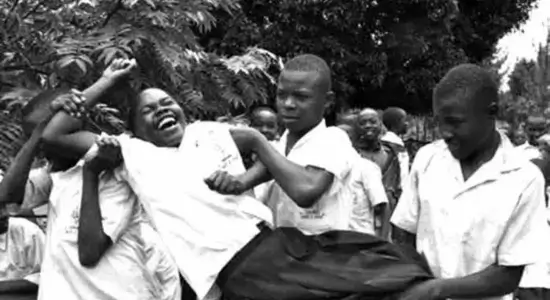
January 30, 1962. Inside a strict mission boarding school in Kashasha, Tanganyika (modern-day Tanzania), three young girls began to laugh. It started as a typical classroom giggle, the kind usually silenced by a stern glare from a teacher. But the laughter didn’t stop. It escalated into breathless, agonizing shrieks.

Within hours, 95 of the 159 students were infected. They were crying, fainting, and suffering from acute respiratory distress, yet their faces were locked in manic, painful grins. The teachers, immune to the outburst but terrified by the chaos, were forced to shut the school down.
But it was too late. The laughter had already escaped the gates.
A Contagion of Agony
Over the next 18 months, this bizarre plague tore across the Lake Victoria region. This was not the joyous laughter of a comedy show; it was a grueling physical assault. Bouts of involuntary laughing and crying lasted anywhere from a few hours to 16 continuous days.
Victims—primarily adolescents and young adults—suffered from extreme exhaustion, fainting, flatulence, and mysterious skin rashes. By the time the epidemic finally burned itself out, over 1,000 people had been afflicted, and 14 schools had been completely paralyzed.
Medical researchers and toxicologists rushed to the region, expecting to find a viral pathogen, a neurotoxin in the local water supply, or perhaps a bad batch of grain tainted with hallucinogenic fungus. They tested the blood, they tested the soil, and they tested the food. They found absolutely nothing. The victims were, biologically speaking, perfectly healthy.
The Pressure Cooker of Independence
To understand how a laugh can become a pathogen, you have to look beyond the microscope and into the minds of the afflicted. The true vector of this disease was extreme, inescapable stress.
In 1962, Tanganyika had just achieved its independence from British rule. The cultural landscape was shifting at breakneck speed, creating an environment of immense societal anxiety. For the young students at the Kashasha mission school, the pressure was uniquely crushing. They were caught in a brutal tug-of-war between the traditional expectations of their families at home and the rigid, alien demands of a Western-style educational system.
They were strictly disciplined, isolated, and terrified of failure. Their developing minds were subjected to a psychological powder keg, and they had absolutely no socially acceptable way to express their overwhelming fear.
The Dark Engine of Mass Psychogenic Illness
Modern psychology classifies the Tanganyika event as a textbook case of Mass Psychogenic Illness (MPI). MPI occurs when a group of people, bound by shared trauma or extreme stress, physically manifest their psychological pain.
The Rabbit Hole Goes Deeper…
If you thought this medical anomaly was terrifying, history is full of bizarre plagues and glitches in the human body. Dive into more mind-bending medical mysteries right here on FunFact
-
The Fatal Footwork: Why Doctors Prescribed ‘More Dancing’ to Cure the 1518 Plague
-
The Sleep That Didn’t End: How a Ghost Virus Turned 500,000 People into Living Statues
When the human brain is subjected to prolonged anxiety without a release valve, it eventually fractures. The subconscious mind forces a physical “vent.” In 1518 Europe, this manifested as a compulsion to dance. In 1962 Tanganyika, it was laughter.
When the first three girls snapped, it acted as a psychological permission slip. The shared, unspoken anxiety of the entire student body recognized the release, triggering a domino effect of involuntary neurological misfires. Their brains effectively hijacked their bodies, using laughter not to express joy, but to broadcast a massive, system-wide SOS.
Conclusion: A Cry for Help
The Tanganyika laughter epidemic is often dismissed as a quirky historical footnote, a bizarre tale of giggles gone wrong. But the reality is far more chilling. It was a desperate, unconscious cry for help from a generation pushed to the absolute brink. It stands today as a profound reminder of the mind’s terrifying power: when the burden of reality becomes too heavy to bear, the brain will rewrite the rules of the body, weaponizing our most joyous expressions to sound the alarm.