
At Fact Fun, we dive into mysteries that challenge everything we thought we knew about human history. And today’s mystery centers on a young child’s skull, buried nearly 140,000 years ago in one of the world’s oldest known cemeteries, which might hold genetic secrets from two entirely different human species—Homo sapiens and Neanderthals.

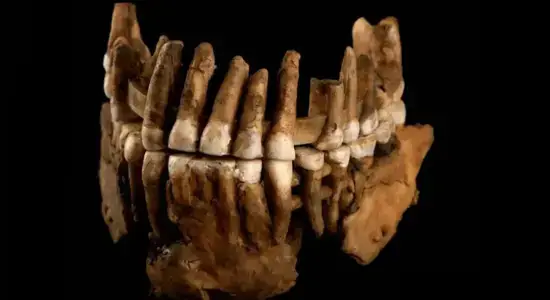
The skull of the child shows a combination of traits typically associated with both modern humans (Homo sapiens) and Neanderthals. (Image credit: Israel Hershkovitz/Tel Aviv University)
A study recently published in L’Anthropologie has brought fresh attention to a skull found in Israel’s Mount Carmel, at a site known as Skhul Cave. The remains—specifically a young child’s fractured cranium and lower jaw—have triggered serious speculation among paleoanthropologists that this could represent one of the earliest known Neanderthal-Homo sapiens hybrid fossils ever identified.
A Closer Look at Skhul I
The skull, dubbed Skhul I, likely belonged to a girl aged around 3 to 5 years old, who lived roughly 140,000 years ago. The fossil was first uncovered on May 3, 1931, by researcher Theodore McCown, among a remarkable cluster of deliberately buried individuals at the site: seven adults, three children, and bone fragments from at least 16 others, making Skhul Cave one of the oldest intentional human burial sites ever discovered. For decades, these remains were thought to represent a transitional form between Neanderthals and modern humans, but were eventually reclassified as fully Homo sapiens—a classification that has now been called back into question.
However, new high-resolution CT scans allowed a research team led by Bruno Bouvier, Anne Dambricourt Malassé, and Israel Hershkovitz to digitally strip away decades-old plaster reconstructions from the 20th century, revealing anatomical details that had been hidden from view for nearly a century. What they found was striking: the neurocranium (braincase) closely matched the rounded, modern shape typical of Homo sapiens, but the jawbone lacked a proper chin and showed a broad dental arch—both classic, distinct Neanderthal traits. Researchers also noted that the pattern of blood vessel channels inside the skull, along with the shape of the inner ear’s bony labyrinth, leaned toward Neanderthal-like organization as well, adding further weight to the mosaic interpretation.
Lead author Anne Dambricourt Malassé, a paleoanthropologist with France’s CNRS and the National Museum of Natural History, asserts this child was “objectively” a hybrid. She insists that this specific combination of features—a modern braincase paired with a distinctly Neanderthal-shaped mandible—cannot be explained away as simple natural variation within Homo sapiens. Because definitive ancient DNA has not been recovered from the fossil, the research team has proposed an interim solution: classifying Skhul I under a separate designation, the “Skhul paleodeme,” rather than forcing it into either the Homo sapiens or Neanderthal category outright.

Using digital techniques, researchers eliminated the green-colored plaster overlaying the jaw. (Image credit: Israel Hershkovitz/Tel Aviv University)
Not Everyone Agrees
However, the scientific community remains divided over this Skhul I hybrid classification debate. Chris Stringer, a paleoanthropologist from the Natural History Museum in London, isn’t entirely convinced. He notes that while the jaw may appear primitive, the overall skeleton aligns more closely with modern humans overall. Still, he doesn’t rule out the possibility of genetic mixing, especially in light of 2024 research supporting early gene flow between Neanderthals and humans roughly 100,000 years ago.
“Even if not first-generation hybrids,” Stringer says, “it’s certainly possible that the Skhul fossils reflect some gene flow between the two populations.”
Another skeptic, John Hawks, an anthropologist at the University of Wisconsin-Madison, adds that physical traits alone aren’t enough to confirm hybrid status with certainty. Without direct ancient DNA analysis, he warns, researchers are still essentially making highly educated guesses.
“Human populations are variable,” Hawks notes. “There can be a lot of variation in appearance even without interbreeding with ancient groups like Neanderthals.”
Why It Matters
Modern humans today carry between 1% to 3% Neanderthal DNA, inherited from ancient interbreeding events that most researchers had long placed at around 50,000 years ago. But the Skhul I skull, if confirmed as a genuine hybrid, would represent one of the earliest physical examples of human-Neanderthal interbreeding ever found—pushing that timeline back by tens of thousands of years and potentially reshaping our understanding of human evolution and the migration of Homo sapiens out of Africa.
🦴 Did You Know?
In 2018, scientists uncovered the remains of “Denny,” a teenage girl in Siberia with a Neanderthal mother and a Denisovan father—making her the first confirmed first-generation hybrid between two archaic human species ever identified through DNA. Discoveries like Skhul I suggest that interbreeding between different ancient human lineages may have been far more common throughout prehistory than scientists ever imagined.
Is Skhul I a genuine ancient human-Neanderthal hybrid, or simply a misunderstood member of our own species’ natural variation?
Follow Fact Fun for more deep-dives into human evolution, ancient mysteries, and the fascinating threads that connect us to our prehistoric past.
ref : Live Science , Wikipedia