
Vienna, winter of 1916. A young woman sits down to write a Christmas card. Her hand hovers over the paper. Minutes pass, then hours. She doesn’t blink. She doesn’t speak. She isn’t dead, and she hasn’t had a stroke. She has simply stopped, frozen mid-motion like a photograph of herself.
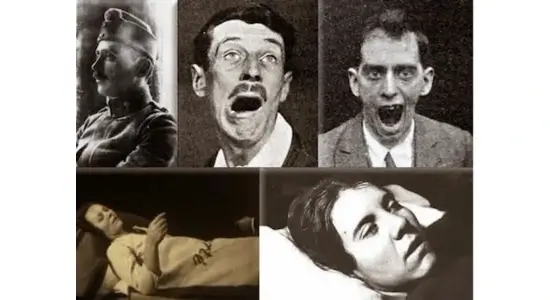
She was among the earliest recorded cases of a disease that would spread alongside the 1918 influenza pandemic, killing roughly 500,000 people worldwide and leaving hundreds of thousands more trapped in bodies that no longer obeyed them. Doctors called it encephalitis lethargica, or “sleepy sickness.” Decades later, it would vanish almost as suddenly as it arrived, and it remains one of the least understood epidemics in modern medical history.
A Disease That Didn’t Follow the Rules
Austrian neurologist Constantin von Economo first documented the illness in 1917, describing a wave of unusual neurological cases moving through Vienna. Physicians initially assumed it was some variant of influenza, given that the pandemic was unfolding at the same time. But the case patterns didn’t line up. Epidemiologist Edwin Oakes Jordan later studied outbreak data across American cities between 1918 and 1923 and found no consistent overlap between flu outbreaks and encephalitis lethargica cases. The two diseases seemed to be traveling on separate, overlapping tracks.
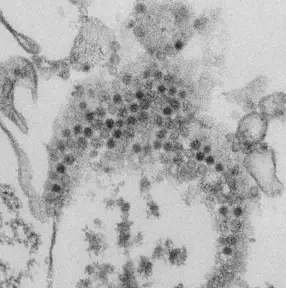 Enteroviruses have also been suggested as a possible cause of EL. Source: CDC/Cynthia S. Goldsmith, Yiting Zhang
Symptoms typically began with a sore throat, fever, and double vision, ordinary enough to be mistaken for a bad flu. Then came what von Economo named the disease for: a pathological drowsiness deep enough that patients could fall asleep mid-sentence, mid-meal, or mid-step. More than half of acute cases ended in death. For those who survived the initial attack, the disease wasn’t finished with them.
Trapped Awake Inside a Frozen Body
Months or even years after the acute illness passed, thousands of survivors developed what doctors termed post-encephalitic parkinsonism. They became motionless, expressionless, and largely speechless, not because they’d lost consciousness, but because something in their brain had severed the connection between wanting to move and actually doing it. Patients could still see, hear, and think clearly. They were, in the words of one researcher, “effectively dead” to the outside world while remaining fully aware on the inside.
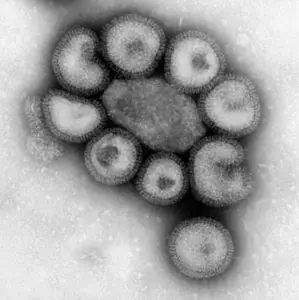 Influenza has been studied as one of the possible causes of EL. Source: Pixnio/F.A. Murphy
These patients were institutionalized, many for the rest of their lives, in asylums that had little else to offer them. One of the last confirmed survivors, a man named Philip Leather, was diagnosed at age 11 and remained hospitalized until his death in 2002, at age 82, having watched more than seven decades of the outside world pass by from inside a body that wouldn’t respond.
The Summer Everything Changed, Briefly
For nearly 50 years, there was no treatment. That changed in 1969, when neurologist Oliver Sacks, working at Beth Abraham Hospital in New York, began administering a newly available Parkinson’s drug called L-DOPA to a ward of post-encephalitic patients who had been essentially motionless for decades. The response, in some patients, was immediate and extraordinary. People who hadn’t spoken or walked in 30 or 40 years suddenly stood up, talked, and moved, waking into a world of television and jet travel they had no memory of.
The effect didn’t last. Sacks documented that many patients developed severe side effects, including uncontrollable tics, psychosis, and extreme sensitivity to even small dose changes, and within weeks or months most drifted back toward their prior state, now with the added grief of knowing exactly what they’d lost. Sacks published the case histories in his 1973 book Awakenings, later adapted into the 1990 film of the same name starring Robin Williams and Robert De Niro.
Fun Fact
The Matheson Commission, a research effort funded by businessman William Matheson to find a cause and cure for the disease, recorded 52,781 cases between 1919 and 1928 alone. Matheson died in 1930, and funding for the search largely died with him.
An Unsolved Case, Not a Closed One
New diagnoses of encephalitis lethargica dropped off sharply after 1927, and the epidemic is generally considered to have ended by the late 1920s, though isolated cases continued to surface for years afterward. To this day, nobody has definitively identified what caused it. Researchers have tested and largely ruled out influenza itself, since attempts to find flu virus traces in preserved brain tissue from EL patients have repeatedly come back negative.
The two leading modern hypotheses point elsewhere. A 2012 study using electron microscopy found virus-like particles in preserved brain tissue from EL patients that resembled coxsackievirus B4, an enterovirus, rather than influenza. Separately, other researchers have found elevated strep-related antibodies in a subset of modern suspected EL cases, suggesting an autoimmune reaction, the body’s own immune system mistakenly attacking healthy neurons after a throat infection, similar to conditions like anti-NMDA-receptor encephalitis. Neither theory has been confirmed, and only around 80 case reports resembling EL have been published worldwide in the 85 years since the epidemic ended.
American Society for Microbiology — Encephalitis Lethargica: A Mysterious Neurological Disease
Sacks, O. (1973) — Awakenings
Vilensky, J.A. et al. (2007) — Encephalitis Lethargica and Enteroviruses
What caused encephalitis lethargica
The exact cause has never been confirmed. Researchers have largely ruled out influenza despite the epidemic overlapping with the 1918 flu pandemic. Current leading theories point to an enterovirus similar to coxsackievirus, or an autoimmune reaction triggered by a prior strep infection.
How many people died from encephalitis lethargica
Estimates suggest more than one million people were affected worldwide during the epidemic period, roughly 1917 to the late 1920s, with approximately 500,000 deaths. Many survivors developed permanent neurological disabilities.
What did Oliver Sacks do for encephalitis lethargica survivors
In 1969, Sacks administered the drug L-DOPA to post-encephalitic patients at Beth Abraham Hospital in New York who had been immobile for decades. Many temporarily regained speech and movement, though the effects were unstable and most patients eventually relapsed. He documented the cases in his book Awakenings.
Could encephalitis lethargica happen again
It’s possible but unconfirmed. Only about 80 case reports resembling the disease have surfaced globally since the original epidemic ended, and without a confirmed pathogen, researchers can’t predict whether or when a similar outbreak could recur.