
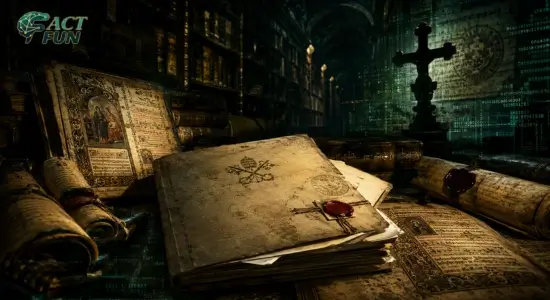
In early 2026, the internet was set ablaze by explosive rumors regarding a catastrophic data breach within the walls of the world’s most guarded institution: the Vatican Apostolic Archive. Conspiracy forums and social media platforms were saturated with sensational claims that the 2026 Vatican Leak had finally exposed the ultimate theological cover-up. According to the viral narrative, the Holy See was allegedly harboring ancient, classified manuscripts containing definitive proof of pre-flood non-human civilizations that dominated the Earth long before the dawn of modern human history.
But what actually lives inside the heavily fortified subterranean vaults of Vatican City? While the internet loves a good science fiction narrative, the physical and historical reality of the Vatican’s archives is far more fascinating than the extraterrestrial rumors suggest. To understand why these specific ancient mysteries erupt with such intensity, you have to look past the viral clickbait and examine the actual geology, ancient theology, and massive paper trail hidden beneath the cobblestone streets of Rome.
The Anatomy of the 2026 Vatican Leak Rumors
To understand how stories of lost civilizations take root, you must first demystify the Archive itself. For centuries, the facility was officially known as the Archivio Segreto Vaticano. To modern ears, the word “secret” implies a malicious cover-up. However, the Latin adjective secretum simply translates to “private” or “separated”—meaning the documents were the personal, restricted property of the Pope. To dispel these persistent conspiracy theories, Pope Francis officially changed the name to the Vatican Apostolic Archive on October 22, 2019.
Despite this rebranding, the physical reality of the Archive sounds exactly like a fortress. It contains over 85 linear kilometers (53 miles) of shelving holding twelve centuries of human history. A significant portion of this immense collection is stored in “The Bunker,” a massive, two-story underground vault built directly beneath the Cortile della Pigna (Courtyard of the Pinecone) within the Vatican Museums. When rumors of a digital leak circulate, imaginations naturally run wild about what might be locked inside a subterranean concrete vault containing millions of unread pages.
The Historical Reality of Pre-Flood Texts
So, why did the rumor mill specifically focus on proof of pre-flood non-human civilizations? Because the Vatican actually does possess some of the oldest and most complex “antediluvian” (pre-flood) texts on Earth. However, these are not blueprints of alien technology or suppressed archaeological data; they are ancient religious and historical manuscripts that attempt to explain the world’s deep, mythological past.
Throughout antiquity, from the Sumerian King List to the biblical Book of Genesis, ancient cultures shared a common narrative: a great global deluge that wiped out an earlier, highly advanced era. The Vatican preserves rare apocryphal texts, such as ancient copies of the Book of Enoch, which vividly describe the “Nephilim”—a race of giant hybrids born from the union of heavenly beings and humans before the great flood. When amateur researchers or internet sleuths uncover references to these bizarre, mythological texts in academic indexes, it is incredibly easy for them to strip away the theological context and falsely present them as literal, biological evidence of non-human entities.
The 75-Year Rule and the Power of the Unknown
The true reason the 2026 Vatican Leak rumors gained such massive global traction is rooted in the Vatican’s strict bureaucratic protocols. The Archive is not a public library. While Pope Leo XIII famously opened the doors to qualified scholars back in 1881, access remains fiercely regulated. Researchers cannot browse the shelves; they must request specific documents, which are brought to them in a monitored reading room.
The most frustrating rule for researchers—and the greatest fuel for conspiracy theorists—is the papal time limit. By standard practice, documents are not made available to the public until at least 75 years after the end of a specific Pope’s reign. For example, the highly controversial archives detailing Pope Pius XII’s actions during World War II and the Cold War were only unsealed to historians in recent years. This massive lag time creates a permanent informational vacuum. When you have an underground bunker filled with millions of documents that the public is legally forbidden to see for nearly a century, it becomes the ultimate blank canvas for people to project their wildest theories about lost worlds.
Conclusion
Ultimately, the Vatican Apostolic Archive does not hold the physical remains of alien empires or the geological records of a forgotten Earth. What it actually holds is the carefully preserved memory of human civilization over the last 1,200 years. The true marvel of the Archive isn’t a hidden sci-fi secret; it is the sheer, staggering scale of human history safely locked away beneath the streets of Rome, waiting for the right century to be read.
The truth is always stranger than fiction. If you are hungry for more mind-bending deep dives, bizarre historical anomalies, and weird scientific realities, head back to the FactFun homepage to explore our latest articles and fuel your daily curiosity.
References:
Reuters — Pope renames Vatican Secret Archives to remove ‘secret’
The Guardian — Vatican unseals Pius XII’s WWII archives
National Geographic — What’s really inside the Vatican’s secret archives?