

In the spring of 1901, Greek sponge divers seeking shelter from a violent storm off the tiny island of Antikythera stumbled upon a shipwreck brimming with ancient treasures. Among the bronze and marble statues lay a corroded, calcified lump of bronze and wood that was initially tossed aside as debris. It wasn’t until the metal split open in a museum a few months later, revealing precision-cut gear wheels the size of coins, that researchers realized they were looking at something seemingly impossible.
This heavily encrusted artifact, dating back to roughly 150 to 100 BCE, fundamentally broke our understanding of ancient technology. It is a device so advanced that nothing even close to its complexity would appear again in the historical record for another thousand years, until the development of mechanical clocks in medieval Europe. Today, scientists recognize this astonishing find as a 2,000-year-old Greek computer, an astronomical calculator designed to predict celestial events with terrifying accuracy.
Decoding The Antikythera Mechanism
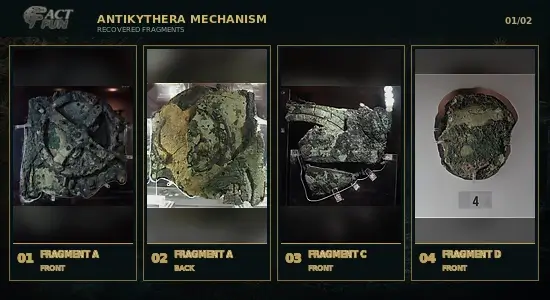
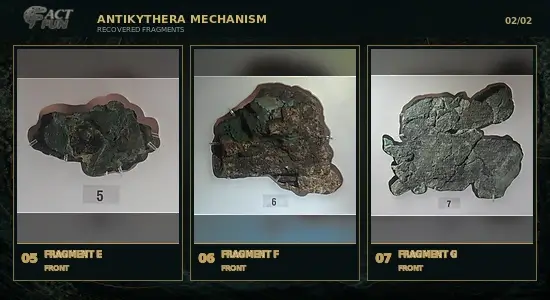
For decades, the true purpose of the device remained a mystery. In the 1950s, science historian Derek J. de Solla Price began investigating the fragments, suggesting it was far more than a simple astrolabe. But the real breakthrough came in 2005, when an international team of researchers, including mathematician Tony Freeth, used high-resolution X-ray computed tomography to look inside the 82 surviving fragments. They discovered a hidden system of at least 30 interlocking bronze gears, alongside thousands of microscopic Greek characters serving as a built-in user manual.
The way it worked was surprisingly similar to a modern analog watch, but instead of tracking hours and minutes, it tracked the cosmos. By turning a hand crank on the side, the user could calculate the positions of the sun, the moon, and the five planets known to antiquity. It could also predict eclipses down to the exact hour and track the four-year cycle of the ancient Olympic Games, adjusting for leap years with mechanical precision.
A Missing Link in Ancient Engineering
The existence of this 2,000-year-old Greek computer forces historians to completely rewrite the timeline of human engineering. Before its discovery, academics assumed the ancient Greeks were brilliant philosophers and architects, but lacked the metallurgical skills to build highly calibrated machinery. The gear teeth in the device are cut at exactly 60-degree angles, a level of mechanical standardization that requires specialized tools and deep mathematical knowledge.
Its sudden appearance in the archaeological record is like digging up an ancient Egyptian tomb and finding a working smartphone. Researchers believe the machine likely draws on the lunar theories of the astronomer Hipparchus, who lived on the island of Rhodes during the exact same period the device was constructed. It proves that the Greco-Roman world had achieved a staggering level of mechanical engineering—a technology that was tragically lost to time, likely destroyed during the fall of the Roman Empire and the subsequent centuries of global upheaval.
If this ancient anomaly sparked your curiosity, dive deeper into more bizarre and forgotten chapters of the human past in our untold history
Conclusion
The Antikythera Mechanism stands as a haunting reminder of how fragile human progress can be. It was not a rough prototype, but a highly refined, miniaturized machine that suggests a long, undocumented tradition of Greek mechanical engineering. While it may be broken and resting in the National Archaeological Museum in Athens today, its gears still turn in the minds of scientists, proving that our ancient ancestors were far more technologically capable than we ever dared to imagine.
References:
- Freeth, T., Bitsakis, Y., Moussas, X. et al. (2006). Decoding the ancient Greek astronomical calculator known as the Antikythera Mechanism. Nature, 444, 587–591.
- Price, D. J. de S. (1974). Gears from the Greeks. Transactions of the American Philosophical Society, 64(7), 1-70.
Why is the Antikythera Mechanism called the first computer?
It is considered the first analog computer because it used a highly complex system of at least 30 interlocking bronze gears to process mathematical inputs and output precise astronomical data, rather than just taking simple measurements.
Do we know who built the Antikythera Mechanism?
While the exact inventor remains unknown, researchers strongly suspect the device is tied to the lunar theories of the ancient Greek astronomer Hipparchus, who lived on the island of Rhodes during the same period it was constructed (150 to 100 BCE).
Where is the Antikythera Mechanism kept today?
The surviving 82 fragments of the mechanism are carefully preserved and currently on display at the National Archaeological Museum in Athens, Greece.