
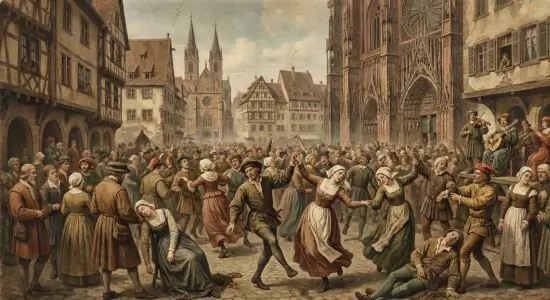
It began on a sweltering July morning in 1518. A woman named Frau Troffea stepped into a narrow street in the city of Strasbourg, then part of the Holy Roman Empire, and began to violently twist, twirl, and shake. There was no music playing. Her face was contorted not in joy, but in sheer, glassy-eyed distress.
She reportedly danced for days without meaningful rest, collapsing in exhaustion only to twitch and resume her frantic movements soon after. Within a week, roughly 30 others had joined her. Within a month, chroniclers estimated the number had swelled to around 400. It looked like a macabre festival, but for some it became a death march. Contemporary accounts describe people dancing until their bodies simply gave out from heart attacks, strokes, and sheer physical exhaustion.
History calls it the Dancing Plague of 1518. But the true mystery isn’t just why it started — it’s the bizarre, counter-intuitive way the authorities tried to stop it, a decision that may have made everything dramatically worse.
The Prescription of Doom
When reports of the strange affliction spread and casualties mounted, the city council of Strasbourg panicked. They consulted local physicians, who ruled out astrological alignments and demonic possession, instead diagnosing the victims with “hot blood.” According to the humoral medical theory of the time, the only way to cool an overheated bloodstream was to burn it off through relentless physical exertion.
The official medical prescription was, in hindsight, remarkable: the afflicted needed to dance it out.
Instead of restraining the victims, authorities reportedly cleared out the grain market and the guildhalls, built temporary wooden stages, and hired musicians, pipers and drummers, to play continuously. Some accounts even describe strong men being paid to help hold exhausted dancers upright so they could keep moving.
This response may have acted like gasoline on a fire. Rather than curing the afflicted, the pounding drums and public spectacle likely drew in more vulnerable onlookers. Caught in the hypnotic rhythm and swept up in psychological contagion, some who came to watch reportedly stepped onto the stage themselves and joined the compulsive dance.
The Poisoned Bread Theory (And Why It Mostly Fails)
For decades, one popular scientific theory attempted to explain the outbreak through biology alone: ergotism. Ergot is a toxic fungus that grows on damp rye, historically the staple grain of Strasbourg’s poorer residents. Eating ergot-tainted bread can cause violent spasms and hallucinations, since the fungus contains compounds chemically related to LSD.
It sounds like a tidy explanation, but most historians who’ve studied the case in depth, including John Waller, the historian most associated with modern research into this event, argue it falls apart under scrutiny. Severe ergot poisoning restricts blood flow to the extremities and can cause gangrene. Someone suffering from serious ergotism would likely be in agonizing pain with blackened, damaged limbs, not physically capable of sustaining coordinated, rhythmic dancing for days at a stretch. The dancers of 1518, by contrast, were reportedly performing sustained, if erratic, feats of physical endurance that severe ergotism would have made almost impossible.
Fun Fact
The 1518 outbreak in Strasbourg wasn’t an isolated event. Chroniclers recorded similar dancing manias, sometimes called “St. John’s Dance” or “St. Vitus’s Dance,” spreading along the Rhine River to towns in what is now the Netherlands and Belgium, suggesting the phenomenon spread partly through shared belief and cultural panic rather than a single localized cause.
The Mind Breaks Before the Body
If it wasn’t simply a biological poison, what drove the dancers of Strasbourg to such extremes? The leading modern explanation points to the terrifying power of the human mind under extreme duress: mass psychogenic illness (MPI).
The year 1518 was a time of genuine misery across the Holy Roman Empire. The poor were reeling from a string of brutal harvests and near-famine conditions. Syphilis, a devastating and newly spreading disease at the time, was tearing through the population. On top of this physical suffering sat a heavy psychological burden: a deeply ingrained theological fear of St. Vitus, a patron saint who, according to local belief, could curse sinners with a compulsion to dance uncontrollably.
The people of Strasbourg were pushed close to a breaking point. Historian John Waller argues that Frau Troffea’s initial episode may have been a dissociative trance, a psychological break triggered by unbearable stress. Because much of the city shared the same deep-seated fear of St. Vitus’s curse, witnessing her dance appears to have triggered a kind of psychological domino effect in others already primed by stress and belief. Their minds, in Waller’s interpretation, effectively hijacked their bodies, pushing them into a collective altered state as an escape from an already unbearable daily reality. If stories about the mind’s power over the body fascinate you, you might also want to read about the man who literally ate everything, another case where an uncontrollable compulsion completely took over someone’s life.
Conclusion: A Virus of the Mind
The Dancing Plague of 1518 eventually burned itself out by early September, once many of the surviving dancers were reportedly taken to a shrine dedicated to St. Vitus to pray for forgiveness and a cure. The true death toll remains genuinely disputed among historians, with contemporary sources and modern estimates ranging anywhere from several dozen to several hundred deaths over the roughly two-month episode. What isn’t disputed is that it stands as one of history’s most striking examples of how deeply intertwined the mind and body really are. Whatever ultimately killed some of Strasbourg’s dancers, it wasn’t a virus of the blood. It looks far more like a virus of belief, one severe enough to convince a body to dance itself toward collapse.
Wikipedia — Dancing Plague of 1518
HistoryNet — The Dancing Plague of 1518: History’s Oddest Epidemic
British Psychological Society — Dancing Plagues and Mass Hysteria
How many people actually died in the Dancing Plague of 1518
The exact number is genuinely disputed. Contemporary sources and modern historians offer estimates ranging from several dozen to several hundred deaths over the roughly two-month episode, with some chroniclers claiming as many as 15 deaths a day at its peak.
Was ergot poisoning actually responsible for the dancing plague
Most historians consider this unlikely. Severe ergot poisoning causes restricted blood flow, gangrene, and intense pain, which would have made sustained, coordinated dancing for days nearly impossible, unlike the extended dancing episodes described in historical accounts.
What is mass psychogenic illness
It’s a phenomenon where intense psychological stress produces genuine, involuntary physical symptoms that spread through a group, often within communities sharing similar beliefs, fears, or cultural pressures, without any biological pathogen being involved at all.
Did the authorities’ response make the dancing plague worse
Many historians believe it likely did. By hiring musicians and building public stages instead of restraining the afflicted, officials may have unintentionally created a spectacle that drew in more people already primed by stress and shared superstition, amplifying the outbreak rather than containing it.