
On April 11, 2026, the Orion spacecraft slammed into the Pacific Ocean, successfully capping off a historic 10-day lunar flyby. Reid Wiseman, Victor Glover, Christina Koch, and Jeremy Hansen just became the first humans to travel beyond low Earth orbit in more than 50 years. But while reaching the dark side of the moon is an incredible feat of orbital mechanics, the most mind-bending part of this entire mission is the fact that they survived the trip home.
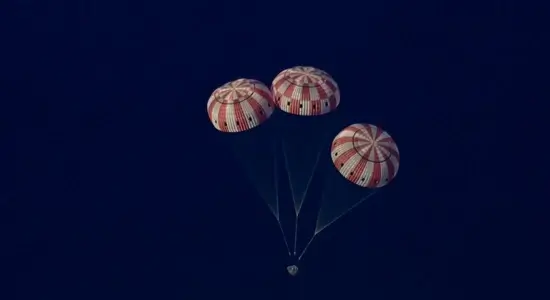
When Orion returned to Earth today, it didn’t just casually drift down from the sky. It violently smashed into our atmosphere at a blistering 24,500 miles per hour, or roughly Mach 32. At that insane speed, the atmospheric friction generated a plasma wake hitting 5,000 degrees Fahrenheit—which is about half the temperature of the surface of the sun. If a single thermal tile failed, the crew wouldn’t have just crashed; they would have vaporized before they ever hit the water. Here is the extreme physics that kept the crew alive.
The Physics of the Skip Re-Entry
In the Apollo days, capsules returned to Earth using a direct plunge, basically falling like a highly engineered rock and subjecting the crew to crushing G-forces. But today’s Artemis 2 astronauts splashdown utilized a completely different, highly advanced aerodynamic trick known as a skip re-entry.
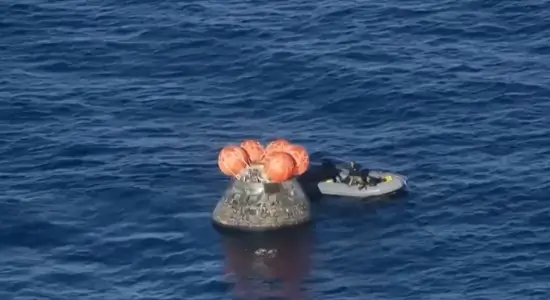
Imagine throwing a flat stone across the surface of a pond. The Orion capsule did the exact same thing, but with Earth’s atmosphere. The spacecraft dipped into the upper atmosphere to bleed off a massive amount of speed and heat, then briefly bounced back up into the vacuum of space to cool down, before finally plunging back down for the final descent. This two-step braking maneuver cut the physical strain on the crew’s bodies in half and allowed NASA to pinpoint their landing zone off the coast of San Diego with incredible accuracy.
Protecting the Artemis 2 Astronauts with Melting Plastic
Speed is your absolute worst enemy when returning from deep space. To survive the heat of a Mach 32 atmospheric collision, the bottom of the Orion capsule was coated with a specialized epoxy resin called Avcoat. This heat shield isn’t designed to simply block the heat; it is designed to physically melt away.
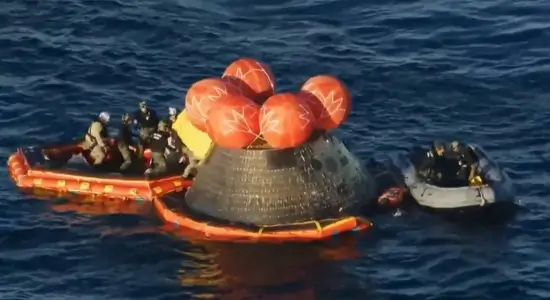
Through a process called ablation, the intense thermal energy actively burns the Avcoat material. As the material vaporizes and flakes off into the plasma wake, it carries the extreme heat away from the spacecraft with it. This controlled destruction is so efficient that while the outside of the capsule was literally engulfed in a blinding ball of fire, the inside of the cabin stayed at a comfortable, air-conditioned room temperature.
Pushing the Limits of Human Travel
Before they turned the ship around to face that fiery re-entry, the crew broke a massive historical record. Instead of entering lunar orbit, Orion utilized a “free-return trajectory.” They essentially used the moon’s gravity as a massive slingshot to whip them around the far side and fling them straight back toward Earth.

During this slingshot maneuver on April 6, the crew reached a distance of over 252,000 miles from Earth. They completely shattered the previous distance record set by the legendary Apollo 13 mission in 1970. For a brief moment in time, these four people were further away from our home planet than any other biological organism in the history of the universe.
Conclusion
Today’s successful Artemis 2 astronauts splashdown is far more than just the end of a successful lunar road trip. It serves as the ultimate stress test for next-generation spaceflight hardware. Proving that humans can safely ride a 5,000-degree plasma fireball back from deep space was the final, critical hurdle. Now that the physics have been proven, the stage is officially set for Artemis 3, which will finally put human boots back in the lunar dirt.
The Rabbit Hole Goes Deeper…
If surviving a 5,000-degree plasma fireball on your way back from the moon sounds like something out of a sci-fi movie, you aren’t the only one who struggles to believe what NASA can pull off.
Think Artemis 2 is an incredible achievement? Just wait until you dive into the psychology of the people who absolutely refuse to believe humans ever left low Earth orbit in the first place. Explore the wild paranoia behind the moon landing hoax: a conspiracy that won’t die.
Or maybe you’re more interested in what happens after a multi-ton space capsule violently smashes into the ocean. Sometimes, the locals come out to greet the returning travelers. Check out the incredible moment when dolphins welcome NASA astronauts return to Earth on March 18, in the Gulf of Mexico!
References:
NASA — Artemis II: The First Crewed Mission to the Moon in Decades
Scientific American — The Extreme Physics of Orion’s Skip Re-Entry
Space.com — How the Artemis 2 Crew Survived Re-entry