
Medical imaging is usually a massive, clunky affair. If you need a look inside your body, you have to go to a hospital, lie on a cold bed, and let a technician slather your skin in freezing gel. They then press a bulky, handheld wand against your ribs or stomach to catch a fleeting glimpse of your heart or lungs on a nearby monitor. It works perfectly, but it only gives doctors a brief, momentary snapshot of your internal machinery while your body is completely at rest.
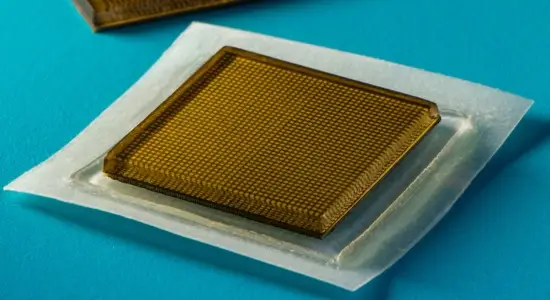
Now, imagine bypassing the hospital entirely. Instead of wheeling in a cart full of electronics, you simply peel the backing off a small sticker, slap it onto your chest, and go for a jog. As you move, this flexible patch streams a high-resolution, live-action video of your beating heart directly to your smartphone. This isn’t a concept from a sci-fi novel; it is the reality of a groundbreaking medical device developed by engineers at MIT. By shrinking decades of acoustic technology down to a piece of flexible tape, researchers have created a continuous, wearable window into the human body.
The Acoustic Physics of The Stamp-Sized Ultrasound
To figure out why this invention is such a massive mechanical leap, we have to look at how traditional sonography actually works. Standard ultrasound machines rely on piezoelectric crystals. When an electrical current hits these crystals, they rapidly vibrate, sending high-frequency sound waves deep into your tissue. Those sound waves bounce off your internal organs and echo back to the wand, which instantly translates the returning vibrations into a real-time image.
The problem is that achieving a high-resolution image usually requires a large, rigid array of these crystals, plus a thick layer of liquid gel to help the sound waves travel through your skin without scattering. If the wand moves or the gel dries out, the sound waves disperse, and the image immediately turns to static. Shrinking this entire acoustic engine into a piece of tape without losing image quality seemed physically impossible, mainly because making the crystals flexible ruins the resolution.
Shrinking a Hospital Machine into a Sticker
Engineers solved this acoustic problem by completely rethinking the physical structure of the device. Instead of trying to make the fragile piezoelectric crystals themselves bendable, they packed a rigid, ultra-dense matrix of microscopic acoustic transducers into a tiny, hard protective shell.
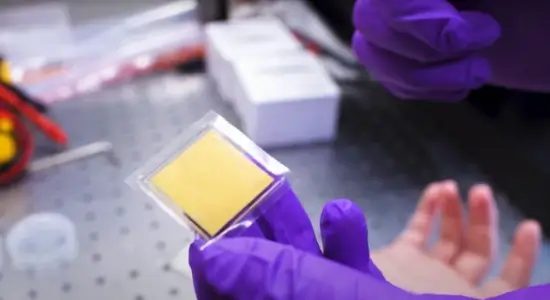
To connect this hard shell to the squishy, moving surface of human skin, they designed a specialized, highly adhesive hydrogel. This hydrogel is mostly composed of water, acting as a permanent, built-in acoustic gel that won’t dry out or slide around. It serves as an incredible mechanical bridge: the top layer houses the rigid, high-powered sound emitters, while the bottom jelly layer stretches, bends, and adheres securely to the patient. This creates a highly functional wearable stamp-sized ultrasound patch that can broadcast crisp internal video for up to 48 hours straight without slipping off.
Watching the Human Engine in Motion
The true superpower of this technology isn’t just its size; it is the fact that it allows for continuous, dynamic monitoring. When you get a traditional echocardiogram, your heart is monitored while you lie perfectly still in a quiet, climate-controlled room. But many cardiovascular or pulmonary issues only reveal themselves when your biological engine is under severe stress.
By sticking a wearable stamp-sized ultrasound patch onto a patient’s chest, doctors can watch exactly how the heart’s chambers expand and contract while the patient is actively lifting weights, jogging on a treadmill, or drinking coffee. Researchers have already used the patch to watch stomachs actively digesting juice and to observe exactly how lung tissue behaves during heavy physical exertion. It transforms human biology from a series of static medical photographs into a live-streaming, high-definition documentary.
Conclusion
The leap from massive hospital machinery to a wearable sticker is one of the most exciting developments in modern bioengineering. In the near future, these patches will become completely wireless, utilizing software to instantly alert you on your phone if your heart rhythm dangerously shifts or if your muscles are close to tearing during a workout. By taking complex medical imaging out of the clinic and placing it directly onto our skin, we aren’t just changing how doctors diagnose disease; we are finally getting a real-time view of the incredible machines we live inside every single day.
The Rabbit Hole Goes Deeper…
If turning a massive hospital ultrasound machine into a flexible sticker blows your mind, the future of bioengineering has plenty of other sci-fi medical breakthroughs waiting for you.
Think a wearable sticker is tiny? Imagine swallowing a microscopic surgeon. Discover how doctors are using magnets and dried pig intestine to safely extract swallowed batteries from the stomach using the origami robot pill.
Why just monitor a failing organ on a screen when you could eventually just print a brand new one? Dive into the mind-bending biology behind 3D bioprinting human organs on demand.
Or maybe you want to see what happens when we wire the human brain directly to the digital world. Explore how paralyzed patients are effortlessly controlling computers with thoughts using the Neuralink Telepathy chip.
References:
MIT News — Engineers develop a postage stamp-sized ultrasound patch
Science Magazine — Bioadhesive ultrasound for long-term continuous imaging of diverse organs
Nature — Wearable ultrasound technology for continuous monitoring