

In the coastal waters of Keelung, Taiwan, the ocean floor is a colorful forest of microscopic life. Divers exploring these shallow reefs often seek out vibrant, alien-looking marine invertebrates. But during a recreational dive in the summer of 2019, an undergraduate student named Ho-Yeung Chan noticed a tiny speck clinging to a clump of underwater moss. It was translucent, polka-dotted with black and yellow, and scarcely larger than a single grain of rice.
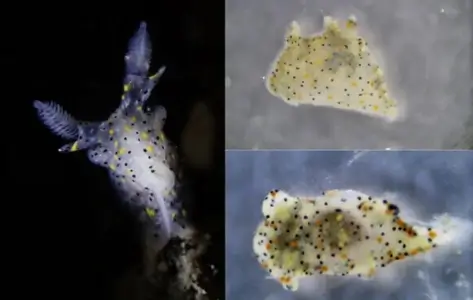
At the time, Chan simply snapped a photograph and moved on, completely unaware that this brightly colored speck was unknown to science. It wasn’t until he consulted with marine taxonomy expert Hsini Lin via Facebook that the true magnitude of his photograph became clear. Now, researchers have formally introduced the world to one of the ocean’s most beautifully bizarre micro-predators, proving that you don’t need to be a giant of the deep to completely baffle marine biologists.
Identifying the New Sea Slug in a Volatile Ocean
Snapping a quick photograph is easy, but formally documenting a previously undiscovered species is a massive scientific undertaking. The coastal waters of northern Taiwan, particularly around Mother Rock Bay, are notoriously rough. Between May and September, the region is battered by aggressive summer typhoons. When winter arrives, the monsoon season brings dangerous waves and plunges sea temperatures below 16 degrees Celsius. Because of these harsh conditions, marine biologists only get a narrow four-month window each year to safely dive and search for microscopic organisms.
Despite these extreme logistical hurdles, Chan and researchers from the National Taiwan Ocean University spent four years carefully collecting specimens. On May 11, 2026, their findings were officially published in the journal ZooKeys. They named the creature Thecacera sesama. Local Taiwanese divers had already affectionately nicknamed the creature “sesame,” and the researchers chose to honor that moniker. Measuring under three millimeters in length, this tiny sesame seed sea slug is the first new addition to its genus in nearly three decades.
The Biology of Thecacera sesama
If you were to look at this creature under a macro lens, it looks like a highly decorated alien spacecraft. Its translucent, whitish body allows you to faintly see its internal organs working in real-time. But its most striking biological feature is its elaborate camouflage. The entire body—including its frilly gills and the rod-like chemical sensors on its head called rhinophores—is covered in distinct black spots and larger yellow dots. Between these vivid markings, the skin is dusted with delicate, white snowflake-shaped pigment patches.
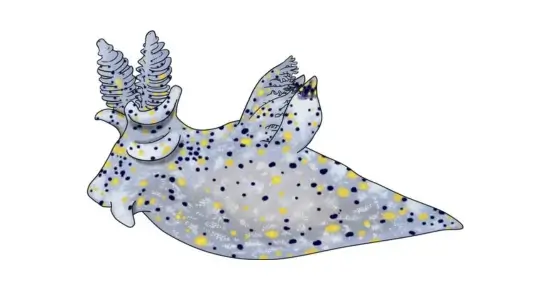
This elaborate coloration isn’t just for show. Like most nudibranchs, this tiny sesame seed sea slug uses its vibrant patterns to blend into its highly specific environment and warn potential predators of chemical toxicity. Despite its incredibly small size, it is a highly evolved, specialized predator that navigates the ocean floor with just four primary behaviors: feeding, searching, mating, and laying eggs.
A Micro-Predator With a Highly Exclusive Diet
Perhaps the most fascinating aspect of Thecacera sesama is what it actually eats. The slug spends nearly its entire lifespan clinging to and grazing on bryozoans, which are tiny, aquatic colonial invertebrates often referred to as “moss animals.” The sea slug uses the bryozoan colony as a hunting ground, a mating stage, and a nursery for its spiral ribbons of eggs.
However, nature loves a good mystery. When the research team conducted DNA sequencing on the specific bryozoan that Thecacera sesama was eating, they found that it only had an 82 percent genetic similarity to any known species in global databases. This strongly suggests that the sea slug’s exclusive food source is, itself, a species completely new to science.
Conclusion
The discovery of Thecacera sesama is a beautiful reminder of just how much of our own planet remains undocumented. We often gaze into the deep ocean expecting to find massive, terrifying leviathans, but some of the most spectacular biological discoveries are hiding in plain sight, perfectly camouflaged on a blade of underwater moss. As marine biologists continue to explore the biodiverse waters of the western Pacific, it is almost guaranteed that thousands of other alien-like micro-creatures are just waiting for a diver to look a little closer.
Dive Deeper into the Ocean’s Mysteries…
If the discovery of a sesame-sized sea slug blew your mind, the ocean floor is full of even stranger, alien-like creatures waiting to be uncovered.
- Did you know there is a stunningly beautiful, microscopic sea slug that intentionally eats venomous jellyfish just to weaponize their toxic cells? Uncover the astonishing biology of why the tiny blue dragon hacks the ocean to steal lethal weapons.
- What if a terrifying deep-sea creature vanished from scientific records for over a century, only to suddenly reappear in the dark abyss? Explore the bizarre reality of how the faceless cusk eel was rediscovered after 144 years in deep Pacific waters.
References:
ZooKeys — Thecacera sesama sp. nov. (Nudibranchia, Polyceridae)
Discover Magazine — Sesame-Sized Sea Slug Found Off Taiwan Turns Out to Be a New Species
Popular Science — Seed-size sea slug looks like an everything bagel