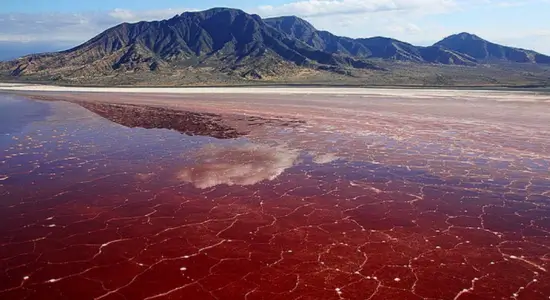

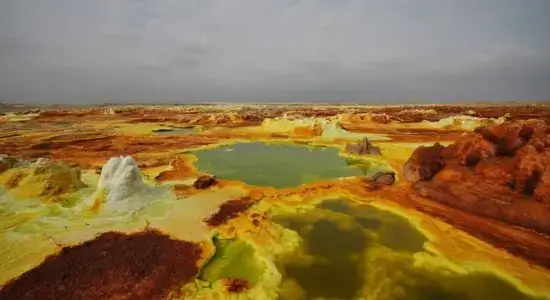
Picture a shimmering plain located 125 meters below sea level, where the year-round average temperature routinely exceeds 45 degrees Celsius (113 degrees Fahrenheit). This is the Danakil Depression in northern Ethiopia, a geological cauldron situated directly over the Afar triple junction, where three massive tectonic plates are actively tearing the African continent apart. In the heart of this scorching desert sits a geological anomaly that looks like it belongs on Jupiter’s moon Io: a vibrant, kaleidoscope-colored terrain of bubbling green acid ponds, towering salt pillars, and bright yellow geysers.
For decades, the journey to reach this isolated location was nearly impossible due to extreme heat and regional instability. However, modern scientific expeditions have finally managed to probe this alien terrain, seeking the absolute biological limits of life on our planet. What they discovered fundamentally challenged everything astrobiologists thought they knew about habitability. While finding liquid water on another planet is often touted as the ultimate jackpot for alien hunters, the searing, neon-colored pools of this Ethiopian salt dome prove a terrifying reality: sometimes, water is simply too toxic for life to exist.
The Geochemistry Inside Dallol
To understand what makes this place so uniquely hostile, you have to look beneath the crust. The earth here is heavily fractured, allowing magma from deep underground to push up and violently interact with a thick, ancient layer of marine salt deposits left behind by the Red Sea hundreds of thousands of years ago. The resulting magmatic fluids heat the groundwater to near-boiling temperatures, often exceeding 100 degrees Celsius (212 degrees Fahrenheit) right at the source.
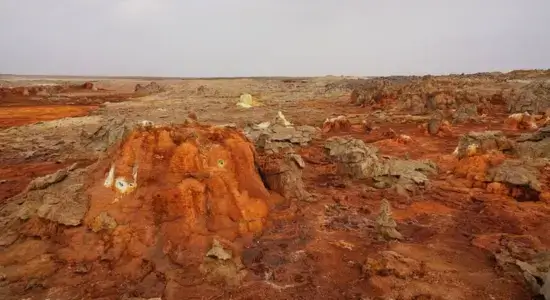
As this superheated brine forces its way to the surface, it dissolves a massive amount of minerals, including iron, sulfur, and potash. When the fluid finally erupts into the open air and begins to oxidize, it paints the extreme volcanic hydrothermal landscape in surreal, toxic shades of neon green, rust orange, and bright yellow. The water sitting in these pools creates a horrifying combination of physical traits: it is hypersaline (saturated with salt), hyperthermal (boiling), and hyperacidic, with some pools registering a pH of 0 or even dipping into negative values.
The Battle Over the Limits of Life
Because of its extraterrestrial appearance and poly-extreme conditions, astrobiologists heavily targeted the region as a perfect analog for the hydrothermal environments of early Mars. Initially, the scientific community believed that life could conquer any environment with liquid water. In May 2019, a research team led by Felipe Gómez, a microbiologist from Spain’s Astrobiology Center, published a paper claiming they had found life. Gómez’s team reported the discovery of ultra-small microorganisms, known as Nanohaloarchaea, surviving perfectly well inside the boiling, acidic pools.
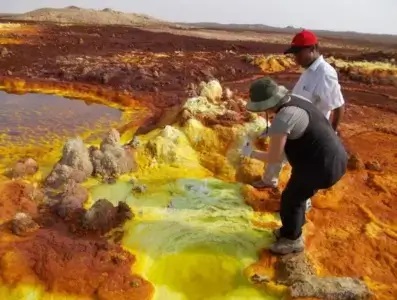
However, just a few months later in October 2019, another team led by Purificación López-García, a microbial diversity expert at the French National Center for Scientific Research, published a highly contradictory and definitive study in Nature Ecology & Evolution. After conducting an extensive survey of the pools with incredibly strict contamination controls, López-García’s team found absolutely zero evidence of living DNA inside the hyperacidic, magnesium-rich ponds. While resilient microbes called archaea thrived in the milder, neighboring salt canyons, the actual neon pools inside the crater were completely sterile.
The Illusion of “Biomorphs”
So, how did the first team mistake a lifeless pool for a thriving biological ecosystem? The answer lies in the tricky chemistry of this extreme volcanic hydrothermal landscape. When López-García’s team examined the water using powerful electron microscopes, they discovered “biomorphs”—tiny, silica-rich mineral precipitates that physically mimic the shape and structure of microscopic cells. To the untrained eye, or through a less rigorous chemical analysis, these mineral formations look exactly like living alien microbes.
This revelation carries heavy implications for space exploration. The reality that liquid water can exist on Earth and remain entirely lifeless serves as a stark warning for scientists hunting for extraterrestrial biosignatures. If a rover on Mars eventually finds microscopic, cell-like shapes inside an ancient hydrothermal vent, researchers must remember Ethiopia’s sterile pools and prove they aren’t just looking at geological trickery.
Conclusion
The neon-colored springs and jagged salt formations of the Danakil Depression prove that geology doesn’t need biology to craft a visually stunning, complex world. While the blistering heat and hyperacidic water of the region dash the hopes that life can survive absolutely anywhere, they provide astrobiologists with a crucial, sobering lesson: liquid water is essential for life, but on its own, it is never a guarantee.
Dive Deeper into More of Earth’s Mysteries…
If the toxic, alien-like pools of Dallol blew your mind, our planet has plenty of other baffling natural phenomena waiting to be explored.
- Did you know a massive explosion in 1908 completely flattened 80 million trees in Siberia, yet left absolutely no crater behind? Discover the scientific reality of the Tunguska event.
- What happens when the ocean floor suddenly drops into a massive, pitch-black underwater sinkhole? Explore the extreme biology and hidden secrets waiting at the bottom of the world’s oceanic blue holes.
Keep exploring the weird and wonderful archives on FactFun.co… because our planet is always stranger than fiction.
References
Nature Ecology & Evolution — Hyperdiverse archaea near life limits at the polyextreme geothermal Dallol area
Scientific Reports — Ultra-small microorganisms in the polyextreme conditions of the Dallol volcano Atlas Obscura — Searching for the Limits of Life in Earth’s Most Extreme Environment