
Imagine soaring over the coast of what is now Brazil, roughly 113 million years ago, and spotting a massive, leathery-winged reptile diving into the ocean to snatch a meal. For over a century, paleontologists have been stuck guessing what these ancient giants actually ate. Because soft tissue—the skin, the stomach, the literal gut contents—usually rots away long before it can fossilize, the diets of pterosaurs have remained a frustrating “best guess” scenario based primarily on the shape of their teeth. That all changed when a team of researchers decided to take a much closer look at a fossilized wing membrane that survived the ages in shocking detail.
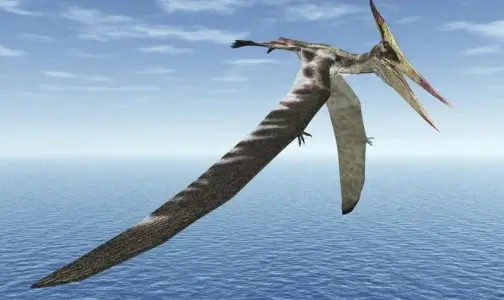
Found in the famous Crato Formation of Brazil, this specific specimen belongs to a group of toothed pterosaurs known as Anhangueridae. While the fossil itself was already a scientific treasure, the real breakthrough happened when researchers ran a high-tech chemical analysis on the preserved wing tissue. What they found wasn’t just ancient skin; it was a chemical time capsule holding the molecular signatures of the creature’s meals. This wasn’t just another fossil study—it was the biological equivalent of opening a 113-million-year-old lunchbox.
Analyzing The Molecules Detected On Perfectly Preserved 113-Million-Year-Old Pterosaur Wing
To pull off this scientific detective work, researchers used a technique called synchrotron-based X-ray fluorescence, which allowed them to scan the fossil’s chemical composition without causing any damage. By targeting the wing membrane, the team was searching for chemical markers that didn’t belong to the rock itself—specifically, isotopes and molecules originating from marine prey.
The data revealed a high concentration of specific organic compounds characteristic of cephalopods. Essentially, the chemical residue left behind on the wing surface indicated that this pterosaur specialized in hunting squid and other soft-bodied marine life. Seeing these molecules detected on a pterosaur wing provides the first hard chemical evidence of a specific diet in these extinct flying reptiles, moving our understanding from educated guessing to confirmed biology.
The Mechanical Reality Of A Squid-Guzzling Diet
Why would a pterosaur evolve specifically to guzzle squid? Looking at the skull structure of the Anhangueridae makes it perfectly clear. These creatures had long, narrow beaks lined with sharp, needle-like teeth engineered perfectly for grabbing and holding onto slippery, squirming prey. While many other pterosaurs might have been scavengers or insect-eaters, this specific lineage was built for the coastal hunt.
The molecular evidence suggests they patrolled ancient seaways, using their flight stability to skim the water’s surface. When they snapped up a squid, the chemical breakdown of the prey’s tissues absorbed into the pterosaur’s system. Traces of that diet were physically preserved on the wing surface thanks to the unique, rapid mineralization process at the Crato Formation. This groundbreaking molecules detected on a pterosaur wing study confirms these reptiles were far more active, specialized hunters than previously imagined.
A New Era For Paleontology
This discovery fundamentally shifts how we approach fossilized remains. Historically, scientists would examine a fossil, identify the bones, and move on. Now, we are entering an era where we can effectively sample the last meal of an animal that died over a hundred million years ago. By applying this same molecular scanning technology to other soft-tissue fossils, researchers can start building a highly accurate menu of the Cretaceous period.
We aren’t just looking at the rocky remains of the past anymore; we are decoding the active life histories of the creatures that lived there. Finding the chemical remnants of a squid-heavy diet on a 113-million-year-old wing shows that even the most established paleontological mysteries can be turned upside down with the right technology.
Conclusion
The study of this Brazilian pterosaur proves that the prehistoric world is far more accessible than we ever dared to hope. By pinpointing microscopic chemical signatures, researchers bridged a gap of 113 million years, connecting us directly to the dietary habits of a creature that once dominated the skies. The next time you look at a fossil, remember: it isn’t just a lifeless rock. It is a data-rich ledger waiting for the right tool to read it.
Dive Deeper into the Prehistoric World…
If uncovering the 113-million-year-old diet of a flying reptile blew your mind, the fossil record has plenty of other incredibly rare time capsules waiting to be opened.
- Did you know that right around the exact same time this pterosaur was hunting squid, a terrifying, metal-horned predator was perfectly trapped in amber? Discover the bizarre biology of the oldest Hell Ant fossil ever found.
- What about the absolute rarest dinosaur baby on Earth? Uncover the story behind the world’s only known Ankylosaur hatchling.
Keep exploring the weird, wonderful, and ancient archives right here on Site Fact fun . because the past is always stranger than fiction.
References
National Geographic — How Scientists Are Tasting the Past Through Fossilized Molecules
Smithsonian Magazine — Fossilized Skin Reveal Ancient Pterosaur Hunting Habits
IFLScience — For First Time, Molecules Detected On Perfectly Preserved 113-Million-Year-Old Pterosaur Wing Reveal Squid-Guzzling Diet