
It’s hard to picture something as armored as an ankylosaur ever being small. These Cretaceous tanks are famous for bony plates running down their backs and, in many species, a bone-crushing club welded onto the end of their tail. But a fossil from northeastern China just gave paleontologists their first confirmed look at what one of these animals looked like the moment it hatched, and the answer had been sitting in museum drawers, misidentified, for over twenty years.
A 20-Year Case of Mistaken Identity
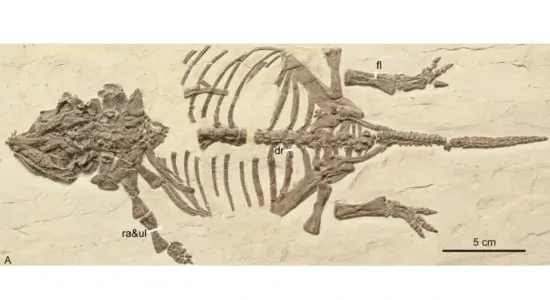
The species at the center of this discovery is Liaoningosaurus paradoxus, first described back in 2001 from fossils found in Liaoning Province, a region of northeastern China famous for exceptionally preserved Early Cretaceous fossils, roughly 115 million years old. From the very first specimen, something about Liaoningosaurus didn’t add up: every single fossil ever found measured under 40 centimeters long, tiny compared to most ankylosaurs, some of which stretched past 6 meters as adults.
For two decades, researchers debated what that meant. Were these actual miniature adults, representing an unusually small ankylosaur species? Or was everyone looking at juveniles of a species whose full-grown form nobody had found yet? A team led by Dr. Wenjie Zheng of the Zhejiang Museum of Natural History, publishing in the Journal of Vertebrate Paleontology in October 2025, finally settled the question by cutting into the bones themselves.
What the Bones Actually Said
Zheng’s team used histology, essentially slicing thin cross-sections of fossilized bone and examining the microscopic structure under a microscope, on two Liaoningosaurus specimens. Growing bone leaves behind physical evidence: patterns of blood vessel channels, and in older animals, distinct growth rings similar to tree rings that mark pauses in development, usually corresponding to seasons.
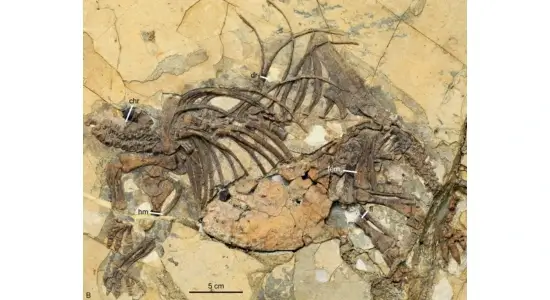
Neither specimen showed any growth rings at all, which told the team both animals died before their first birthday. One specimen, cataloged as ELDM V1121, had something even more telling: a visible hatching line, a distinct ring-like feature that forms in bone tissue right around the moment an animal breaks out of its egg. That detail made ELDM V1121 the first confirmed ankylosaur hatchling ever identified in the fossil record, out of every armored dinosaur fossil ever discovered anywhere on Earth.
Born With Armor Already On
The most striking result wasn’t just the age confirmation. It was what the hatchling’s skeleton revealed about armor development. Adult ankylosaurs are covered in osteoderms, bony plates that form directly within the skin rather than growing from the internal skeleton, fused into an interlocking shield. Researchers had generally assumed young ankylosaurs started out soft and vulnerable, growing armor gradually as a defense against predators.
ELDM V1121 said otherwise. Even at an age of less than one year, the hatchling already carried recognizable osteoderms, including a co-ossified cervical half-ring, a band of fused armor plates around the neck. The protection wasn’t as thick or extensive as an adult’s, but it was already there from a very early stage of life, which pushes the origin of ankylosaur body armor earlier in development than most paleontologists had assumed.
Fun Fact
Because every known Liaoningosaurus fossil is a juvenile under 40 centimeters long, nobody has ever found an adult of this species. Paleontologists genuinely don’t know how big it would have grown, making it one of the only dinosaur species defined almost entirely by its babies.
The mystery isn’t fully solved, either. Study co-author Dr. Paul Barrett and the team still aren’t sure why no adult Liaoningosaurus has ever turned up, despite dozens of juvenile specimens being recovered from the same region over the past two decades. One working theory is that the juveniles lived in or near water while adults, if they existed as a larger form at all, occupied different terrain that simply hasn’t preserved fossils as well.
IFLScience — This Is The Only Known Ankylosaur Hatchling Fossil In The World
Phys.org — First Armored Dinosaur Hatchling Discovered in China
Earth.com — Baby Dinosaur Fossils Show That Some Species Were Armored at Birth
What species is the only known ankylosaur hatchling fossil
The hatchling belongs to Liaoningosaurus paradoxus, an ankylosaur species from the Early Cretaceous of Liaoning Province, China, roughly 115 million years old. The specimen, cataloged as ELDM V1121, is the first ankylosaur hatchling ever confirmed in the fossil record.
How did scientists know it was a hatchling and not just a small adult
Researchers used bone histology to examine microscopic growth patterns. The specimen showed no annual growth rings, meaning it died before age one, and it had a visible hatching line, a bone feature that forms around the time an animal emerges from its egg.
Did baby ankylosaurs have armor right after hatching
Yes. The hatchling already had recognizable bony plates, including a fused ring of armor around its neck, showing that at least some ankylosaur species developed protective armor from a very early stage rather than growing it gradually over years.
Has anyone found an adult Liaoningosaurus
No. Every Liaoningosaurus specimen discovered so far, over two decades of fossil finds, has measured under 40 centimeters and been confirmed as a juvenile. What the adult form of this species looks like, or whether one has simply never been found, remains an open question.