
Imagine sailing a boat to a specific set of coordinates in the middle of the South Pacific Ocean. You pull out your binoculars and scan the horizon in every direction, but you won’t see a single speck of land. In fact, if you were to drop anchor at this exact spot, the closest living humans to you wouldn’t be on a passing cargo ship or a remote island—they would be floating 250 miles straight up in the International Space Station. You have reached the oceanic pole of inaccessibility, a patch of water so utterly remote that it took advanced geospatial software to even prove it existed.
But what lies beneath the surface of this desolate stretch of water is even more fascinating than its extreme geography. If you could dive two and a half miles down to the crushing darkness of the abyssal plain, you wouldn’t find a thriving metropolis of deep-sea life or undiscovered hydrothermal vents. Instead, you would find the mangled, charred titanium remains of hundreds of space stations, spy satellites, and robotic supply ships. Welcome to the world’s most exclusive, highly regulated scrap yard—a place where the history of human spaceflight goes to be permanently buried.
The Mathematical Hunt For Point Nemo
For centuries, sailors navigated the globe without knowing exactly where the absolute middle of the ocean was. It wasn’t until 1992 that a Croatian-Canadian survey engineer named Hrvoje Lukatela decided to calculate it. Instead of sending out an expedition, Lukatela used a specialized geospatial computer program that accounted for the Earth’s ellipsoidal shape to pinpoint the exact spot farthest from any landmass.
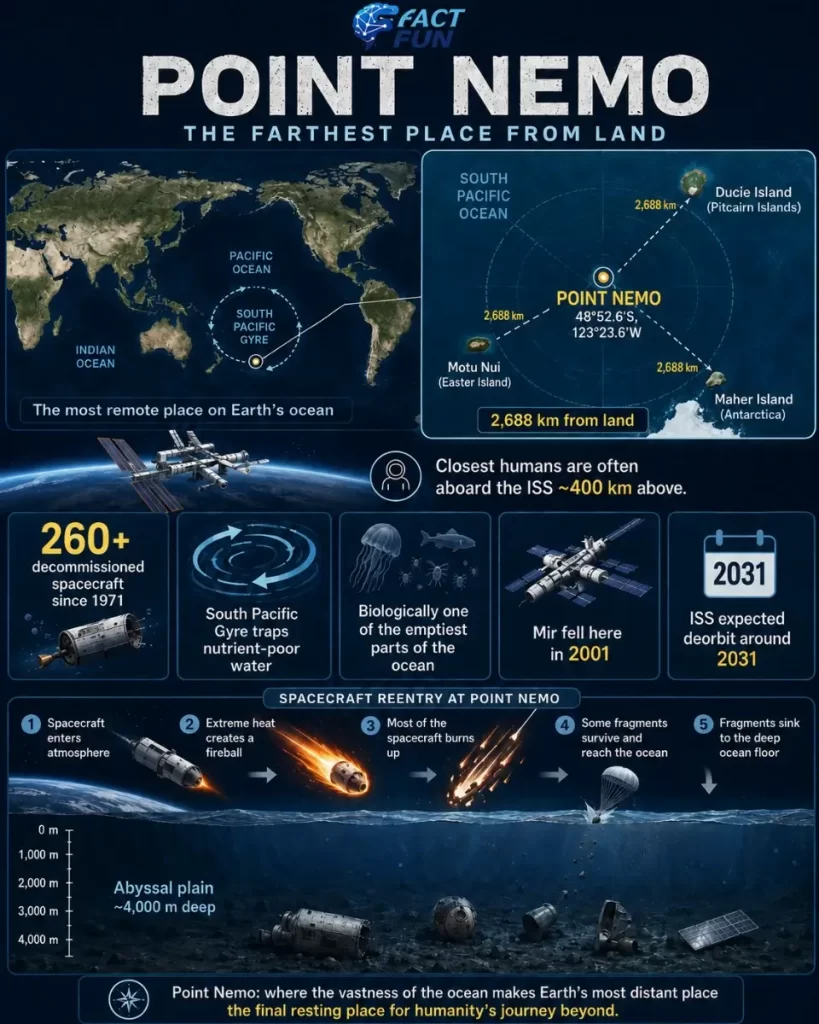
He discovered coordinates 48°52.6′S 123°23.6′W. This location is exactly 2,688 kilometers (1,670 miles) away from three distinct landmasses: Ducie Island in the Pitcairn chain to the north, Motu Nui of the Easter Island chain to the northeast, and Maher Island off the coast of Antarctica to the south. Lukatela named this mathematically perfect center of nothingness Point Nemo, after the famous submarine captain from Jules Verne’s Twenty Thousand Leagues Under the Sea. It is geographically the hardest place to reach on the surface of the planet.
A Biological Desert Driven By Ocean Currents
You might wonder why the world’s space agencies collectively decided to use this specific patch of pristine ocean as a graveyard of spaceships. Aside from the obvious lack of human population, the answer lies in a massive oceanographic phenomenon known as the South Pacific Gyre.
Point Nemo sits squarely in the center of this massive, rotating system of ocean currents. The gyre acts like a giant, invisible blender that physically traps the water inside it, preventing nutrient-rich waters from the coastlines or the deep ocean from entering the area. Because there are practically no nutrients, phytoplankton—the microscopic plants that form the absolute foundation of the marine food web—cannot survive here. Without phytoplankton, there are no small fish, and without small fish, there are no larger predators. Biologically speaking, Point Nemo is an oceanic desert. Dumping tons of metal from the sky into this specific region causes virtually zero ecological damage because there is hardly any life there to disrupt in the first place.
The Mechanics Of The Point Nemo Space Graveyard
Bringing a spacecraft down from orbit is a violently precise feat of physics. Since 1971, global space agencies including NASA, Roscosmos, and the European Space Agency have deliberately directed more than 260 decommissioned spacecraft to crash into Point Nemo.
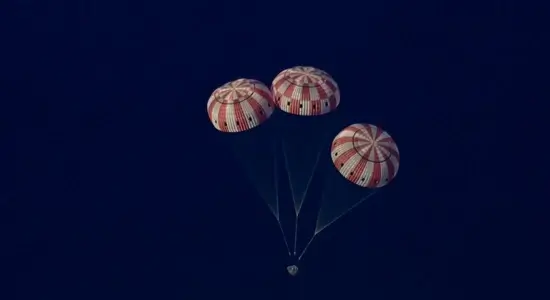
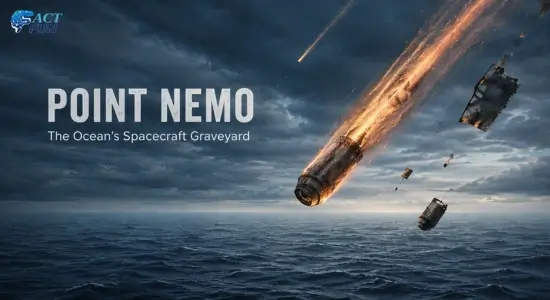
The process is heavily calculated. Engineers use the spacecraft’s remaining fuel to perform a “de-orbit burn,” deliberately slowing the vessel down so gravity can drag it into the Earth’s atmosphere at a steep angle. As the craft hits the thick atmospheric gases at roughly 17,500 miles per hour, friction generates thousands of degrees of heat, turning the ship into a brilliant fireball. Smaller components vaporize instantly, but massive, dense parts like titanium fuel tanks and steel engine blocks survive the inferno.
On March 23, 2001, the massive Russian space station Mir underwent this exact process, breaking apart into glowing fragments that rained down over a massive 3,000-mile footprint perfectly centered on Point Nemo. When the International Space Station (ISS) reaches the end of its operational lifespan—currently projected for 2031—it will suffer the exact same fate, ending its incredible orbital journey scattered across this graveyard of spaceships.
Conclusion
Point Nemo is a brilliant paradox. It is one of the only places on Earth completely untouched by human habitation, yet it holds the physical remains of our greatest technological triumphs. The fact that we had to use advanced mathematics to find a perfectly safe, biologically barren drop zone in the middle of the Pacific Ocean is a stunning reminder of the scale of our planet. As we continue to push further into the cosmos, this silent, crushing abyss will remain the final resting place for the machines that helped get us there.
References:
Popular Science — The Place on Earth That’s Farthest from Land
BBC Earth — The mystery of Point Nemo
Space.com — Spacecraft Cemetery: Where do satellites go when they die?