Scientists Just Doubled the Genetic Alphabet Every Living Thing Uses
Every living thing on Earth writes its genetic code with 4 letters. Scientists just proved a natural enzyme can read 8.
Table of Contents
Four letters, forever, or not
Every organism that has ever lived, from bacteria to blue whales to you, writes its entire genetic code using just four letters: A, T, G, and C. It’s the most universal rule in biology, older than every species alive today. In September 2026, researchers at UC San Diego showed that a completely ordinary enzyme already sitting inside living cells can read twice that many letters, without anyone redesigning it to do so.
The enzyme in question is RNA polymerase, the molecular machine responsible for transcribing DNA into RNA inside every cell on the planet. It turns out this everyday enzyme has been sitting on an untapped ability the entire time.
Fun fact: The four extra letters aren’t new inventions from 2026. They were synthesized back in 2019 by a separate research team and named “Hachimoji” DNA, from the Japanese words for “eight” (hachi) and “letters” (moji). What’s new in 2026 is proof that a natural, unmodified cellular enzyme can actually read them.
What Hachimoji DNA actually is
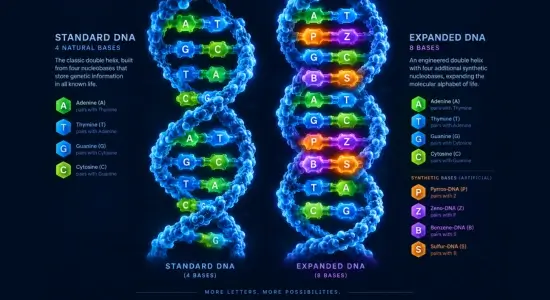
Natural DNA pairs its four letters in two fixed combinations: A always pairs with T, and G always pairs with C. Hachimoji DNA keeps those two original pairs and adds four synthetic letters, named P, Z, B, and S, that form two entirely new pairing combinations. The result is a genetic alphabet with eight letters and four total base pairs instead of two.
Since 2019, scientists have known this expanded DNA could exist and hold its double-helix shape correctly. What remained unproven for years was whether any of the cellular machinery that reads ordinary DNA could also read this artificial version.
The 2026 discovery: a natural enzyme already knew how
That’s exactly the gap a team led by professor Dong Wang at UC San Diego’s Skaggs School of Pharmacy closed. Their research, published in Nature Communications on September 2, 2026, demonstrated that ordinary E. coli RNA polymerase, the same enzyme found in one of the most common bacteria on Earth, can accurately transcribe all eight Hachimoji letters into RNA.
No genetic engineering of the enzyme itself was required. It already had the structural tools needed to recognize the synthetic letters using the same mechanisms it uses to recognize the natural ones.
How they proved it
To find out exactly how the enzyme managed this, the team used cryo-electron microscopy, a technique that images molecular structures at resolutions between 2.42 and 2.75 angstroms, small enough to distinguish individual atoms. They systematically tested all 32 possible pairings between template letters and incoming nucleotides to map precisely how the enzyme distinguishes a correct match from an incorrect one.
- Published in Nature Communications on September 2, 2026, by a team led by Dong Wang.
- Used cryo-EM imaging at 2.42 to 2.75 angstrom resolution.
- Tested all 32 possible letter-pairing combinations systematically.
- Found the enzyme recognizes synthetic letters using the same structural logic as natural ones.
This is not a new lifeform, yet
Here’s the part that keeps this discovery grounded rather than science fiction: everything described here happened in a test tube. No living organism has been given a functioning eight-letter genome, and the study did not attempt translation, the step where RNA gets converted into an actual protein. What was proven is narrower and, in its own way, more foundational: the machinery of life itself may already be more flexible than the four-letter code it has used for billions of years.
If future research manages to close the translation gap, the implications stretch from entirely new categories of synthetic proteins to genetic storage systems with far greater information density than natural DNA allows. For now, the discovery stands as proof that biology’s oldest rule has more flexibility built into it than anyone confirmed before 2026.
The same year, engineered biology kept finding new limits to break: This is the third time in recent months that scientists have pushed biological systems past their assumed boundaries. Researchers at MIT recently proved that bacteria can be engineered into living transistors, forming chemical circuits capable of basic computation. Where MIT reprogrammed how bacteria behave, UC San Diego’s discovery suggests the raw genetic alphabet those bacteria are built from was never as fixed as biology textbooks assumed.
Part of the Series: This story is part of FactFun’s ongoing coverage of synthetic biology and genetic engineering breakthroughs. Explore more in our Science section.
References
- Nature Communications — Structural Basis of Transcription of the Hachimoji Eight-Letter Alphabet by E. coli RNA Polymerase (September 2, 2026)
- UC San Diego Today — Breakthrough Helps Expand Genetic Alphabet (September 2026)
- ScienceDaily — Life uses 4 DNA letters. Scientists just made 8 work (September 2026)
- Nature World News — An E. coli Enzyme Reads an Eight-Letter DNA Alphabet, but Only in a Test Tube (September 2026)
- Science — Hachimoji DNA and RNA: A genetic system with eight building blocks (original 2019 synthesis study)
Frequently Asked Questions
What is the 8-letter genetic alphabet?
The 8-letter genetic alphabet, known as Hachimoji DNA, adds four synthetic letters (P, Z, B, and S) to the four natural DNA letters (A, T, G, and C), doubling the number of possible base pairs from two to four. It was first synthesized in 2019.
What did UC San Diego discover in 2026?
UC San Diego researchers discovered that ordinary E. coli RNA polymerase, a natural enzyme found in common bacteria, can accurately read and transcribe all eight Hachimoji letters into RNA without any genetic modification to the enzyme itself.
Does this mean scientists created 8-letter life?
No. The demonstration took place in a test tube, not inside a living organism. No functioning eight-letter genome exists yet, and the study did not test whether the RNA produced could be translated into a protein.
How did researchers prove the enzyme could read synthetic DNA?
The team used cryo-electron microscopy to image the enzyme’s structure at resolutions between 2.42 and 2.75 angstroms, then tested all 32 possible pairings between template letters and incoming nucleotides to confirm the enzyme recognized synthetic letters using the same structural logic as natural ones.
Why does an expanded genetic alphabet matter?
An expanded genetic alphabet could eventually enable entirely new categories of synthetic proteins and genetic storage systems with far greater information density than natural DNA allows, though these applications depend on future research closing the translation gap.