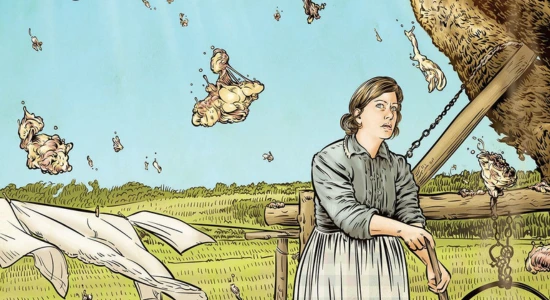

Picture being a German reconnaissance pilot in the summer of 1944. You’re flying over the French countryside when you spot a massive buildup of American Sherman tanks, heavy artillery, and jeeps parked at the edge of a forest. You immediately radio the coordinates back to base, sending the German high command into a panic as they scramble Panzer divisions to brace for a heavy assault. But what that pilot didn’t know was that he hadn’t spotted a mechanized division at all. He had just been duped by a bunch of theater set designers and art students armed with air compressors.
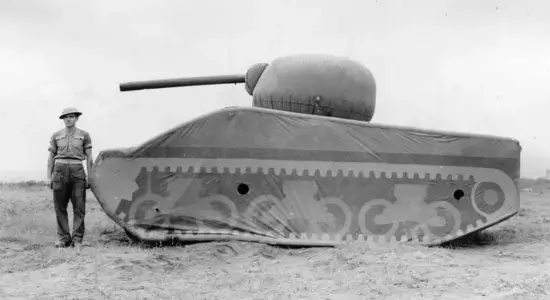
This was the 23rd Headquarters Special Troops, a highly classified Allied unit that officially did not exist. Instead of hardened riflemen, this crew was made up of sound engineers, architects, actors, and illustrators recruited straight out of art schools in New York and Philadelphia. Their mission was completely wild. They weren’t deployed to fight the Nazis with bullets or bombs—they were sent to the front lines to fight them with Hollywood-level special effects.
Deploying The Ghost Army’s Inflatable Armor
The visual illusion was the core of their entire operation. If the Allies wanted to secretly move a real armored division of 30,000 men to attack a weak point in the German line, they desperately needed the Nazis looking in the opposite direction. So, these artists would roll into a completely different location and literally inflate a fake army.
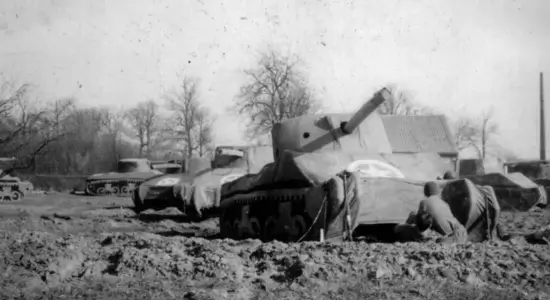
They used highly detailed, life-sized rubber and canvas inflatables shaped like tanks, jeeps, and airplanes. A fake Sherman tank—which normally weighs about 30 tons—actually weighed just 93 pounds. Four guys could easily pick it up and carry it across a field. But the artists knew the Germans weren’t stupid. A rubber tank doesn’t leave heavy tread marks in the dirt. To make this World War II tactical deception truly believable, the unit drove real bulldozers in carefully planned patterns around the inflatables, perfectly simulating the churning tracks of a heavy tank battalion. From 10,000 feet in the air, the optical illusion was flawless.
Sonic Warfare: The World’s Heaviest Mixtape
But visuals alone weren’t going to trick German patrols stationed just a few miles away, especially in the pitch dark. To really sell the con, the unit had to master audio engineering. Before shipping out to Europe, sound engineers from Bell Labs traveled to Fort Knox and recorded the chaotic sounds of real armored divisions. We’re talking tanks grinding gears, infantrymen yelling, trucks getting stuck in the mud, and pontoon bridges groaning under heavy weight.
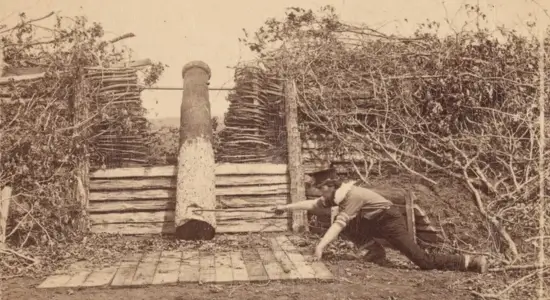
They pressed these highly specific soundscapes onto state-of-the-art wire recorders (the tech that came right before magnetic tape). Out in the field, they blasted these recordings through massive, 500-pound speakers bolted to the back of armored halftracks. The audio was so incredibly loud and clear that it could be heard up to 15 miles away. German troops listening in the distance were absolutely convinced a massive American convoy was rolling in just over the next hill.
Method Acting on a Lethal Stage
The final layer of this World War II tactical deception relied on pure theatrical acting. The unit used a specialized radio squad to execute “spoof radio.” See, every radio operator has a unique rhythm when tapping Morse code, known as their “fist.” The Ghost Army’s operators learned to perfectly mimic the specific fists of operators in real combat divisions. They would send fake messages back and forth just to totally confuse German intelligence interceptors.
Meanwhile, the actors in the unit would dress up as American generals and high-ranking officers. They’d deliberately drive into local French towns with the insignias of real combat divisions painted on their bumpers, stroll into a café, and loudly order 5,000 omelets for their “arriving troops.” They knew local Nazi spies and informants were hanging around, clinging onto every word. It was the ultimate, high-stakes long con.
Conclusion
The 23rd Headquarters Special Troops ended up staging more than 20 battlefield deceptions between the D-Day landings and the end of the war. By constantly drawing Nazi fire and attention away from actual Allied troop movements, military historians estimate this single unit of creatives saved anywhere from 15,000 to 30,000 lives. Their story was kept highly classified for 50 years after the war ended. Today, it stands as a brilliant reminder that sometimes the most effective weapon on a battlefield isn’t a bigger bomb—it’s a really good imagination.
The Rabbit Hole Goes Deeper…
If you thought winning a major World War II campaign with rubber tanks and sound effects was absurd, military history has plenty of other completely unhinged moments waiting for you.
-
Think the Ghost Army was the weirdest military operation of the 20th century? Wait until you hear about the time the Australian army deployed actual machine guns against 20,000 flightless birds—and suffered a humiliating defeat. Discover The bizarre reason the military lost the Great Emu War.
-
Or maybe you think the 1940s was the most chaotic era in human history? Try living through a period where the entire planet essentially hit the self-destruct button all at once. Dive into The General Crisis: Why the 17th Century Was Absolute Hell.
References:
Smithsonian Magazine — How the Ghost Army Fooled the Nazis
The National WWII Museum — The 23rd Headquarters Special Troops
The Atlantic — The Art of Deception: The Ghost Army of WWII