
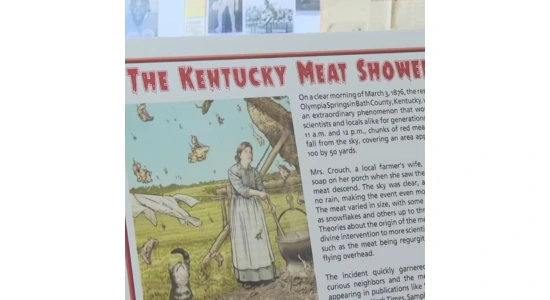
Picture this. It’s March 3, 1876, in the tiny community of Olympia Springs, Bath County, Kentucky. A local farmer’s wife named Rebecca Crouch is just chilling in her yard making soap—because what else do you do on a Friday morning in the 1870s—when suddenly the sky starts spitting chunks of raw flesh all over her yard. Not a cloud in sight. Just raining meat.
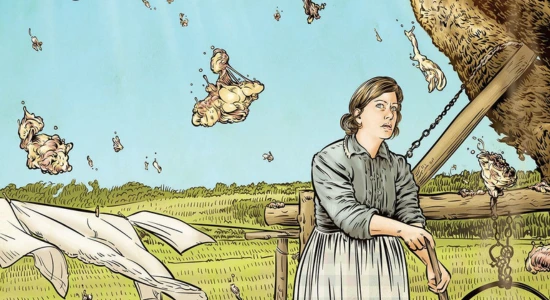
Literal gristle. Fat and tissue slapping against the wooden fence posts like a wet mop.
Some of it was the size of delicate snowflakes, but other pieces were legit three-to-four-inch slabs of whatever-the-hell-it-was. The whole shower lasted somewhere between one and two minutes, but by the time it stopped, more than half a bushel of meat—potentially over 40 pounds of it—was scattered across a patch of yard roughly 100 by 50 yards. Keep in mind, there were no commercial airplanes back then. No exploding meat factories nearby. It was just a quiet, picturesque Appalachian town that abruptly turned into a butcher’s open-air dumpster. Obviously, everyone freaked out. Because how do you even begin to process that?
The Immediate Aftermath of the Kentucky Meat Shower
So what do you do when mysterious sky-meat litters your property? You eat it, apparently.
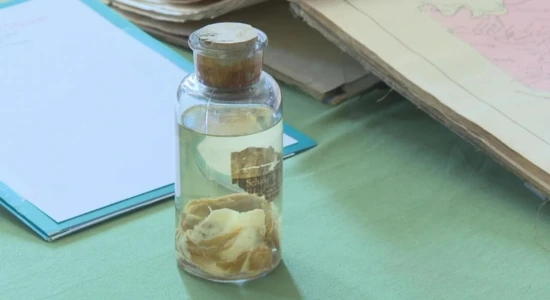
Yes. Really. Two local guys actually tasted the yard-flesh to figure out what it was, which is a move that would make modern disease control experts absolutely lose their minds. They chewed on it. Decided it tasted sort of like mutton. Or maybe venison. Gross. Word got around fast, and within days the story had reached national newspapers, including The New York Times, which ran a firsthand account from a witness described as being of “unquestionable veracity.” Soon enough, jars of this mystery meat were being shipped off in glycerin to prominent scientists who had zero clue what they were looking at.
Desperate Theories and the 1876 Mystery Meat Shower
At first, the experts were completely stumped. A few tried to blame it on Nostoc—which is just this weird algae that puffs up into a gross jelly when it rains—but a quick look under a microscope killed that theory fast. It was definitely animal tissue: muscle fiber, connective tissue, cartilage, and fat, all confirmed by multiple independent examiners.
As people got more desperate to explain the 1876 mystery meat shower, the guesses got exponentially wilder. One guy swore it was bear meat. Another researcher decided it was lung tissue from a horse, or, terrifyingly, a human infant. Someone even suggested a rogue tornado had ripped apart a flock of sheep somewhere and dumped the leftovers on Mrs. Crouch. Except there hadn’t been a single tornado reported in the entire region. Not one. If you think that’s the strangest medical mystery history has to offer, wait until you hear about the 18th-century Frenchman with an uncontrollable eating disorder that drove him to devour garbage and live animals—you can read about the dark medical mystery of Tarrare, the guy who literally ate everything. Seriously. It’ll ruin your lunch too.
The Vulture Vomit Verdict
Then along came a chemist named Dr. L.D. Kastenbine, writing in the Louisville Medical News just months after the event. He took one look at the samples and offered an explanation that actually made sense—and it’s absolutely repulsive.
Projectile vulture vomit.
Both turkey vultures and black vultures are native to Kentucky. And they have this super charming defense mechanism where, if they get spooked or need to take off in a hurry, they violently throw up whatever they just ate to drop weight. Imagine a massive flock of them soaring way up high. They’ve just gorged themselves on a dead horse or a rotting sheep. Something scares them, and boom. A collective, mid-air barf session, with the wind scattering the half-digested chunks over the Crouch farm below. It perfectly explains the shredded, half-digested state of the meat, and the sheer variety of tissue types found in the samples.
Fun Fact
The vulture theory has one big hole critics love to point out: Rebecca Crouch, the only person who actually witnessed the shower firsthand, never once mentioned seeing any birds overhead. To fully believe the vulture explanation, you basically have to disbelieve the one eyewitness account we have.
Sure, it’s not as fun as aliens or a glitch in the matrix. But the vulture vomit theory is pretty much the only thing that holds up under scientific scrutiny when it comes to the 1876 mystery meat shower, even 150 years later. Just a reminder that nature is often way more disgusting than we give it credit for. In fact, Bath County held a Kentucky Meat Shower Festival in 2026 to mark the event’s 150th anniversary, proving this bizarre slice of Appalachian history still hasn’t lost its grip on people’s imaginations.
Wikipedia — Kentucky Meat Shower
Mental Floss — That Time It Rained Flesh in Kentucky
Courier Journal — Vulture Vomit? Kentucky Meat Shower to Mark 150th Anniversary
The Takeout — The Day It Rained Meat in Kentucky
When and where did the Kentucky meat shower happen
It occurred on March 3, 1876, at the Crouch family farm near Olympia Springs in Bath County, Kentucky. The shower lasted only one to two minutes but scattered more than 40 pounds of meat across the yard.
What is the leading scientific explanation for the meat shower
Most researchers point to vulture regurgitation. Turkey vultures and black vultures, both common in Kentucky, are known to vomit partially digested food when startled, and once one bird in a flock does it, others often follow.
Did anyone actually eat the meat that fell from the sky
Yes. According to contemporary newspaper reports, two local men tasted the fallen meat and described the flavor as similar to mutton or venison, a detail scientists have since cited as loosely consistent with the vulture theory.
Is the vulture vomit theory universally accepted
Not entirely. Critics point out that Rebecca Crouch, the only eyewitness to the event, never reported seeing vultures overhead, which leaves a genuine gap in the leading explanation even 150 years later.