
So, it’s the 12th century in a tiny English farming village called Woolpit, in Suffolk, sometime during the reign of King Stephen. The locals are out finishing up the harvest near a set of deep trenches dug into the earth specifically to keep wolves away from livestock, standard medieval infrastructure for the area. But suddenly, they hear crying echoing from the bottom of one of the pits. When they look down, they don’t find a trapped wolf. They find two absolutely terrified children.
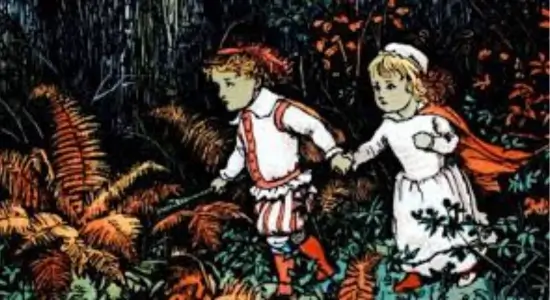
But these weren’t just some lost farm children. The villagers pulled out a boy and his sister wearing clothes made from an unfamiliar material nobody could identify. And then there was the skin. From head to toe, both children were tinged a distinctly greenish colour. They spoke an unrecognizable language, seemed deeply distressed by daylight, and refused every kind of food offered to them.
This wasn’t just a local ghost story invented at the village pub, either. Two respected medieval chroniclers, Ralph of Coggeshall and William of Newburgh, both documented the event independently within a few decades of it supposedly happening, citing a named eyewitness. For centuries, historians have debated what actually took place. And the leading modern explanation is far darker than any fairy tale.
Surviving the Green Children of Woolpit Discovery
The children were brought from Woolpit to the nearby village of Wykes, to the home of a local knight, Sir Richard de Calne, who took them in. But they remained completely alienated by the world around them. For days, they reportedly refused to eat at all, becoming distressed whenever someone offered them bread or cooked meat. Eventually, a servant brought in freshly cut broad bean stalks straight from the garden. The children reacted immediately, tearing open the stalks and eating the raw beans inside as though they hadn’t eaten properly in a long time. For months afterward, that remained essentially the only food they would touch.
Sadly, the boy never fully adapted to life above ground. He grew increasingly sick, and according to the chronicles, died not long after the children were baptized. The girl, however, survived. As she was gradually introduced to a normal diet, her green skin tone reportedly faded toward a typical human complexion. She eventually learned enough English to offer an explanation for the whole medieval emerald siblings mystery.
The Twilight World of St. Martin’s Land
Her account made the situation, if anything, even stranger. She claimed that she and her brother came from a place called St. Martin’s Land, an underground realm where the sun never fully rose. Instead, her homeland existed in a permanent, hazy twilight. Everyone who lived there, she said, shared the same green-tinted skin.
Fun Fact
According to Ralph of Coggeshall’s original 13th-century account, the girl said she and her brother were tending their father’s flock when they heard the sound of church bells, and followed the noise into a cave, only to become lost wandering through the darkness before eventually stumbling out into the blinding daylight near Woolpit.
According to her story, she and her brother were tending their father’s sheep when they heard the distant, echoing sound of church bells. They followed the sound into a dark, winding cave and wandered through the tunnels, disoriented, until they eventually emerged into the overwhelming brightness of the English countryside. Still half-blind and confused, they stumbled around until they fell into the wolf pit where the villagers eventually found them.
Escaped Refugees or a Genuine Anomaly?
So what’s the leading explanation behind the medieval emerald siblings mystery today? Most modern historians reject the underground twilight realm entirely, pointing instead to a much grimmer historical reality. The theory most widely accepted, first proposed by researcher Paul Harris and later expanded by historians including Derek Brewer, holds that the children were likely Flemish immigrants. During the 12th century, large Flemish communities had settled in eastern England, in part encouraged by King Henry I to support the local wool trade, but many were later violently persecuted once King Stephen or Henry II turned against them. Under this theory, the children may have survived an attack on their community by hiding for an extended period, possibly in the flint mine workings near Thetford Forest, which would help explain both their fear of sunlight and their story of emerging from an underground “twilight” world. If dark historical mysteries like this one intrigue you, you may also enjoy reading about how the Vatican once dug up a rotting corpse to have a dead pope put on trial.
And the green skin? Many historians and physicians point to chlorosis, historically nicknamed “green sickness.” It’s a form of hypochromic anemia caused by severe iron deficiency and malnutrition, which can genuinely give skin a pale greenish tint. Once the surviving girl was fed a proper, more balanced diet at Sir Richard’s estate, the chlorosis theory holds that her iron levels recovered and her skin tone normalized over time. It’s worth noting this explanation isn’t universally accepted; some researchers argue chlorosis alone doesn’t fully account for every detail in the chronicles, including the extended refusal of food or the specific description of their clothing, so the story still carries some genuine unresolved edges even under the leading theory.
Conclusion
The chlorosis diagnosis offers a plausible explanation for the green skin, and the Flemish refugee theory accounts for the unfamiliar language and fear of the massacre that likely displaced them. But the story still carries a deeply unsettling edge. The girl reportedly grew up, married, and integrated into ordinary society. But by most accounts, she stuck to her story about the twilight world of St. Martin’s Land for the rest of her life. Whether the siblings were traumatized refugees hiding from violence, or something modern science still can’t fully explain, they remain one of medieval England’s most enduring unsolved mysteries. It’s a reminder that some of history’s strangest “fairy tales” may really be tragedies wearing a folkloric disguise.
Historic UK — The Green Children of Woolpit, Suffolk
Medievalists.net — Who Were the Green Children of Woolpit? A New Look at a Medieval Mystery
Ralph of Coggeshall — Chronicon Anglicanum (c. 1220)
Is the story of the Green Children of Woolpit actually documented historically
Yes. Two independent medieval chroniclers, Ralph of Coggeshall and William of Newburgh, both recorded the event within a few decades of when it supposedly occurred, with Ralph specifically citing Sir Richard de Calne as his named source.
What is the leading theory explaining the green children
Most historians favor the Flemish refugee theory, which holds the children were displaced during violent persecution of Flemish immigrant communities in 12th-century England, and that their green skin was likely caused by chlorosis, a form of anemia linked to severe malnutrition.
What happened to the boy and girl after they were found
The boy grew increasingly ill and died shortly after being baptized. The girl survived, gradually adjusted to a normal diet, lost her green skin tone, learned English, and eventually married and integrated into local society, though she maintained her account of St. Martin’s Land for the rest of her life.
Why did the children refuse to eat normal food
According to the chronicles, they would only eat raw broad beans for months after being found, refusing bread and meat entirely. This detail is sometimes cited as consistent with extreme deprivation or unfamiliarity with a settled diet, though it remains one of the story’s more debated elements.