
When you think of Paris at the turn of the 20th century, you probably picture the glittering beauty of the Belle Époque. It’s the era of the Moulin Rouge, the brand-new Eiffel Tower, and high-society artists sipping absinthe in sun-drenched cafes. But if you took a wrong turn into the dark, cobblestone alleys of working-class neighborhoods like Belleville or Montmartre, you’d run into a completely different kind of culture. You’d come face-to-face with a terrifyingly violent, hyper-stylish criminal underworld.
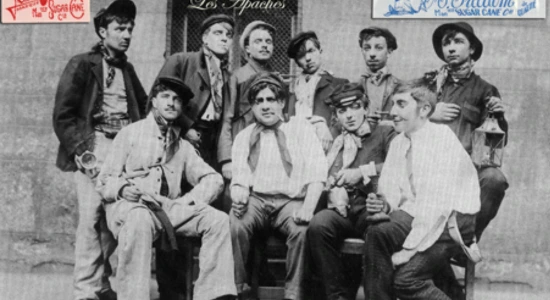
Long before Thomas Shelby and his crew dominated British television, France had its own terrifyingly fashionable equivalent. If you’re a fan of the Peaky Blinders aesthetic—where razor-sharp tailoring meets brutal street violence—you need to know about their real-life Parisian counterparts. They were a loose syndicate of muggers, street fighters, and pimps who used bespoke fashion as both a weapon and a status symbol. The French media and the terrified upper classes gave them a name that stuck in history: Les Apaches.
The Bloody Rise of Les Apaches
To figure out why thousands of teenagers and young men turned into ruthless gangsters, you just have to look at the massive wealth inequality of the time. The industrial boom of the late 1800s made Paris incredibly rich, but it shoved the working poor into cramped, unsanitary slums on the city’s edges. With no jobs, no education, and a deep, simmering resentment toward the aristocrats parading through the city center, these marginalized kids formed localized street tribes just to survive.
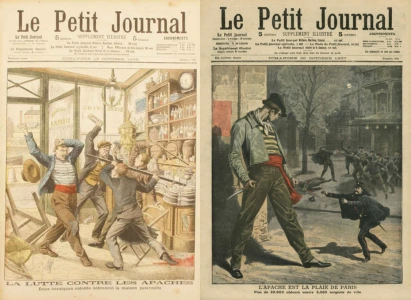
Around 1902, the sensationalist French press started reporting on these violent crimes. Drawing a highly dramatic, racist comparison to the fierce Native American warriors of the American West, a journalist dubbed the thugs “Apaches” to describe their perceived savagery. But instead of being insulted, the street kids absolutely loved the name. They adopted it as a badge of honor, cementing their reputation as the most feared Parisian street gangs of the 1900s.
Dressing to Kill: The Apache Aesthetic
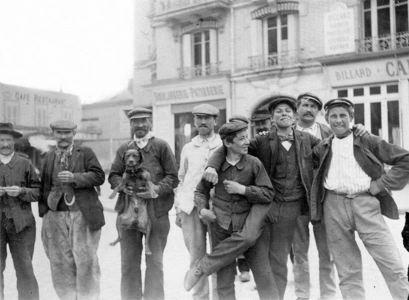
What makes these guys so fascinating today isn’t just their crime rate; it’s the fact that they were completely obsessed with fashion. Unlike typical street thugs wearing dirty rags, an Apache gangster carefully curated his outfit. The standard uniform was incredibly specific: highly polished boots, flared trousers worn tight and belted at the waist, a striped shirt (often missing buttons to show off jailhouse tattoos), a bright silk neck scarf, and a distinctive flat cap pulled down low over the eyes.
Just like the legendary boys from Birmingham, their clothing was highly functional for street warfare. That iconic silk scarf wasn’t just to keep the chill off; it was the primary tool for their signature mugging technique, known as the coup du père François. Two gang members would trail a wealthy target. One would suddenly whip his silk scarf around the victim’s neck and hoist the poor guy onto his back, instantly cutting off his air supply and rendering him helpless. Meanwhile, the second Apache casually emptied the victim’s pockets.
The Original Multi-Tool of Death
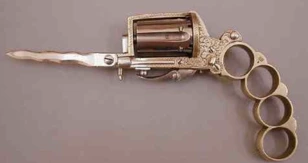
If you were running with one of these Parisian street gangs of the 1900s, you couldn’t exactly walk around carrying a standard rifle. The police were cracking down hard on gang violence, meaning weapons had to be easily hidden inside a tailored jacket. This daily necessity led to the invention of one of the weirdest and most terrifying weapons in history: the “Apache revolver.”
This custom-made, foldable nightmare was basically a Swiss Army knife built strictly for trench warfare. It mashed three deadly weapons into one compact piece of brass and steel. Folded up, it functioned as a heavy set of brass knuckles. Unfolded, a spring-loaded, dual-edged knife blade popped out for close-quarters combat. Finally, the brass knuckle grip served as the handle for a six-shot, pinfire revolver. It had absolutely no barrel, meaning it couldn’t hit the broad side of a barn past three feet. But if an Apache was mugging you in a pitch-black alleyway, it was a devastatingly effective piece of hardware.
The Deadly Dance of the Savate
When they ran out of bullets or lost their knives, the Apaches relied on Savate, a uniquely French style of kickboxing. Because French law slapped heavy penalties on anyone caught fighting with closed fists, early street fighters got creative. They developed a brutal system of open-handed slaps combined with highly precise, punishing kicks aimed at the knees, shins, and groin.
This gang culture was so deeply tied to physical violence that it eventually birthed the Danse Apache. This was a highly aggressive, mock-combat dance style performed in underground cabarets. The dance perfectly mimicked a brutal street fight between a gangster and a prostitute, complete with hair-pulling, throwing, and slapping. In a massive twist of irony, the wealthy Parisian aristocrats who lived in constant fear of being mugged by the Apaches actually became obsessed with the dance. They romanticized the gang’s violence and turned it into mainstream pop-culture entertainment.
Conclusion
The golden age of Les Apaches came to a sudden, bloody end in 1914. When World War I erupted across Europe, the French government aggressively drafted the young men of the slums. They sent the vast majority of the Apache street gangs straight into the meat grinder of the Western Front, and very few ever returned. Today, they remain a bizarre historical paradox: a group of impoverished street kids whose brutal desperation accidentally created one of the sharpest, most iconic fashion subcultures in European history.
References:
History Today — The Apaches of Paris: The Gangs of the Belle Époque
Atlas Obscura — The Deadly, Sensual Dance of the Parisian Apache
The Paris Review — The Stylish Thugs of Early 20th-Century Paris