
The Romans left us roads, aqueducts, and enough writing to know what some of them thought about their dinner. Then there is the Roman dodecahedron: twelve faces, a collection of holes, and no surviving explanation anyone has confidently identified.
It looks like a tool. Or an ornament. Or something you would recognize immediately if its owner could spend thirty seconds showing you how it worked.
Unfortunately, its owner is unavailable.
What was the Roman dodecahedron used for? The honest answer is still uncertain. Measuring instruments, textile tools, and religious objects have all been proposed. A particularly well-preserved discovery in England has given researchers another chance to investigate—not because it came with an answer, but because it came with something many intriguing antiquities lack: an archaeological context worth digging into.
A Very Good Find in a Trench That Was About to Close
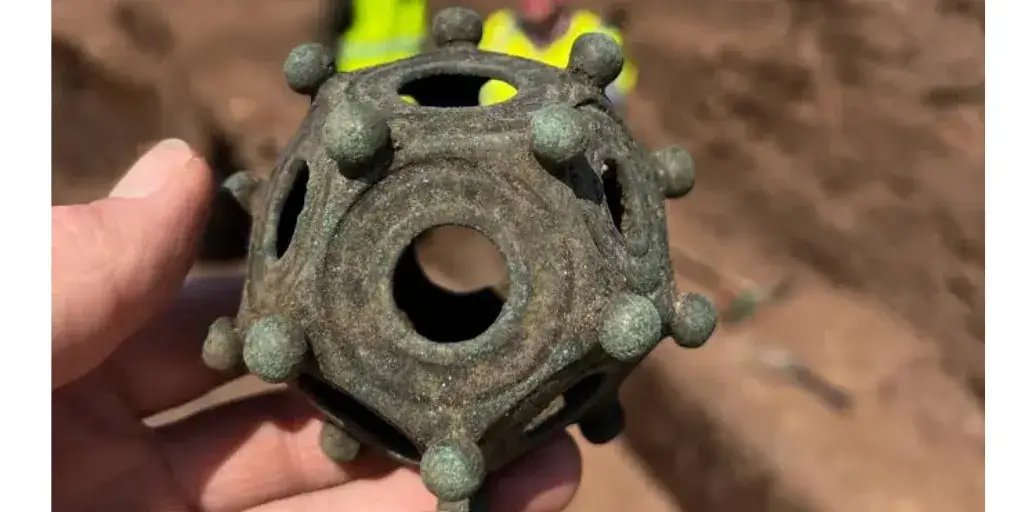
In June 2023, volunteers with the Norton Disney History and Archaeology Group were excavating in Lincolnshire, England, when one of them uncovered a hollow, twelve-sided metal object. The trench had been opened only in the final days of the dig. Soon afterward, the team had to close it again.
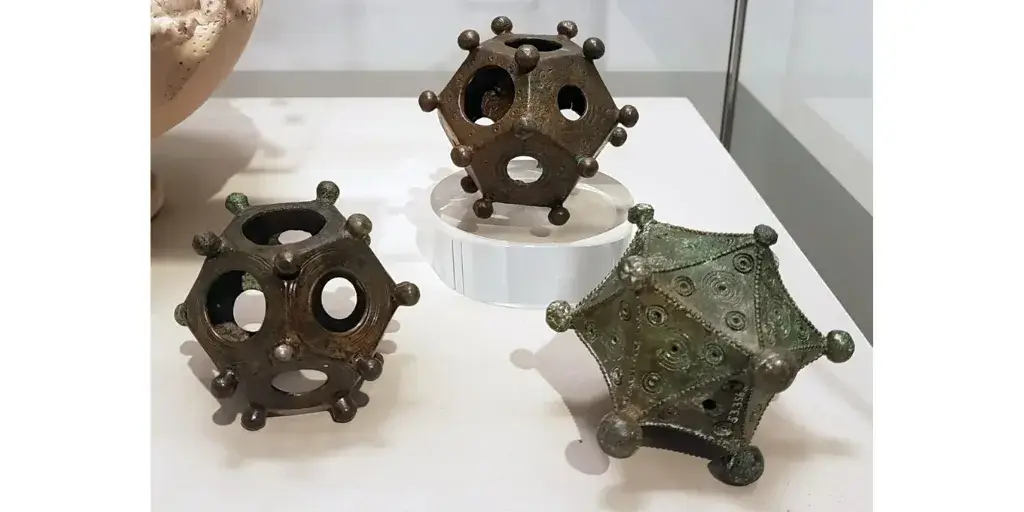
The object itself was in remarkable condition: complete, undamaged, and carefully finished. A dodecahedron has twelve faces; on these Roman-period examples, the faces are pentagons pierced by circular openings, with rounded knobs at the corners. The openings vary in size, giving the whole thing the appearance of a device waiting for the correct attachment.
Analysis reported by the excavation group found that the Norton Disney example was approximately 75 percent copper, 7 percent tin, and 18 percent lead. Whatever its purpose, producing it required skilled metalworking.
It was not unique. The group reports roughly 130 known examples across the Roman world, concentrated in its northwestern provinces. That figure is an approximate published count, rather than a final inventory, but the pattern is important: these objects belong to the Roman world without turning up evenly across it.
Which makes “the Romans used them for…” a sentence that needs care. A proposed explanation has to account not only for the holes and knobs, but also for the places where the objects have actually been found.
The Norton Disney team returned in 2024 to investigate the discovery’s surroundings. Its published account identifies the feature containing the dodecahedron as a sand quarry pit. Understanding how and why it ended up there remains part of the investigation.
That may sound less exciting than discovering a secret function. In practice, it could be more useful. An object tells you what someone made. Its surroundings may help reveal what someone did with it.
The Holes Are Doing a Lot of Work in These Theories
The measuring-instrument idea is easy to understand. Different openings suggest different sizes. Look through one hole and out through another, and a rangefinder or surveying device starts to seem plausible.
Plausible is not useless. It gives researchers something to test. But an explanation needs to identify the measurement, the procedure, and the evidence connecting that procedure to the ancient objects.
The Norton Disney group argues against a measuring function because the known objects are not a standard size. That is a real challenge to theories requiring interchangeable, standardized equipment. It is not, by itself, proof that no individually calibrated instrument could work.
The harder question is whether a proposed method explains the surviving examples consistently, rather than producing a clever result with one conveniently chosen replica.
Textile-making provides an even more tempting demonstration. The knobs look suitable for looping yarn, while the openings suggest tubes of different widths. If those tubes were glove fingers, the mysterious object would suddenly become a surprisingly elaborate piece of craft equipment.
People have indeed made glove fingers using modern models. Architectural historian Jonathan Foyle acknowledged the demonstrations when discussing the Norton Disney find with the BBC: “You can indeed make a glove finger from them, which people have ingeniously done.”
His objection was historical rather than mechanical. As he pointed out, evidence for knitting comes centuries after the Roman period under discussion. The Norton Disney excavators also reject the knitting interpretation.
A successful demonstration therefore establishes something narrower than its most enthusiastic viewers might hope. It shows that the shape can be used that way—not that this is why an ancient metalworker made it.
A house key can open a parcel. Archaeologists of the future would still be making a mistake if they classified it as specialist cardboard-cutting equipment.
“Ritual Object” Is a Possibility, Not a Solution
The Norton Disney team’s preferred explanation lies elsewhere. Its published account states: “A potential link with local religious practice is our current working theory.”
The group points to the craftsmanship of its find and the absence of wear it reports. It also notes that a mounted horseman deity figurine, known as the Norton Disney Rider God, was discovered near the site in 1989.
That makes local religious activity a reasonable avenue to investigate. It does not establish that the figurine and dodecahedron were used together, or that either explains the other.
There is an obvious danger in this territory. “Ritual” can sound like an answer while leaving the central question almost untouched. Was an object displayed, carried, consulted, offered, or buried? Those are different activities, and each would call for different supporting evidence.
Nor does fine workmanship automatically separate sacred objects from practical ones. People can lavish skill on useful possessions. Limited visible wear is a clue to examine, not a label saying “religious.”
The team’s next sentence is therefore just as important as its proposed explanation: “More investigation is required though.”
For now, the religious interpretation is a working hypothesis attached to an ongoing investigation. Turning it into a solved mystery would outrun the people excavating the site.
The Missing Clue Might Not Be Another Dodecahedron
One striking feature of this mystery is how much researchers can describe without being able to identify the object’s job. Its material can be analyzed. Its manufacture can be examined. Its shape can be measured. None of those automatically supplies the missing action: what a person actually did with it.
A securely dated image showing one in use would be enormously informative. So could a recognizable written description, distinctive residues, or a repeated association with a particular activity at well-recorded sites.
Those are possible routes to an answer, not evidence already in hand. The Norton Disney investigation offers a different opportunity: to reconstruct the circumstances of one object’s deposition as carefully as possible.
That is why the quarry pit matters. Another dodecahedron might add another set of measurements. A better understanding of this one’s surroundings could help narrow the range of stories that fit.
The most useful clue may turn out to be something much less photogenic than the artifact itself—a fragment of pottery, a trace on its surface, or a pattern shared by several discovery sites.
Somewhere in Roman Britain, this was not an archaeological mystery. It was simply an object somebody knew what to do with. The challenge is recovering enough of that person’s world to make it ordinary again.