
We’ve all grown up with the image of a T-Rex as this fast-growing, unstoppable teenage rebel of the Cretaceous period. But it turns out the “King of the Dinosaurs” was more of a late bloomer than we ever thought. New research into T-rex aging and growth rate has pulled back the curtain on their life cycle, revealing that these massive predators were still putting on size well into their 40s.
For years, the general idea was that a T-Rex lived a “live fast, die young” lifestyle, peaking in size during its late teens and rarely seeing its 30th birthday. But scientists took another look at the growth rings in the bones of several famous skeletons. What they found was a much slower, more gradual path to adulthood. These kings weren’t just big; they were old, durable, and likely much more experienced than we gave them credit for.
Reading the History in Their Bones
How do you age a dinosaur? It’s a lot like counting the rings on a tree. Paleontologists look at the Lines of Arrested Growth (LAGs) inside the leg bones. By analyzing these rings, researchers realized that the growth didn’t just flatline once the dinosaur hit sexual maturity.
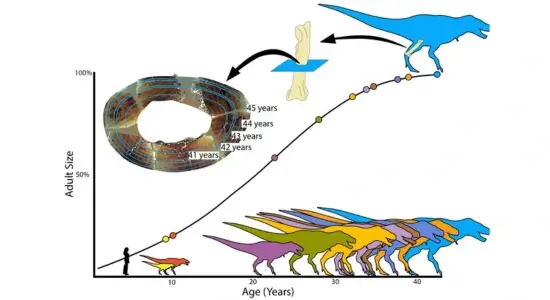 A growth curve analysis of T. rex dimensions relative to age, featuring specific research specimens plotted to illustrate their developmental scale. Image credit: Dr. Holly Woodward Ballard
Instead of a massive growth spurt that ended in a plateau, the T-Rex kept adding bone and muscle mass year after year. Some of the largest specimens studied were still growing when they died in their fourth decade. This completely flips the script on how we view their survival. To make it to 40 in a world filled with triceratops horns and unpredictable climates, you had to be the toughest thing on the block.
The King of Endurance
This slower T-rex aging and growth rate tells us that the absolute giants we see in museums—the Sue’s and the Scotty’s of the world—weren’t just lucky; they were survivors. Living longer meant they had to endure more injuries and outlast more droughts than their younger rivals.
It also changes how we think about the Cretaceous ecosystem. If T-Rex lived longer, it means the population was likely made up of fewer, more dominant “elder” kings that held onto their territory for decades. These 40-year-old titans would have been the ultimate apex predators, possessing the sheer bulk and experience that only comes with age.
Why This Discovery Matters
Knowing that T-Rex lived longer than 30 years isn’t just a fun fact; it helps us understand the biodiversity of the ancient world. It shows us that these dinosaurs had a growth strategy that allowed them to adapt to their environment over a long period. The King of the tyrant lizards wasn’t just a force of nature—it was a masterpiece of biological endurance that dominated the landscape far longer than we ever imagined.
Did You Know?
While the T-Rex was perfecting the art of aging on land, other prehistoric beasts were developing their own specialized survival tactics. Did you know that long before humans existed, there was a fierce predator nicknamed the “predator-eating predator” because of its brutal diet? Learn more about the terrifying Garjainia and how it dominated the food chain.
And it wasn’t just the giant adults that hold secrets; even the smallest fossils tell a huge story. Check out the world’s only Ankylosaur hatchling fossil to see how these armored tanks started their lives. From armored babies to the flying dragons of the desert, the prehistoric world was far more diverse than we ever dreamed. For more deep dives into the past, stick with Fact Fun.
ref : iflscience